.svg&w=384&q=75 "Pitchgist logo")
Cagliari vs Udinese: Tactical Analysis of a 2–0 Defeat
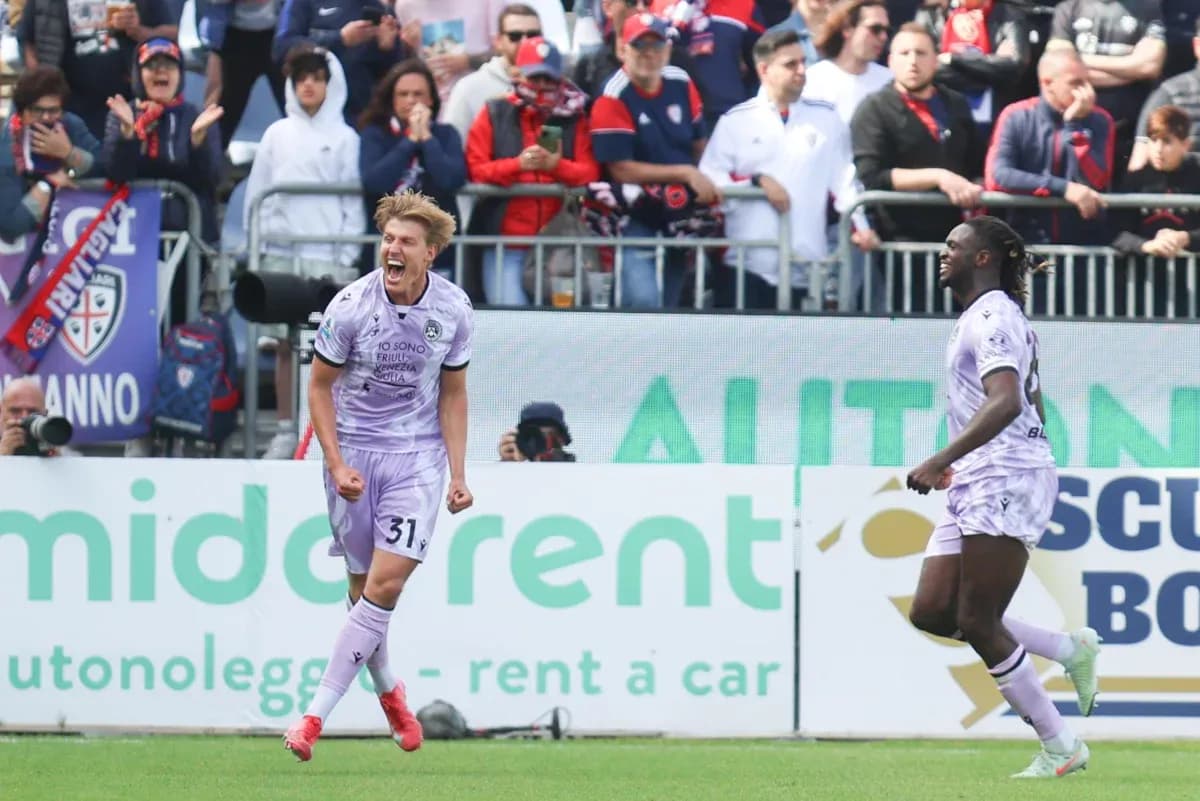
Cagliari’s 2–0 home defeat to Udinese at the Unipol Domus was a classic case of territorial dominance without incision. In a Serie A Round 36 fixture where Fabio Pisacane’s side controlled 63% of the ball and launched 22 shots, Kosta Runjaic’s visitors absorbed pressure in a compact 3-5-2, struck twice through transitions, and managed the game with ruthless clarity. Udinese’s higher xG (2.17 to 1.41) despite far fewer attempts underlined a sharper attacking structure and superior shot quality, turning a backs-to-the-wall defensive performance into three points.
Disciplinary and Key-Event Timeline
The disciplinary and key-event timeline framed the tactical story. At 34', a VAR review cancelled a potential Cagliari penalty involving Michel Adopo, removing what could have been a structural reward for their early pressure. The first card arrived at 44': Kingsley Ehizibue (Udinese) — Off the ball foul, symptomatic of Udinese’s willingness to disrupt Cagliari’s rhythm high or wide when their wing-back was exposed.
After the interval, Cagliari’s back five continued to squeeze up, but their defensive line became increasingly vulnerable to direct play. At 53', Zé Pedro (Cagliari) — Foul, was booked, reflecting a late intervention as Udinese tried to spring forward. The breakthrough came at 56': a Normal Goal for Udinese, scored by A. Buksa and assisted by H. Kamara. It rewarded Udinese’s pattern of using Kamara as the advanced runner from the left side of midfield, attacking the spaces behind Cagliari’s wing-back and outside centre-back.
Runjaic then moved quickly to refresh legs and preserve structure. At 55', J. Piotrowski (OUT) was replaced as L. Miller (IN) came on for Udinese, and B. Mlacic (OUT) made way as N. Bertola (IN) came on. Both changes stabilized the central and left defensive channels just before and after the opener. Pisacane responded at 62' with a double change to increase width and verticality: M. Palestra (OUT) was replaced as G. Zappa (IN) came on, and J. Pedro (OUT) was withdrawn as I. Sulemana (IN) came on to add energy in midfield.
At 65', Udinese protected their goalscorer and added fresh running in transition: A. Buksa (OUT) was replaced as K. Davis (IN) came on. Cagliari doubled down on attacking profiles at 73': M. Folorunsho (OUT) was replaced as A. Albarracin (IN) came on, pushing more creative and direct threat between the lines. Udinese’s response at 78' was explicitly about counter-attacking and defensive work rate: N. Zaniolo (OUT) was replaced as I. Gueye (IN) came on, and K. Ehizibue (OUT) was replaced as J. Arizala (IN) came on, refreshing both a forward and a wing-back to maintain transition threat and flank coverage.
Pisacane’s final throw came at 88', shifting further from the original 5-3-2 structure. M. Adopo (OUT) was replaced as A. Belotti (IN) came on, and A. Obert (OUT) was replaced as Y. Trepy (IN) came on, effectively sacrificing a midfielder and a defender for extra attacking presence. But Udinese’s game management hardened. At 90+2', Keinan Davis (Udinese) — Argument, was booked, a late flashpoint that reflected the tension of Udinese’s deep defending and time management. Moments earlier, at 90', Udinese had sealed the result: a Normal Goal scored by I. Gueye, assisted by K. Davis, a textbook transition finish that punished Cagliari’s stretched late-game shape.
Cagliari’s Structure
Structurally, Cagliari’s 5-3-2 under Fabio Pisacane was aggressive with the ball. E. Caprile’s 4 saves and a goals-prevented figure of 0.82 underline that he was exposed to relatively high-quality chances despite Cagliari’s territorial control. The back three of M. Palestra, Zé Pedro, and A. Dossena, flanked by J. Rodriguez and A. Obert, pushed high to compress play, enabling the midfield trio of M. Adopo, G. Gaetano, and M. Folorunsho to camp in Udinese’s half. This produced volume: 22 total shots, 15 inside the box, and 8 corners. However, the shot profile was often suboptimal—crowded central zones, half-chances from second balls, and blocked efforts (6 blocked shots).
In possession, Cagliari’s 537 passes at 86% accuracy show a patient, structured build-up, but the front pairing of S. Esposito and P. Mendy struggled to find clean separation against Udinese’s back three. Much of Cagliari’s attacking relied on crosses and cutbacks from advanced wing-backs, which Udinese’s central defenders and goalkeeper handled well. The single yellow card for Cagliari (Zé Pedro — Foul) also signals that their defensive aggression was more controlled, but that restraint did not translate into effective transition defending when they lost the ball.
Udinese’s Structure
Udinese’s 3-5-2 under Kosta Runjaic was built on compactness and vertical efficiency. With only 37% possession and 9 total shots, they engineered a higher xG (2.17) by consistently creating clearer looks at goal. The back three of B. Mlacic, T. Kristensen, and O. Solet stayed narrow, with wing-backs Ehizibue and H. Kamara tucking in without the ball to form a dense block. J. Karlstrom anchored midfield, with J. Piotrowski and A. Atta providing legs and cover. The front two, N. Zaniolo and A. Buksa, plus later K. Davis and I. Gueye, were tasked with attacking the channels left by Cagliari’s high wing-backs.
M. Okoye’s 3 saves and identical goals-prevented figure to Caprile (0.82) indicate that while he was tested, Udinese limited Cagliari’s truly dangerous looks. Their 331 passes at 76% accuracy reflect a more direct, risk-accepting approach: win second balls, play early into the forwards, and use Kamara’s and later Gueye’s running power to turn defence into attack. The two yellow cards — Ehizibue (Off the ball foul) and Keinan Davis (Argument) — show a side comfortable with tactical disruption and emotional edge when needed to break Cagliari’s rhythm and protect the lead.
Statistical Verdict
Statistically, the verdict is clear: Cagliari’s Overall Form in this match was about volume and control, but their Defensive Index was undermined by vulnerability in transition and poor box protection at key moments. Udinese, by contrast, posted a stronger Defensive Index through compact shape and efficient goalkeeping, and a superior attacking return relative to their possession and shot count. The 2–0 away win, aligned with the xG split and card profile (Cagliari 1 yellow, Udinese 2 yellows, Total: 3), validates Runjaic’s pragmatic, transition-focused game plan over Pisacane’s territorial, but ultimately blunt, dominance.