.svg&w=384&q=75 "Pitchgist logo")
Cagliari vs Udinese Match Analysis: Tactical Insights and Season Trajectories
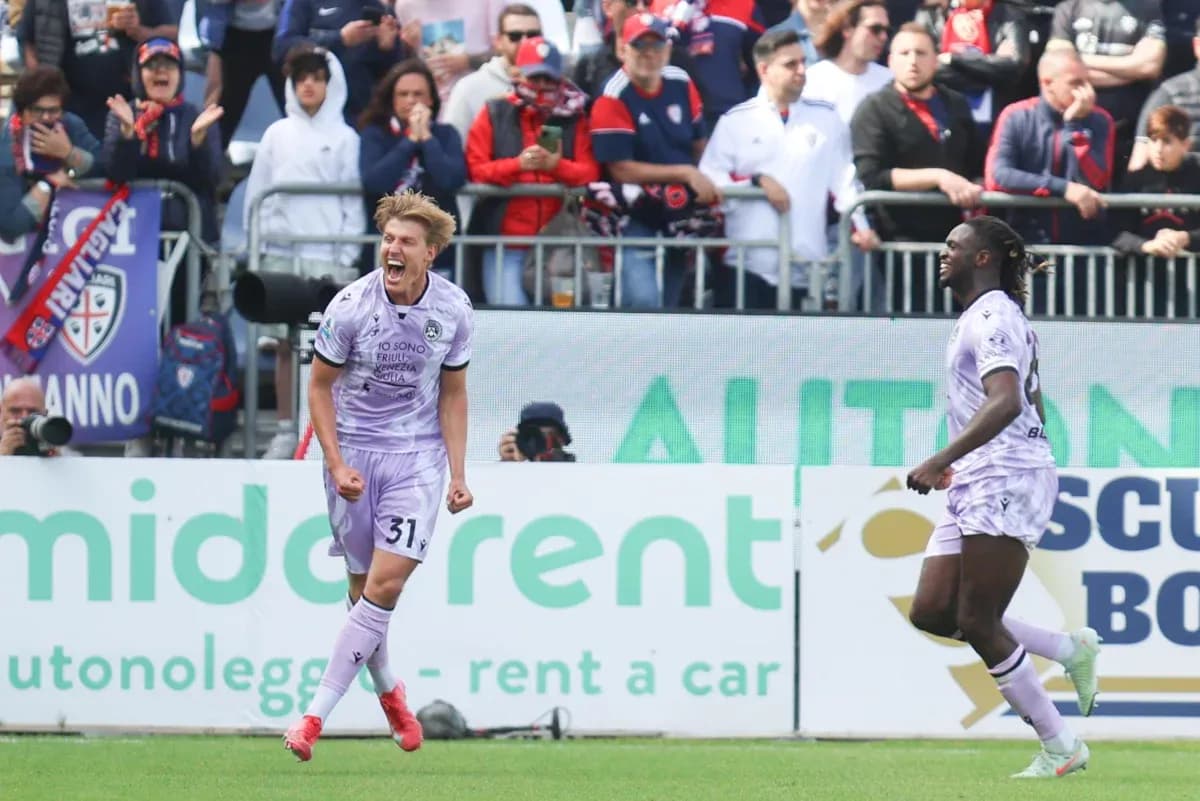
The afternoon at Unipol Domus closed with a stark verdict. Following this result, Cagliari’s 0–2 home defeat to Udinese crystallised the different trajectories of two sides separated not just by the scoreboard, but by their seasonal identities. The league table framed the narrative even before kick-off: Cagliari sitting 16th on 37 points with a goal difference of -15, Udinese in 9th with 50 points and a goal difference of -1. Over 36 matches, Cagliari had scored 36 and conceded 51 overall; Udinese had 45 for and 46 against. One team fighting to keep the water from rising above their neck, the other quietly assembling a top-half campaign built on away ruthlessness.
The tactical shapes told their own story. Fabio Pisacane’s choice of a 5-3-2 underlined caution. With E. Caprile behind a back five of M. Palestra, J. Pedro, A. Dossena, J. Rodriguez and A. Obert, Cagliari tried to compress space and protect a defence that, heading into this game, had been conceding 1.2 goals per match at home and 1.4 overall. In front, M. Adopo, G. Gaetano and M. Folorunsho were tasked with bridging the gap to a forward pairing of S. Esposito and P. Mendy.
Kosta Runjaic, by contrast, leaned into Udinese’s attacking edge away from home with a 3-4-3. M. Okoye was shielded by a back three of B. Mlacic, T. Kristensen and O. Solet, while the wing-and-engine quartet of K. Ehizibue, J. Piotrowski, J. Karlstrom and H. Kamara stretched and probed. Ahead of them, a fluid front line of N. Zaniolo, A. Buksa and A. Atta mirrored Udinese’s season-long profile on their travels: 27 away goals at an average of 1.5 per match, more incisive and bolder than their home output.
If Cagliari’s structure felt conservative, the team sheet explained why. The absentees list was a roll call of attacking and creative options: G. Borrelli (thigh injury), M. Felici (knee injury), R. Idrissi (knee injury), J. Liteta (thigh injury), L. Mazzitelli (injury) and L. Pavoletti (knee injury) all missing this fixture. For a side that had already failed to score in 14 matches overall and averaged just 1.1 goals at home, that was a brutal handicap. Pisacane was forced to rely on Esposito as both creator and finisher, with Gaetano and Folorunsho asked to add thrust from midfield.
Udinese had their own issues, but of a different nature. J. Ekkelenkamp (leg injury) and A. Zanoli (knee injury) were out, and C. Kabasele was suspended due to yellow cards. Yet the depth on the bench – notably K. Davis, Udinese’s 10-goal, 4-assist attacker this season – gave Runjaic multiple in-game options. Davis, who has produced those 10 goals and 4 assists in 28 appearances with a rating of 7.06, loomed as a late-game weapon even without starting.
Discipline and temperament added another layer. Heading into this game, Cagliari’s yellow card distribution showed a pronounced late-game spike: 26.92% of their yellows came between 76–90 minutes, with another 24.36% between 46–60. Their only red cards in Serie A this season had also arrived late, with 100.00% shown in the 76–90 window. Udinese, meanwhile, concentrated 26.87% of their yellows in the 61–75 period and 22.39% between 76–90, with a solitary red in the opening 0–15 segment. In a match where Cagliari were always likely to be chasing, that late-game volatility was a tactical risk as much as a disciplinary one.
Within that frame, the “Hunter vs Shield” matchup tilted heavily towards Udinese. On their travels, Runjaic’s side had been scoring 1.5 goals per match and conceding 1.4. Cagliari at home were scoring 1.1 and conceding 1.2, with 7 home blanks in 18. The visitors arrived as a side comfortable in transition, capable of turning half-chances into away goals, while Cagliari’s defensive line – even with Obert’s authority and physicality – had struggled to keep opponents at arm’s length.
Obert himself embodies Cagliari’s defensive personality. Across 33 appearances, he has amassed 9 yellow cards and 1 yellow-red, underlining how often he is forced into last-ditch interventions. His 63 tackles, 18 successful blocks and 40 interceptions speak of a defender constantly under siege. Against a front three that drags centre-backs into wide and half-space duels, his timing and discipline were always going to be tested.
The “Engine Room” battle paired creators and enforcers on both sides. For Cagliari, Esposito is the heartbeat: 6 goals, 5 assists, 916 passes with 65 key passes and 49 tackles this season. His dual role as playmaker and presser is essential in a side that often defends deep and then needs to carry the ball out. Udinese’s answer came from Zaniolo and the double pivot behind him. Zaniolo, with 5 goals and 6 assists plus 53 key passes, is more than a wide forward; he is the conduit between midfield and attack, drawing fouls (61) and committing 62 himself in a constant physical dialogue with defenders.
Behind him, Karlstrom and Piotrowski formed a disciplined screen. Their task was clear: deny Esposito time to turn, compress the central lanes where Gaetano likes to operate, and then feed early passes into Buksa, Atta and Zaniolo. With Kamara and Ehizibue pushing high from wing-back, Udinese’s 3-4-3 often morphed into a 3-2-5 in possession, pinning Cagliari’s wing-backs deep and isolating Mendy and Esposito.
From a statistical prognosis perspective, the outcome felt almost pre-written. Udinese’s overall clean sheet count of 11, including 5 away, combined with Cagliari’s 14 overall failures to score, pointed towards a low-scoring home performance. Cagliari’s season-long Expected Goals profile – implied by their 36 goals from 36 matches despite often reactive football – suggests a side that needs volume rather than efficiency to score. Udinese, with 45 goals from 36 and a sharper away average, project as a team that can outperform xG in broken-field situations.
Following this result, the 0–2 scoreline simply confirmed the underlying patterns. Udinese’s away structure, discipline and attacking clarity overwhelmed a Cagliari side stripped of depth and reliant on a narrow core of leaders. The numbers heading into this game had hinted at it; the pitch, over 90 minutes, made it unavoidable.