.svg&w=384&q=75 "Pitchgist logo")
Burnley and Aston Villa Draw 2-2 in Tactical Battle
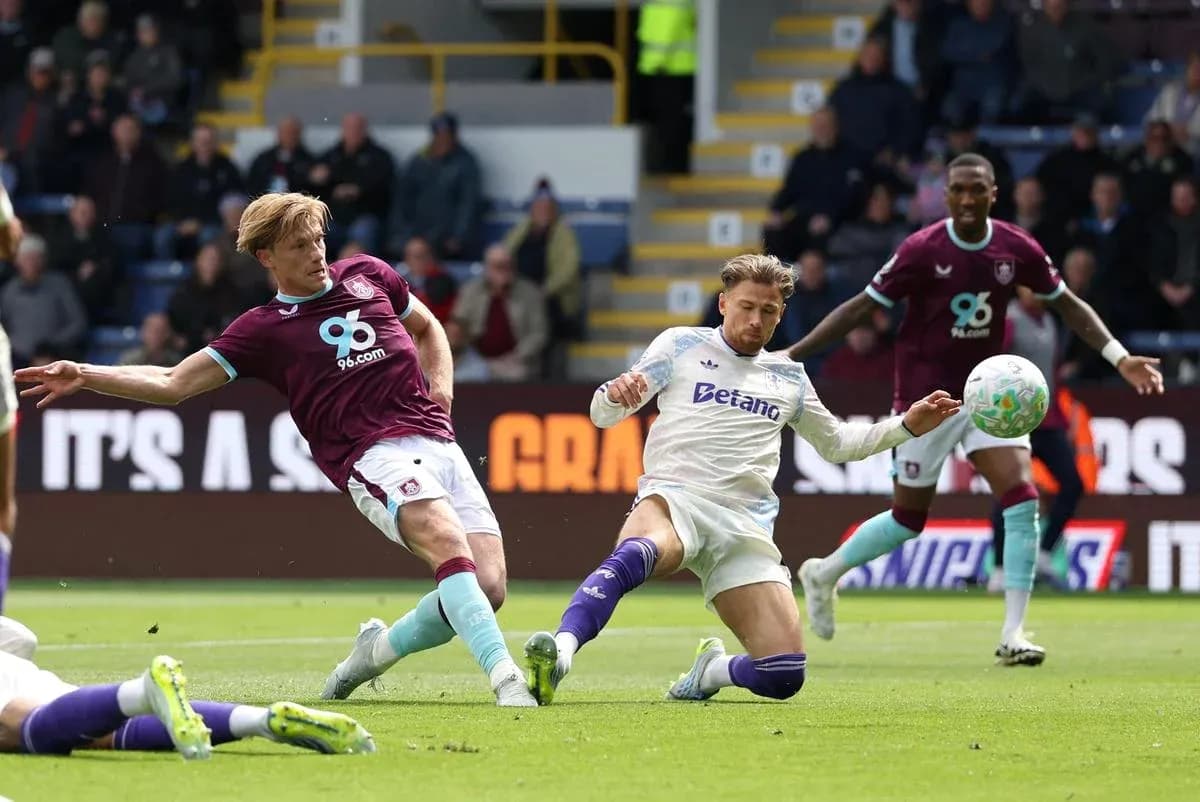
Burnley and Aston Villa shared a 2-2 draw at Turf Moor in Premier League Round 36, a match that neatly split into two distinct tactical phases. Burnley, under Mike Jackson, leaned into a compact 4-2-3-1 and vertical transitions, while Unai Emery’s Aston Villa controlled territory and the ball in the same base shape but with far more emphasis on structured possession. The scoreline mirrored the underlying metrics: Burnley’s 1.77 xG against Villa’s 1.42 xG reflected a home side that generated fewer but higher-quality moments, while Villa’s territorial and passing dominance was clear without ever fully translating into a decisive advantage.
The scoring sequence underlined that contrast. Burnley struck first on 8 minutes, Jaidon Anthony finishing a “Normal Goal” to reward an aggressive early press and direct running from the wide areas. Villa briefly thought they had levelled when a potential goal by Ollie Watkins was disallowed by VAR at 40', a warning that their growing pressure was starting to bite. They did find parity on 42', Ross Barkley converting after combining with John McGinn, a move born from Villa’s ability to pin Burnley deep and find the half-spaces.
Second Half
The second half opened with a clear Villa adjustment in tempo and verticality. Tyrone Mings’ yellow card at 49' — Foul — came as Burnley tried to break the press and Villa defended high and aggressively. Villa’s reward arrived at 56', when Ollie Watkins finished a “Normal Goal” from an Emiliano Martínez assist, a classic Emery pattern: goalkeeper-initiated build-up, quick progression, and a forward attacking the space behind a stretched back line. Burnley’s response was immediate and structured. On 58', Zian Flemming equalised from a “Normal Goal” after link play with Hannibal Mejbri, who provided the assist, exploiting the pockets behind Villa’s double pivot.
Discipline
Discipline remained relatively controlled but had clear tactical implications. The full disciplinary log:
- 49' Tyrone Mings (Aston Villa) — Foul
- 60' Zian Flemming (Burnley) — Persistent fouling
That gives exact totals: Burnley: 1, Aston Villa: 1, Total: 2. Flemming’s yellow at 60' for Persistent fouling captured Burnley’s increasingly aggressive counter-press as they tried to disrupt Villa’s rhythm between the lines.
Substitutions
The substitution pattern from 69' onward showed both coaches managing energy and structure rather than ripping up the plan. At 69', Lyle Foster (IN) came on for Hannibal Mejbri (OUT), giving Burnley a more direct focal point ahead of Flemming. Villa responded with a left-side refresh at 74': Lucas Digne (IN) came on for Ian Maatsen (OUT), and, in the same minute, Emiliano Buendía (IN) came on for Victor Lindelöf (OUT), a clear shift from a more conservative midfield profile to added creativity and crossing threat.
Burnley then doubled down on legs and vertical threat at 79'. Josh Laurent (IN) came on for Lesley Ugochukwu (OUT), adding box-to-box energy, while Zeki Amdouni (IN) came on for Zian Flemming (OUT), keeping a mobile, pressing forward in the central lane. Villa’s 80' double change — Douglas Luiz (IN) came on for Ross Barkley (OUT) and Lamare Bogarde (IN) came on for Matty Cash (OUT) — rebalanced the midfield with more control and fresh legs at right-back, hinting at Emery’s desire to protect transitions while still sustaining attacks. At 85', Leon Bailey (IN) came on for John McGinn (OUT), injecting pace and 1v1 threat on the flank for the closing phase.
Burnley’s late changes at 87' were about stabilising the centre and preserving their pressing intensity. James Ward-Prowse (IN) came on for Florentino Luís (OUT), trading ball-winning for set-piece quality and distribution, while Jacob Bruun Larsen (IN) came on for Jaidon Anthony (OUT), a like-for-like wide runner to maintain the counter-attacking outlet.
Tactical Overview
From a structural perspective, Burnley’s 4-2-3-1 was narrow and compact without the ball, with Florentino Luís and Lesley Ugochukwu screening in front of Axel Tuanzebe and Maxime Estève. The full-backs, Kyle Walker and Lucas Pires, were selective in advancing, which helped limit Villa’s wide overloads but conceded territory. With only 34% possession and 255 passes, 186 accurate (73%), Burnley clearly accepted long spells without the ball, relying on quick, vertical attacks once they regained it. Their 15 total shots, 6 on goal, and 7 from inside the box underscore how effectively they converted limited possession into meaningful penalty-area actions.
Villa’s 4-2-3-1, by contrast, was possession-dominant and structurally aggressive. With 66% of the ball and 510 passes, 439 accurate (86%), they built patiently from Emiliano Martínez through Ezri Konsa and Tyrone Mings, using Youri Tielemans and Victor Lindelöf as a double pivot to circulate and probe. The wide defenders, Matty Cash and Ian Maatsen, pushed high to create 2v1s, while McGinn and Barkley operated between the lines. That framework produced 18 total shots, 7 on goal, with 9 efforts inside the box, but the quality of those chances (1.42 xG) suggested more volume than incision.
In goal, Max Weiss made 5 saves for Burnley, compared with Martínez’s 4 for Villa. The identical negative “goals prevented” values (-0.16 for both) indicate that each goalkeeper conceded marginally more than the post-shot xG would predict, pointing to finishing rather than shot-stopping as the key determinant. Defensively, Burnley’s 17 fouls to Villa’s 8 reflected the home side’s need to disrupt Villa’s rhythm, especially as they protected central zones after equalising.
Statistically, the draw is defensible. Burnley edged xG (1.77 to 1.42) and created slightly higher-quality looks despite being out-shot and out-passed. Villa’s superior possession, passing accuracy, and 8 corner kicks to Burnley’s 2 illustrated their territorial control, but they struggled to convert that dominance into a decisive margin. The 2-2 final score, with Burnley’s goals bookending Villa’s comeback, encapsulated a contest where structural ideas on both sides worked well in phases, yet neither team could fully solve the other’s adjustments over 90 minutes.