.svg&w=384&q=75 "Pitchgist logo")
Brighton Dominates Wolves 3–0 in Premier League Showdown
Brighton dismantled Wolves 3–0 at the Amex Stadium in Premier League Round 36, a scoreline that accurately reflected a territorial and structural dominance rather than sheer chance conversion. Fabian Hurzeler’s side raced into a 2–0 lead inside five minutes through Jack Hinshelwood and Lewis Dunk, then managed the game with almost total control of space and possession. Wolves, under Rob Edwards, were pinned back for long spells, producing only five shots and a single effort on target. A late Yankuba Minteh strike sealed a win built on Brighton’s 72% possession, superior passing structure, and aggressive full‑back usage.
Goals
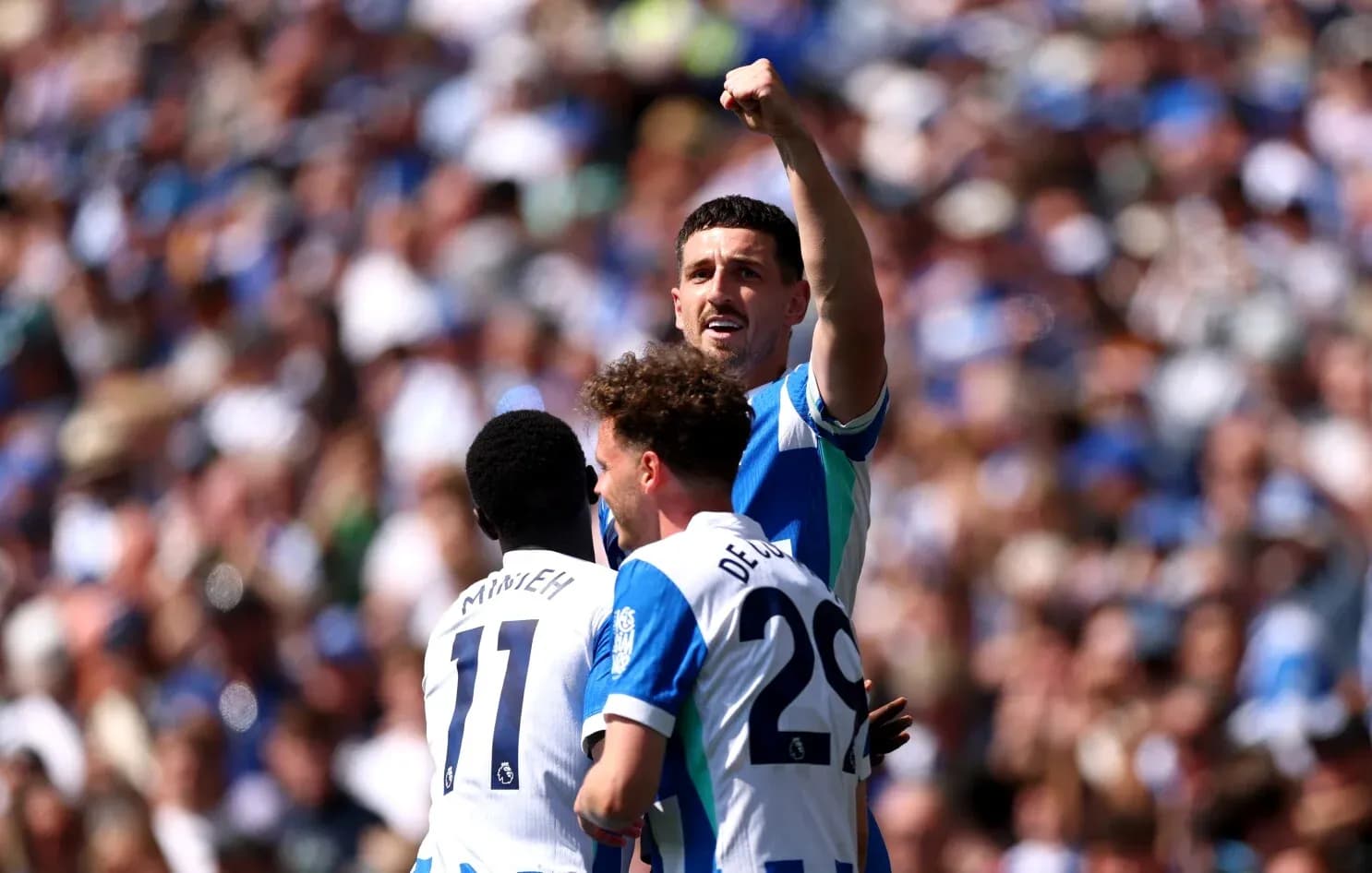
The scoring opened at 1' when Jack Hinshelwood arrived from midfield to finish a move created down the left by Maxim De Cuyper, whose early advanced positioning foreshadowed Brighton’s wing‑dominant plan. At 5', Lewis Dunk doubled the lead, again from a De Cuyper assist, underlining Brighton’s set pattern: progress wide, then attack central spaces with late runs and aerial presence.
Discipline
Discipline was relatively light but tactically relevant. There were three yellow cards in total: Brighton 1, Wolves 2, Total: 3.
Card log:
- 24' Kaoru Mitoma (Brighton) — Foul
- 49' Hwang Hee-chan (Wolves) — Foul
- 68' André (Wolves) — Foul
Mitoma’s caution at 24' came as Wolves tried to break against Brighton’s high rest‑defence line; his foul reflected Brighton’s willingness to commit tactical infringements to prevent transition. After the break, Wolves’ frustration surfaced: Hwang Hee-chan’s yellow at 49' and André’s at 68' both came as they struggled to disrupt Brighton’s circulation and contest second balls.
Substitutions
Substitution patterns confirmed the tactical story. At 46', David Møller Wolfe (IN) came on for Hugo Bueno (OUT), a Wolves adjustment at left side intended to add defensive stability and some ball progression, but without changing the overall structure. At 58', Joël Veltman (IN) came on for Kaoru Mitoma (OUT), allowing Brighton to move from a more aggressive, winger‑led left flank to a slightly more conservative, control‑oriented shape, with Veltman offering extra security in rest defence.
Edwards attempted a double attacking tweak on 67': Rodrigo Gomes (IN) came on for Pedro Lima (OUT) and Jean-Ricner Bellegarde (IN) came on for Mateus Mané (OUT), trying to inject ball‑carrying and between‑the‑lines presence. Yet Brighton’s block, anchored by Dunk and Jan Paul van Hecke, remained compact and untroubled. André’s yellow at 68' showed Wolves’ midfield increasingly arriving late into duels as Brighton circulated around them.
Hurzeler’s own 76' double change refreshed central energy and the forward line: Yasin Ayari (IN) came on for Carlos Baleba (OUT) and Georginio Rutter (IN) came on for Danny Welbeck (OUT). This preserved Brighton’s ability to press and combine between lines without losing structural balance. The third goal at 86' came from Yankuba Minteh, who finished a late attack to make it 3–0, rewarding his persistent high positioning and direct threat. In the closing stages, Charalampos Kostoulas (IN) came on for Jack Hinshelwood (OUT) and Solly March (IN) came on for Maxim De Cuyper (OUT) at 88', while Wolves introduced Angel Gomes (IN) for Hwang Hee-chan (OUT) and Tolu Arokodare (IN) for João Gomes (OUT) at 89', but by then the tactical die was cast.
Possession and Structure
Structurally, Brighton’s dominance was rooted in their possession scheme. With 578 total passes at 86% accuracy versus Wolves’ 225 at 68%, they built a stable 3+2 base in early phases: Dunk and van Hecke split, De Cuyper pushed high on the left, while Ferdi Kadıoğlu could either tuck in as a third centre‑back or advance to create a wide overload. Carlos Baleba and Pascal Groß formed the double pivot, giving constant short options and allowing the front four – Hinshelwood, Minteh, Mitoma, and Welbeck – to occupy interior lanes and half‑spaces.
The early goals were direct products of this structure. De Cuyper’s two assists from the left illustrated how Brighton targeted Wolves’ right‑side spacing, dragging Santiago Bueno and Toti Gomes into wide channels and opening central gaps. Hinshelwood’s timing from midfield on 1' and Dunk’s set‑piece or second‑phase presence at 5' exploited those disorganised moments.
Defensive Strategy
Out of possession, Brighton’s rest‑defence was notably aggressive. With only 9 fouls to Wolves’ 11, they pressed high but in a controlled manner, using Baleba and Groß to screen passes into Adam Armstrong and Hwang Hee-chan. When Wolves did break the first line, Lewis Dunk’s reading of play and van Hecke’s cover ensured that Wolves’ four shots inside the box rarely became clean looks; Wolves ended with just one shot on target.
Goalkeeper Performance
Goalkeeper usage underlined the asymmetry of threat. Bart Verbruggen made 1 save, reflecting how rarely Wolves could turn possession into genuine danger. Daniel Bentley, by contrast, made 3 saves behind a defence that faced 14 total shots (10 inside the box). Both keepers posted the same goals prevented figure (0.25), but the context differed: Bentley’s workload was heavier in volume and came under sustained territorial pressure.
Advanced Metrics
In advanced metrics, Brighton’s xG of 1.62 versus Wolves’ 0.49 confirms that the 3–0 scoreline was a slight overperformance in finishing but fully aligned with chance quality and volume. Brighton turned a moderate xG edge into a decisive result through early clinical execution and set‑play efficiency, while Wolves’ low xG mirrored their inability to access central shooting zones.
From an overall form perspective, Brighton’s capacity to control possession (72%), generate 6 shots on goal, and limit Wolves to a single effort on target points to a side comfortable in a proactive, ball‑dominant identity. Defensively, their index in this match was strong: compact spacing, effective counter‑pressing, and minimal concessions in high‑value areas. Wolves, by contrast, showed structural issues in buildup and progression; their 28% possession and 154 accurate passes suggest a team more reactive than planned, struggling to connect midfield to attack. The tactical verdict is clear: Brighton’s superior structure, pressing organisation, and wing‑based patterns translated directly into a comprehensive, data‑backed 3–0 win.