.svg&w=384&q=75 "Pitchgist logo")
Bayern München vs Paris Saint Germain: Champions League Semi-Final Analysis
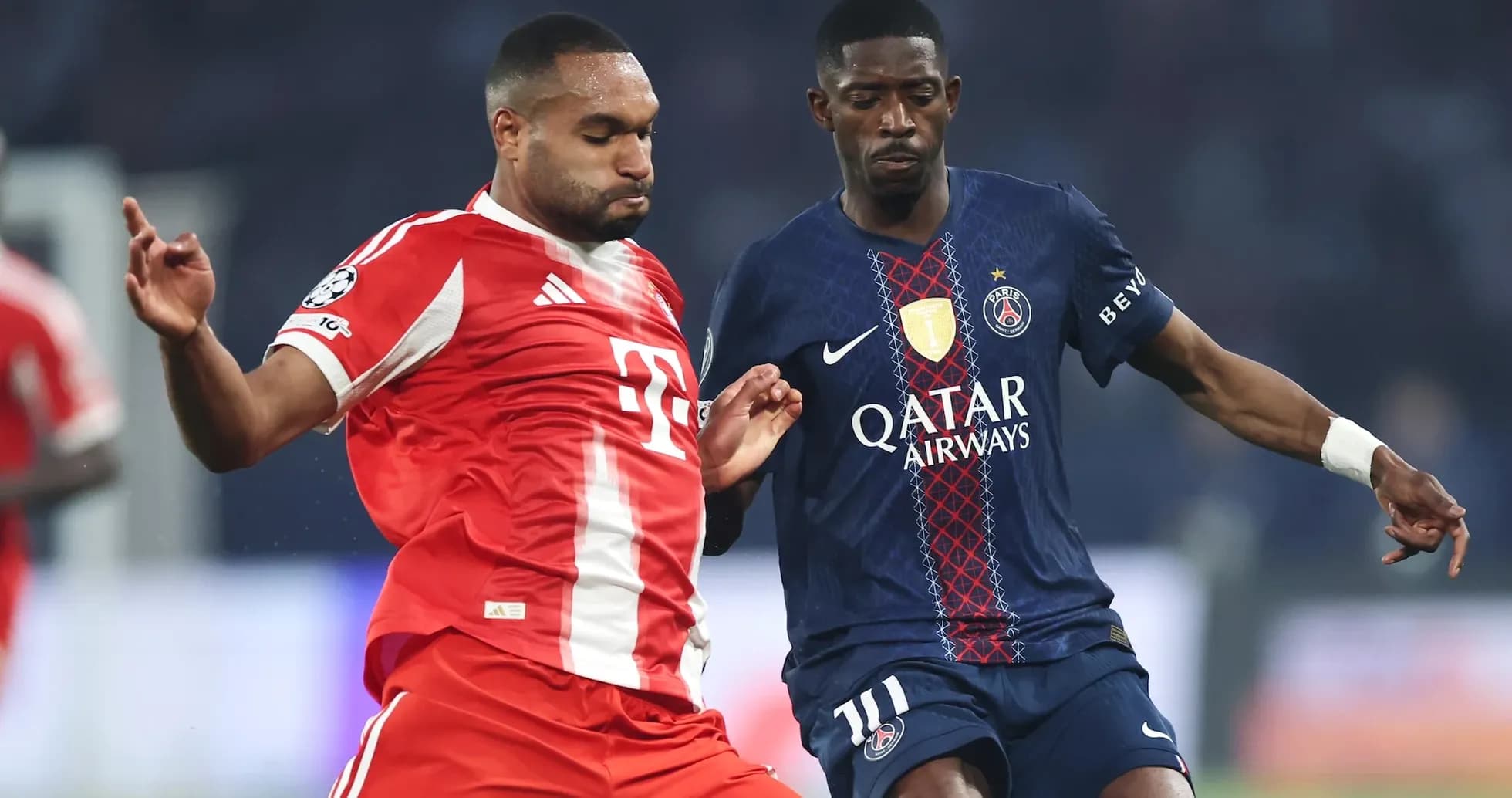
Under the lights of the Allianz Arena, a 1–1 draw between Bayern München and Paris Saint Germain closed the first chapter of this UEFA Champions League semi-final. Following this result, the tie remains perfectly poised, but the underlying numbers and the shapes on the pitch tell a more nuanced story about two teams whose identities are sharply defined.
I. The Big Picture – Two Superpowers, One Narrow Margin
Bayern arrived in this semi-final as a machine built for knockout football. Overall this campaign they have played 14 Champions League matches, winning 11, drawing 1 and losing just 2. At home they have been close to flawless: 7 fixtures, 6 wins, 1 draw and 0 defeats. That Allianz aura is backed by production – at home they average 3.0 goals for and concede 1.0, with 21 home goals scored and 7 conceded. Their overall goal difference in the competition stands at +23, with 43 goals for and 20 against.
PSG, ranked lower in the broader standings but hardened by a long run through the tournament, have their own imposing profile. Across 16 Champions League fixtures they have 10 wins, 4 draws and only 2 losses. On their travels they have played 8 times, winning 5, drawing 2 and losing just 1, scoring 19 away goals and conceding 8. Their overall goal difference is +22, with 44 goals scored and 22 conceded. If Bayern are a relentless storm at home, PSG are a side that travels with conviction and scores 2.4 goals per away game while conceding only 1.0.
Set against that backdrop, a 1–1 in Munich feels less like a stalemate and more like a temporary ceasefire.
II. Tactical Voids – Who Was Missing, and What That Meant
Both coaches had to redraw their maps before kick-off. Vincent Kompany was without S. Gnabry, M. Cardozo, C. Kiala, W. Mike and B. Ndiaye, stripping Bayern of one of their most direct wide threats and some depth options. Gnabry’s absence in particular removed a player who has delivered 5 assists in this Champions League season and offers vertical running from the bench.
Enrique Luis had his own headaches. A. Hakimi, L. Chevalier and Q. Ndjantou were all ruled out, with Hakimi’s thigh injury forcing a structural rethink on the right side of PSG’s defence. Without Hakimi’s overlapping and progressive passing, PSG turned to W. Zaire-Emery in the back line, a move that shifted some of the creative burden further inside onto Vitinha and J. Neves.
Disciplinary trends also hovered over the contest. Bayern’s season-long card profile shows a clear late-game edge: 37.04% of their yellow cards arrive between 76–90 minutes, underlining how their intensity can spill over as matches stretch. They have also seen red twice, with one dismissal in the 46–60 range and another between 61–75. PSG mirror that late volatility: 42.86% of their yellow cards come between 76–90 minutes, and both of their reds have landed in high-tension windows (31–45 and 91–105). This semi-final was always likely to become more chaotic as it wore on, and the closing stages in Munich reflected that simmering edge, even if no dismissal arrived on the night.
III. Key Matchups – Hunter vs Shield, and the Engine Room
Hunter vs Shield
At the sharp end, this tie is framed by two elite attacking hubs. For Bayern, H. Kane is the reference point. In the Champions League this season he has 14 goals and 2 assists in 13 appearances, backed by 36 shots and 25 on target. He has also won 2 penalties and taken 4, scoring 4 but missing 1 – a reminder that even Bayern’s execution is not truly flawless from the spot.
Kane operates at the tip of a 4-2-3-1 that was unchanged again: M. Neuer behind a back four of J. Stanisic, J. Tah, D. Upamecano and K. Laimer, with J. Kimmich and A. Pavlovic as the double pivot. Ahead of them, M. Olise, J. Musiala and L. Díaz orbit around Kane, forming a fluid, technically gifted line of three.
Opposite him, PSG’s defensive shield is anchored by Marquinhos and W. Pacho, flanked by N. Mendes and Zaire-Emery. On their travels this season PSG concede just 1.0 goal per match, and overall they allow 1.4 per game. They are not a low-block side; instead, they compress space with an aggressive high line, trusting their centre-backs’ timing and Safonov’s positioning.
The duel between Kane and Marquinhos is not just physical but positional. Kane’s habit of dropping into the half-spaces threatens to drag Marquinhos out, creating channels for Olise and Díaz. In Munich, that dynamic repeatedly forced PSG’s midfield three to collapse centrally, opening lanes for Bayern’s full-backs to progress.
The Engine Room
If Kane versus PSG’s back line is the headline, the true battleground is the midfield. Kimmich, with 1,117 passes in the competition and 30 key passes, is Bayern’s metronome. He has 4 yellow cards, which underlines his willingness to foul to stop transitions, but his 90% passing accuracy and 9 interceptions show a player who reads danger early.
Across from him, Vitinha is PSG’s conductor. He has played 1,439 minutes in this Champions League campaign, scoring 6 goals and adding 1 assist, but his defining metric is volume and precision: 1,553 passes at 93% accuracy, plus 23 key passes. He is supported by F. Ruiz and J. Neves, forming a triangle that can both suffocate and spring forward.
The presence of D. Doué and O. Dembele either side of K. Kvaratskhelia in PSG’s front three adds layers. Kvaratskhelia is both top scorer and top assist provider for PSG in this competition, with 10 goals and 6 assists. He has attempted 51 dribbles, completing 29, and drawn 28 fouls. His duels with Laimer and Stanisic on Bayern’s right side are a running subplot: can Bayern’s more functional full-backs contain a winger who thrives in isolation?
On Bayern’s left, L. Díaz is a dual-threat. He has 7 goals and 3 assists, 21 shots with 15 on target, and 47 dribbles attempted with 29 successful. He also sits in the red-card column with 1 dismissal, hinting at a competitive edge that can spill over. His direct confrontations with Zaire-Emery and Marquinhos will keep PSG’s right half-space permanently under stress.
IV. Statistical Prognosis – Margins, xG Shape and the Second Leg
Even without explicit xG figures in the data, the profiles of both sides sketch the likely pattern for the return. Bayern’s home average of 3.0 goals for and PSG’s away average of 2.4 suggest that, in a neutral world of chances created, this tie leans towards a high-chance environment whenever either side takes initiative. Both concede 1.4 goals per game overall, reinforcing the idea that clean sheets will be rare and that the semi-final will probably be decided by finishing and decision-making in the box rather than by a defensive lockout.
Bayern’s 2 clean sheets in the competition, both at home, contrast with PSG’s 3 away clean sheets, hinting that PSG may be slightly more comfortable absorbing pressure on their travels than Bayern are when defending big spaces. Yet Bayern have never failed to score, home or away, in this Champions League season, while PSG have failed to score just once overall and only once away.
Penalties could again be decisive. Bayern have taken 4 and scored all 4 at team level this season, but Kane’s individual record includes 1 miss, and PSG’s takers have also shown fallibility: O. Dembele and Vitinha have each scored 1 and missed 1. In a tie this tight, the psychological weight of a spot-kick – especially late, when both sides are statistically at their most combustible in terms of cards – could swing the entire narrative.
Tactically, the second leg is likely to be defined by two intersecting curves. Bayern will seek to stretch PSG’s midfield triangle with the rotations of Musiala and Olise between the lines, using Kimmich’s range to switch play quickly onto Díaz. PSG, meanwhile, will look to isolate Kvaratskhelia against Bayern’s right side and exploit transitions whenever Kimmich or Pavlovic are caught ahead of the ball.
Following this result, the semi-final travels to Paris with the scoreboard level but the balance of risk subtly shifted. Bayern’s attacking volume and never-failed-to-score record make them a constant threat; PSG’s away solidity and multi-headed attack led by Kvaratskhelia, Dembele, Vitinha and Doué give them the tools to answer. Over 180 minutes, this tie feels destined to be decided not by one grand tactical idea, but by which of the hunters – Kane in red or Kvaratskhelia in blue – finds the decisive moment against a defence that, on the numbers, is good but not impermeable.