.svg&w=384&q=75 "Pitchgist logo")
Arsenal Secures 1–0 Victory Against Atletico Madrid in Champions League Semi-Final
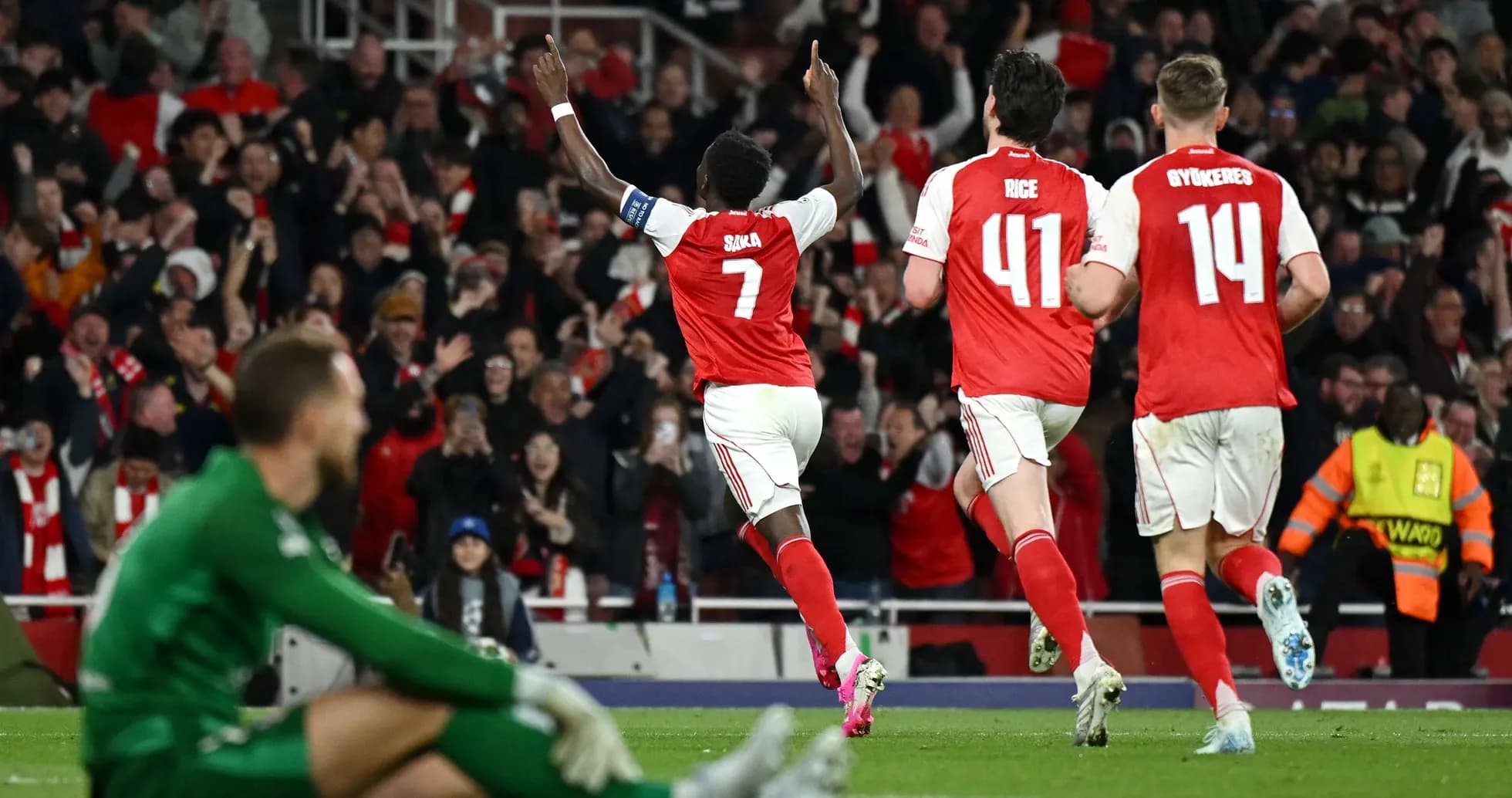
Arsenal edged a cagey UEFA Champions League semi-final first leg 1–0 at Emirates Stadium, leaning on a compact 4-2-3-1 structure and a high-precision press to keep Atletico Madrid’s 4-4-2 largely on the outside. With 54% possession and a 1.58–0.53 xG advantage, Mikel Arteta’s side translated territorial control into the game’s only goal through Bukayo Saka on 44’, then managed the lead with disciplined spacing and controlled tempo. Diego Simeone’s Atletico adjusted aggressively with a raft of second-half substitutions, but despite a late territorial surge, they were held to just two shots on target, matching Arsenal’s total but without the same shot quality or central access.
Scoring Sequence
The scoring sequence was defined by Arsenal’s right-sided superiority. On 44’, B. Saka, starting as the right-sided midfielder in the 4-2-3-1, capitalised on sustained pressure to produce the decisive “Normal Goal”, giving Arsenal a 1–0 lead that matched the half-time scoreline. There were no further goals, and with no VAR references in the data, the strike stood uncontested as the game’s solitary scoring action.
Disciplinary Story
The disciplinary story began unusually early. At -5’, before kick-off, Arsenal substitute goalkeeper Kepa Arrizabalaga received a yellow card for time wasting, a rare pre-match sanction that underscored the referee’s low tolerance for procedural delays. Atletico’s cards arrived late and were both for fouls, reflecting their increased aggression as they chased the game. On 81’, Marc Pubill was booked for a foul, a moment that crystallised Atletico’s struggle to contain Arsenal’s transitions down the flanks. In added time at 90+5’, Koke was also shown yellow for a foul, emblematic of Atletico’s late-game frustration as Arsenal ran down the clock. Across the 90 minutes, Arsenal finished with one yellow (Kepa Arrizabalaga, Time wasting), Atletico with two (Marc Pubill and Koke, both for fouls), and no reds were issued.
Substitutions
Substitutions reshaped the tactical landscape from the 57th minute onward, with Simeone acting first to chase the deficit. At 57’, Atletico executed a triple change to inject verticality and fresh legs. A. Sorloth (IN) came on for R. Le Normand (OUT), pushing Atletico from a more stable back four into a bolder shape with extra presence up front. Simultaneously, N. Molina (IN) replaced A. Lookman (OUT), giving Atletico a more orthodox, overlapping right-sided defender to stretch Arsenal’s left. The third change at the same minute saw J. Cardoso (IN) come on for G. Simeone (OUT), reinforcing central midfield with fresh energy and ball-winning capacity.
Arsenal responded almost immediately to protect their lead and manage physical load. At 58’, N. Madueke (IN) came on for B. Saka (OUT), maintaining one-versus-one threat on the right while preserving Saka’s legs for the second leg. In parallel, P. Hincapie (IN) replaced R. Calafiori (OUT), adding defensive robustness and recovery pace on the left side of the back four to handle Atletico’s renewed wing pressure. On 59’, M. Odegaard (IN) came on for E. Eze (OUT), shifting Arsenal’s No.10 role from a dribble-heavy carrier to a more positional playmaker, helping them control rhythm and secure possession between Atletico’s lines.
Simeone’s second wave of changes came on 66’. A. Baena (IN) replaced A. Griezmann (OUT), a notable shift that traded star quality for fresher legs and more vertical midfield runs, suggesting a push for second-ball dominance rather than pure creativity. At the same minute, T. Almada (IN) came on for J. Alvarez (OUT), offering a more fluid, drifting forward who could drop into pockets and link play, attempting to unbalance Arsenal’s centre-backs by pulling them into midfield zones.
Arteta’s late-game management focused on fresh legs in central and wide zones to preserve the 1–0. At 74’, M. Zubimendi (IN) replaced M. Lewis-Skelly (OUT), moving Arsenal’s double pivot from youth and dynamism to a more experienced, positionally disciplined screen in front of the back four. On 83’, G. Martinelli (IN) came on for L. Trossard (OUT), swapping a technical, combination-oriented wide player for a more direct runner who could stretch Atletico on the counter and carry the ball into space to relieve pressure.
Structural Analysis
Structurally, Arsenal’s 4-2-3-1 functioned as a possession-dominant but risk-aware system. D. Raya, with 2 goalkeeper saves, was protected by a disciplined back four of B. White, W. Saliba, Gabriel, and R. Calafiori (later P. Hincapie). The double pivot of D. Rice and M. Lewis-Skelly (later M. Zubimendi) balanced vertical support with screening duties, allowing the attacking trio of B. Saka, E. Eze (later M. Odegaard), and L. Trossard (later G. Martinelli) to occupy aggressive pockets between Atletico’s lines. V. Gyökeres worked as the lone forward, pinning centre-backs and opening channels for wide runs.
Atletico’s 4-4-2 was more reactive, with J. Oblak making 1 save behind a back four of M. Pubill, R. Le Normand (replaced by A. Sorloth as the structure shifted), D. Hancko, and M. Ruggeri. The midfield quartet of G. Simeone, M. Llorente, Koke, and A. Lookman (later N. Molina) tried to compress central spaces, but Arsenal’s 444 total passes at 85% accuracy gradually wore them down. The front pair A. Griezmann and J. Alvarez, both substituted on 66’, had limited central service, forced to drop deeper due to Arsenal’s territorial control.
Statistical Overview
Statistically, Arsenal’s 54% possession and 13 total shots (2 on target, 8 off target, 3 blocked) reflected a side that controlled the ball and territory but did not overcommit numbers into the box, with 6 shots inside the area and 7 from outside. Their xG of 1.58 aligns closely with the single goal scored, suggesting they converted a reasonable share of the danger they created. Atletico’s 9 shots (2 on target, 4 off target, 3 blocked) and 0.53 xG underline a more limited attacking profile, reliant on lower-quality opportunities and set-piece or second-ball scenarios. Both goalkeepers recorded 0.02 goals prevented, indicating that neither was required to produce extreme, match-defining saves; the game was decided more by structural control and shot quality than by goalkeeping heroics.
Discipline and Duels
In discipline and duels, Atletico’s 13 fouls and 2 yellow cards contrasted with Arsenal’s 10 fouls and a single, highly unusual pre-match yellow for Kepa Arrizabalaga. This small but clear edge in aggression did not translate into scoreboard pressure. Arsenal’s Overall Form on the night was that of a mature, possession-dominant semi-final side, while their Defensive Index was underlined by limiting Atletico to low xG and just two shots on target. Atletico’s Overall Form showed resilience and adaptability through substitutions, but their attacking structure rarely broke Arsenal’s block cleanly. As a first-leg platform, Arsenal’s 1–0, grounded in tactical control and efficient risk management, gives them a narrow but deserved advantage heading into the return fixture.