.svg&w=384&q=75 "Pitchgist logo")
Arsenal Edges Atletico Madrid in UEFA Champions League Semi-Final
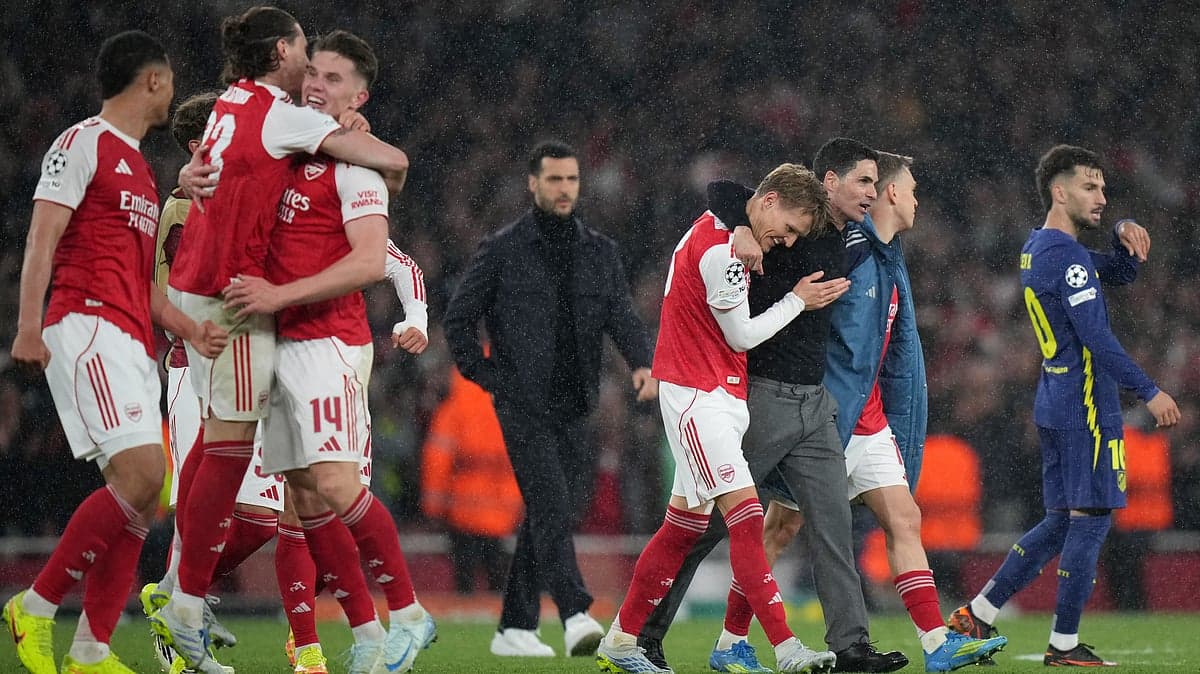
Under the Emirates Stadium lights, this UEFA Champions League semi‑final first leg became a study in control versus chaos. Arsenal edged Atletico Madrid 1–0, a scoreline that flattered the visitors as much as it underlined how far Mikel Arteta’s side have evolved in Europe.
Heading into this game, the numbers framed Arsenal as the tournament’s most complete machine. Overall they had played 14 Champions League matches, winning 11 and drawing 3, with no defeats. They averaged 2.1 goals per game in total and conceded just 0.4, a defensive record built on structure rather than survival. At home, they had been even more ruthless: 7 fixtures, 6 wins, 1 draw, 15 goals for and only 3 against, an average of 2.1 scored and 0.4 conceded at the Emirates.
Atletico arrived as something more volatile. Overall they had played 16 matches, winning 7, drawing 3 and losing 6. They scored 2.2 goals per game in total but conceded 1.8, a far looser side than Diego Simeone’s early-era teams. On their travels, the contrast was stark: 8 away fixtures, just 2 wins, 2 draws and 4 defeats, with 13 goals for and 17 against, an away average of 1.6 scored and 2.1 conceded. This was not the ironclad Atletico of old; it was a team capable of blowing opponents away at home (22 goals in 8) but fragile once removed from Madrid.
I. The Big Picture: Shapes, rhythm, and semi‑final stakes
Arteta went with a 4‑2‑3‑1, but on the pitch it often resembled a 2‑3‑5 in possession. D. Raya anchored behind a back four of B. White, W. Saliba, Gabriel and R. Calafiori. In front, D. Rice and the youthful M. Lewis‑Skelly formed the double pivot, while B. Saka, E. Eze and L. Trossard operated behind V. Gyökeres.
Simeone’s 4‑4‑2 was classic in outline, if more modern in execution. J. Oblak stood behind a back line of M. Pubill, R. Le Normand, D. Hancko and M. Ruggeri. Across midfield, G. Simeone, M. Llorente, Koke and A. Lookman tried to compress space, leaving A. Griezmann and J. Álvarez as the dual threat up front.
The match narrative quickly followed the seasonal trends. Arsenal, undefeated overall and with a goal difference of +23 (29 scored, 6 conceded), suffocated Atletico’s attempts to build. Atletico, whose overall goal difference of +7 (35 scored, 28 conceded) had been earned through high‑variance contests, were pushed into a reactive shell.
II. Tactical voids and absences
Both coaches had to navigate important absences. Arsenal were without M. Merino (foot injury) and J. Timber (ankle injury), two profiles that would have added depth and variation to the left side and the back line. Their absence elevated the importance of Rice’s distribution and Calafiori’s ability to step into midfield.
For Atletico, P. Barrios and N. Gonzalez (both muscle injuries) removed two rotation options who could have added legs and aggression between the lines. In a tie where managing transitions and late‑game intensity is vital, Simeone’s bench was subtly weakened.
Disciplinary trends also shaped the risk calculus. Heading into this game, Arsenal’s yellow cards were clustered in the 61–75 minute window, which accounted for 31.82% of their bookings, with another 18.18% between 76–90. Atletico’s yellows peaked between 46–60 minutes at 25.93%, with a further 18.52% from 61–75. Both sides are prone to picking up cautions as intensity spikes after the interval, something that influenced how aggressively they pressed and counter‑pressed in the second half, even if this particular match never tipped into full disciplinary chaos. Neither team had a red‑card history in this Champions League campaign, and that restraint carried into a disciplined, if bruising, semi‑final.
III. Key Matchups
Hunter vs Shield: J. Álvarez vs Arsenal’s back four
No individual threat loomed larger than J. Álvarez. Heading into this game he had 10 goals and 4 assists in 15 Champions League appearances, with 37 shots (22 on target) and 34 key passes. He had also scored 3 penalties from 3, a perfect record from the spot.
But against Arsenal’s defensive structure, the hunter met a shield of rare solidity. Overall, Arsenal had conceded only 6 goals in 14 matches, with 9 clean sheets and just 1 game in which they failed to score. At home they had allowed 3 goals in 7 fixtures and recorded 5 clean sheets. The Saliba‑Gabriel axis, screened by Rice, compressed central spaces where Álvarez usually thrives, forcing him into wider, less dangerous zones and limiting his touches between the lines.
Engine Room: Koke and M. Llorente vs D. Rice and M. Lewis‑Skelly
The semi‑final’s rhythm hinged on the central quartet. Koke, the metronome, and Llorente, the runner, tried to turn Atletico’s defensive block into quick, vertical attacks. Their challenge was immense: Arsenal’s midfield had been the foundation of their unbeaten run, with Rice dictating tempo and Lewis‑Skelly offering energy and press resistance.
Arsenal’s season‑long numbers framed the duel. With an average of 2.1 goals for and 0.4 against in total, they are used to playing high up the pitch, trusting their midfield to snuff out counters. Atletico’s overall average of 2.2 goals scored suggested they could punish any lapse, but their 1.8 goals conceded per match underlined how often their own structure breaks once the first line is beaten.
On the night, Rice dominated the central lane, repeatedly stepping in front of Griezmann and Álvarez to intercept and recycle possession. Lewis‑Skelly’s positioning allowed Saka and Trossard to stay high, pinning Atletico’s full‑backs and limiting the support M. Pubill and M. Ruggeri could offer their wingers.
Flanks and discipline: B. Saka vs M. Ruggeri and M. Pubill
Saka’s duel with Atletico’s left side became a pressure point. With M. Pubill already a high‑usage defender in this campaign—11 appearances, 18 tackles, and 6 successful blocks—he was tasked with doubling up when Saka drifted inside. Atletico’s yellow‑card history, with 14.81% of bookings between 31–45 minutes and another 14.81% from 76–90, meant any early caution on that flank could have been fatal. Simeone’s line held, but only by retreating deeper and conceding territory.
IV. Statistical prognosis and the road ahead
Following this result, the tie tilts towards Arsenal, but not decisively. The 1–0 scoreline is entirely in keeping with their Champions League profile: control, minimal concession, and enough attacking quality to find a breakthrough. Their overall unbeaten record, combined with a home defensive average of 0.4 goals conceded, suggests they will travel to Madrid with confidence in their ability to manage game state.
For Atletico, the path is narrow but not closed. Their home form—22 goals in 8 matches, an average of 2.8 scored—indicates they can overturn a single‑goal deficit at the Metropolitano. Yet their defensive fragility, especially compared with Arsenal’s steel, means they will have to open up against a side that punishes space ruthlessly.
On xG logic and defensive solidity alone, Arsenal remain favourites to reach the final. Their capacity to restrict chances, married to a multi‑layered attack that can be refreshed from the bench with the likes of Gabriel Martinelli, K. Havertz or Gabriel Jesus, gives them both control and chaos at their disposal. Atletico, driven by Álvarez’s cutting edge and Simeone’s knack for turning second legs into street fights, will need a perfect night in Madrid to bend the numbers back in their favour.