.svg&w=384&q=75 "Pitchgist logo")
Aston Villa: Europa League Champions Again
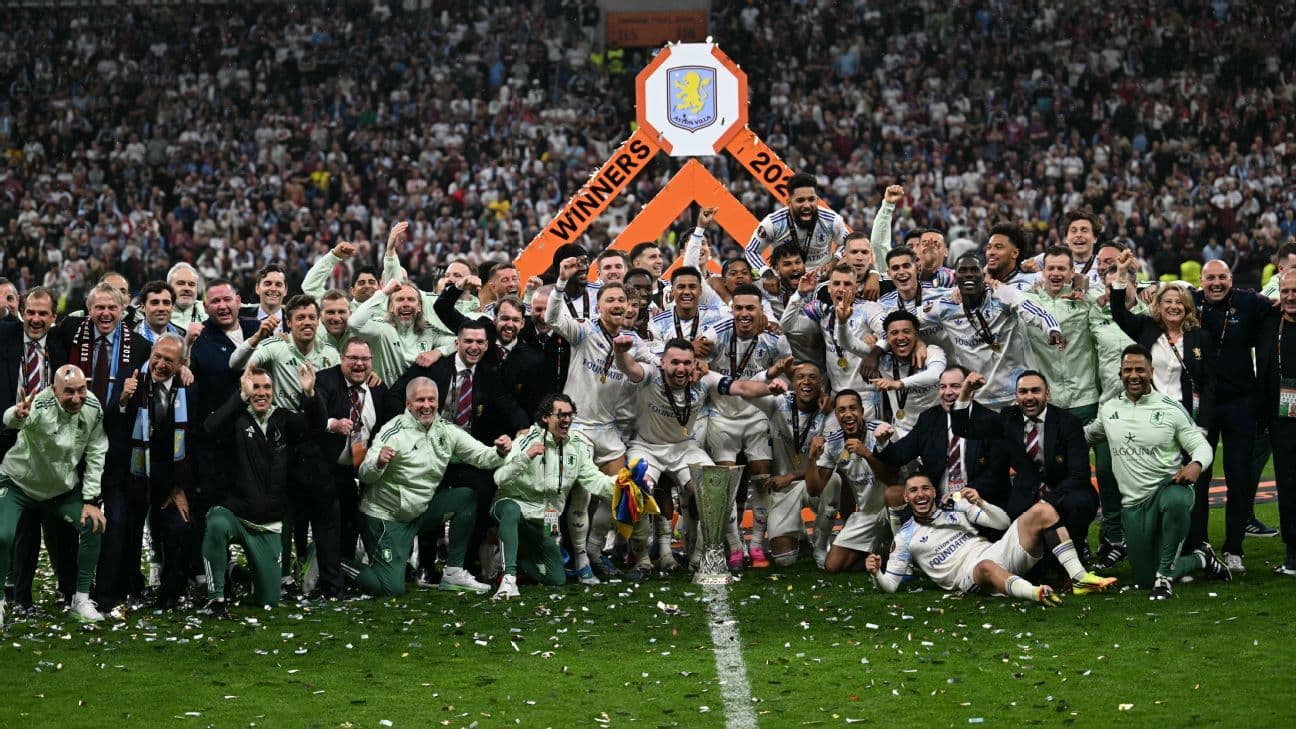
Aston Villa’s long road back to Europe’s summit ended in a blur of claret and blue in Istanbul, 44 years after Bayern Munich and Rotterdam. Different era, different cast, same outcome: Aston Villa, champions of Europe again. And at the heart of it all, inevitably, stood Unai Emery.
The 54-year-old has turned the Europa League into his personal playground. Five titles now, four different clubs. Sevilla, Villarreal, and now a Villa side that once stared into the abyss of relegation and has climbed all the way back to the top deck of the continental game.
This was not a tense, nervy final. It was a dismantling.
Youri Tielemans lit the touchpaper. Emi Buendía added a flourish of pure theatre. Morgan Rogers applied the final, ruthless stroke. Freiburg, brave but blunt, were swept aside 3-0 at Besiktas Park in a final that underlined not only Villa’s rebirth, but Emery’s status as Europa League royalty.
From Preston midweeks to Istanbul nights
For Aston Villa, this trophy is not a one-off. It is the punctuation mark at the end of a decade-long sentence.
Their last major honour was the League Cup in 1996. Since then: drift, decline, and in 2016, the humiliation of Premier League relegation. There were midweek trips to Preston, long nights in the Championship, and a club that felt more like a memory than a force.
The turning point came at Wembley in 2019. John McGinn, all drive and defiance, helped drag Villa past Derby County in the Championship playoff final to restore their Premier League status. Seven years later, the same McGinn climbed the steps in Istanbul as captain of a European champion, the first Scotsman to lead a side in a major European final since Barry Ferguson in 2008, and the first to do so for an English club since Graeme Souness in 1984.
The image of McGinn, Europa League trophy raised above his head, is already etched into Villa folklore. Around him stood the core of a group that has carried this club from those second-tier slogfests to the grandest of stages.
Tyrone Mings and Tammy Abraham were there for that Wembley afternoon. Ezri Konsa, Emi Martínez, Ollie Watkins, Matty Cash came soon after. Together they formed the spine of a team that has flirted with greatness, only to be shoved aside at the crucial moment: a Conference League semifinal exit in 2024, a Champions League quarterfinal defeat to eventual winners Paris Saint-Germain last year.
In Istanbul, the near-misses finally hardened into something more ruthless. Villa kept Freiburg at arm’s length, played with a calm that belied the occasion, and when the chances came, they did not blink.
Three chances. Three cuts. One era-defining night.
Emery, the Europa League’s uncompromising monarch
Thomas Tuchel once joked that UEFA might as well rename this trophy after Unai Emery. It sounded like a quip. It now reads like a proposal.
On the banks of the Bosphorus, Emery lifted the 47kg hulk of silverware for the fifth time. Only Carlo Ancelotti, with his five Champions League titles, has matched that haul in a major European competition. No one else has done it with as many different clubs.
Sevilla three times. Villarreal once. Now Aston Villa.
Emery tried to play it down in the build-up. He insisted he wasn’t the “king” of this tournament, insisted his past had no bearing on this final. The 11,000 Villa supporters packed into the claret and blue end of Besiktas Park, among them future king and lifelong fan Prince William, would disagree. To them, the man who took Villa from 17th in the Premier League to European glory in four years is more than a coach. He is a standard-bearer.
His fingerprints were all over this performance. From the decision to bypass Freiburg’s press with direct balls into Watkins, to the dead-ball detail that unlocked the first goal, Emery’s plan turned a potentially awkward night into a controlled procession.
It is easy to forget how this season started. Villa failed to win any of their first four matches. They did not score until late September. From that stuttering beginning, Emery has steered them into the Champions League places and now to a major European title.
Whatever label you want to give him — specialist, serial winner, tactician — one thing is no longer up for debate: he is one of the defining coaches of the modern European game.
A final decided by three ruthless moments
For 40 minutes, this did not look like a 3-0 final.
The opening exchanges were fractured, bitty. Fouls broke up the rhythm. Neither side found a grip. Villa seemed oddly flat, Freiburg unable to turn their running into any real menace. The German side would end the night having covered 2.5km more than Villa — 102.9km to 100.4km — but their legs moved faster than their ideas.
Then the pressure finally told, not through a sweeping move, but through a training-ground trick.
Austin MacPhee, Villa’s set-piece coach, has built a reputation as one of the sharpest minds in his field. His latest creation arrived via a short corner from Lucas Digne that completely wrong-footed Freiburg. While the defence switched off, Morgan Rogers took a beat, weighed his options, and floated a teasing ball towards a pocket of space just inside the box.
Tielemans arrived like a hammer. One stride, one thudding volley, and the ball screamed past Noah Atubolu before he could properly set himself. 1-0. Freiburg looked stunned. Villa looked liberated.
The goal cracked the game open. Suddenly, the passes were crisper, the runs more daring. Villa’s season-long knack for the spectacular resurfaced.
Buendía, operating on the edge of the contest until then, stepped into the spotlight. Picking up the ball near the edge of the area, on his weaker left foot, he shaped and whipped a shot that seemed to bend around Atubolu’s outstretched hand and kissed the side netting on its way in. It was the kind of strike that draws a collective intake of breath before the roar.
Referee François Letexier barely allowed the replays to roll. He blew for half-time almost immediately, as if acknowledging that nothing in the remaining seconds could top what had just happened.
Freiburg trudged off two down, aware of a grim pattern: the last three Europa League finals with a two-goal half-time lead have all ended 3-0. Atlético Madrid in 2012, Atalanta in 2024, and now Villa in 2026. The script was written. Emery’s team just had to read their lines.
They did so with cold clarity.
Rogers’ goal, Villa’s third, did not possess the same artistry as Tielemans’ volley or Buendía’s curler. It did not need to. It was sharp, decisive, the finish of a player who understood the occasion and refused to shrink from it.
At 23 years and 298 days, Rogers became the youngest Englishman to score in a major UEFA final since Steven Gerrard for Liverpool in the 2001 UEFA Cup. Different generation, same sense of timing.
By then, Freiburg were chasing shadows. They ran, they pressed, they tried to claw their way back, but Villa never lost control. The German side had more distance in their legs; Villa had more clarity in their heads and more quality in their boots.
A club rewired for Europe
Beyond the scoreline, this night carried numbers that speak to history.
Aston Villa’s 44-year wait between major European finals is the third-longest of any club, behind Manchester City’s 51-year gap (1970-2021) and West Ham United’s 47-year hiatus (1976-2023). This win also completes a rare English double: with Spurs lifting the Europa League last season, it is the first time English clubs have won this competition in consecutive years since the very first two editions of the UEFA Cup in 1971-72 (Spurs) and 1972-73 (Liverpool).
There was another small but telling milestone. Jadon Sancho, now in claret and blue, became the first player ever to appear in the final of three different major European competitions in three straight seasons: Champions League in 2023-24, Conference League in 2024-25, Europa League in 2025-26. A career that has twisted and turned continues to find the biggest stages.
Most of all, this was about Villa’s tapestry of heroes growing richer. Names like Paul McGrath and Peter Withe once stood alone in the club’s European mythology. Now they are joined by McGinn, Martínez, Watkins, Tielemans, Buendía, Rogers, and the coach who stitched it all together.
The 30-year trophy drought is over. The scars of relegation have faded. A club that once looked lost has a European title, a Champions League future, and a manager who treats continental nights as his natural habitat.
The question now is not whether Aston Villa are back. It is how far this team, and this coach, can go from here.