.svg&w=384&q=75 "Pitchgist logo")
England's World Cup Opener: Pressure, Drama, and Injury Concerns
England head into their World Cup opener against Croatia with more noise swirling around them than momentum behind them. Tornado scares, medical bulletins, selection dramas, hysterical headlines – the build-up has felt like a rolling news channel rather than a football camp.
Thomas Tuchel, though, has been handed a brutally simple public brief. As one headline on the eve of the tournament put it: “make the semi-finals at least or he has failed.” No nuance. No allowance for jeopardy. No room for the kind of shocks that saw European champions Spain reminded, again, that this tournament is unforgiving and rarely straightforward.
Yet it is not Spain’s reality check that has dominated the English narrative. It’s Harry Maguire’s phone screen.
Maguire, Facetime and a brutal cut
The Manchester United defender discovered his World Cup fate in a way that jarred with plenty of traditionalists. As reported, Tuchel told Maguire over Facetime that he would not be going to the tournament.
No training-ground sit-down. No office door quietly closed. A video call.
Maguire then laid out the manager’s reasoning with a candour that made the exchange sound even more awkward. He explained that Tuchel had opted for “the four lads that he got through the qualifying in the autumn camps where he felt like they did well during those six games,” before immediately admitting: “But he did say that he can’t really give me an excuse.”
The logic and the denial of an excuse sat side by side, contradicting each other in the space of a breath. The message was clear enough, though: Tuchel trusted the defenders who navigated qualifying. Maguire, once a pillar of England’s tournament football, is now outside looking in, his omission both football decision and symbol of a new regime’s ruthlessness.
Saka’s gamble and Arsenal’s “concerns”
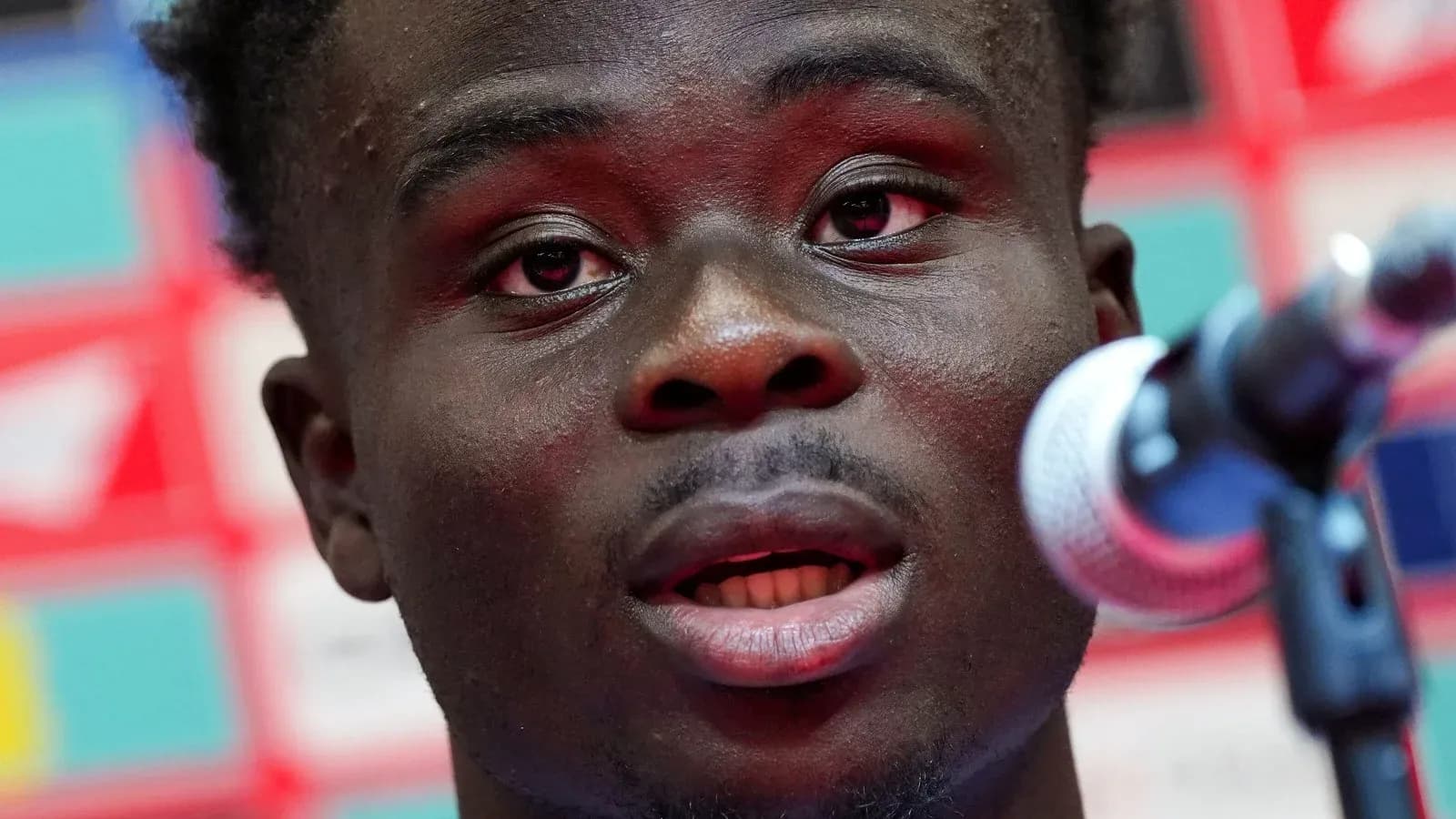
On the other flank of England’s preparation stands Bukayo Saka, smiling, honest, and clearly not fully fit.
The winger has started and finished just one match for club or country since mid-March. He missed the March England squad, was carefully managed in Arsenal’s title run-in, played less than an hour in a Champions League semi-final second leg, and saw his minutes limited in England’s warm-up games. His Achilles has been a running storyline for months.
Tuchel has already accepted the reality: “It is very unlikely he starts and finishes all the matches” at the World Cup. That is not a tactical tease; it is a medical fact.
Saka, though, framed it differently. He called himself “ready to go” and “happy to take the gamble” on his fitness for England. For a player of his temperament, that is no surprise. He wants to play. He always wants to play.
What followed said more about the ecosystem around the team than the player himself. John Cross’s original piece in the Daily Mirror carried a straightforward, upbeat line: Saka ready to take a World Cup “gamble” in a “huge boost” to England. The same words were repackaged on a sister site as: “Bukayo Saka sparks Arsenal concerns with alarming England comments at World Cup.”
Alarming? Arsenal hardly need a headline to tell them their star winger has been patched together since March. Saka himself credited Mikel Arteta and “the Arsenal medical team” for working closely with England and “managed me amazingly since March.” Tuchel echoed that, praising how “they took very good care of him and were very aware of it at Arsenal.”
Everyone inside the camps knows the score. Saka is not at 100%. Hasn’t been for a while. The gamble is real, but it is shared, calculated, and ongoing. To dress his determination to play as a fresh crisis is to ignore months of carefully joined-up management.
Tornadoes, SWAT teams and the theatre of fear
If the injury narrative feels familiar, the off-field “threats” engulfing England’s base verge on parody.
First came the tornado story. England were said to be “shaken” by a twister that forced them to…stay inside on a quiet evening. Their plans, already consisting of being indoors, remained exactly that. The storm changed nothing, beyond offering a dramatic backdrop for a dispatch.
Then came the next instalment: a “SWAT team rushes to armed standoff just mile from England World Cup stadium as suspect arrested.” The headline screamed danger, proximity, drama. The opening line reinforced it: armed police, a mile from where England will play their first match.
By the seventh paragraph, the story admitted the crucial detail: “There is no indication the incident was connected to the World Cup or posed any threat to the tournament or its venues.”
So the incident had nothing to do with England. Nothing to do with the World Cup. It simply happened near a stadium in a major city hosting a global event. The kind of city where armed incidents, sadly, are not unheard of at any time of year.
Yet this is the climate in which Tuchel and his players are trying to prepare: tornadoes that alter nothing, crime scenes with no link to them, and a sense that any event within a taxi ride of the team hotel must somehow be folded into the England storyline. You half expect the next bulletin to warn of fireworks five miles away and the “shockwaves” rocking the camp.
Spain stumble, England judged
While England’s build-up has been framed as a collection of mini-dramas, Spain’s draw with Cape Verde offered a more sober lesson. The European champions, one of the pre-tournament favourites, discovered again that there are no gentle introductions at this level.
Yet even that result was quickly spun into a contradiction. On one hand, it was used as a warning: “Why England and all other World Cup rivals should be worried after Spain are humbled by Cape Verde.” On the other, it concluded that Spain “still cannot be ruled out of contention for the trophy” despite dropping points in their opener.
So Spain can stumble and remain contenders. England, by contrast, are told that anything short of a semi-final is failure before a ball is kicked. That is the context in which every team selection, every injury update, every off-field incident is being judged.
Wirtz, Isak and a strange line on Iraola
The scrutiny is not limited to England. Liverpool’s recruitment hopes have been dragged into the World Cup narrative too, with Florian Wirtz and Alexander Isak catching the eye in early games against Curacao and Tunisia.
The logic there is straightforward: both players performing on the biggest stage only strengthens their appeal. Yet one line jarred.
Writing on Isak, it was suggested that Andoni Iraola “will want this to continue” but “would never admit it,” and that he will hope his striker “uses the biggest stage of all to find himself again, before taking that feeling back to Anfield.”
Why would Iraola “never admit” he wants his main forward, a hugely expensive asset, to find form at a World Cup? Any manager in the tournament, regardless of nationality or potential knockout paths, wants his best players confident and firing. There is no taboo in saying so. There is no great secret to protect. It is football’s most basic truth.
Yet even that is twisted into intrigue, as if a coach quietly hoping for his striker to score goals is some kind of state secret.
England, then, walk into their opening game with Croatia through a corridor of noise: a defender cut on Facetime, a winger gambling on his body, storms that change nothing, police operations with no link to them, and a bar for success set at semi-finals or bust.
Strip that away and the reality is simpler. Tuchel has made hard calls. Saka is desperate to play. Spain have already been reminded that reputations do not win group games.
The only question that matters now is whether, once the whistle goes, England can finally drag the story back onto the pitch.