.svg&w=384&q=75 "Pitchgist logo")
Arsenal vs Paris Saint Germain: UEFA Champions League Final Analysis
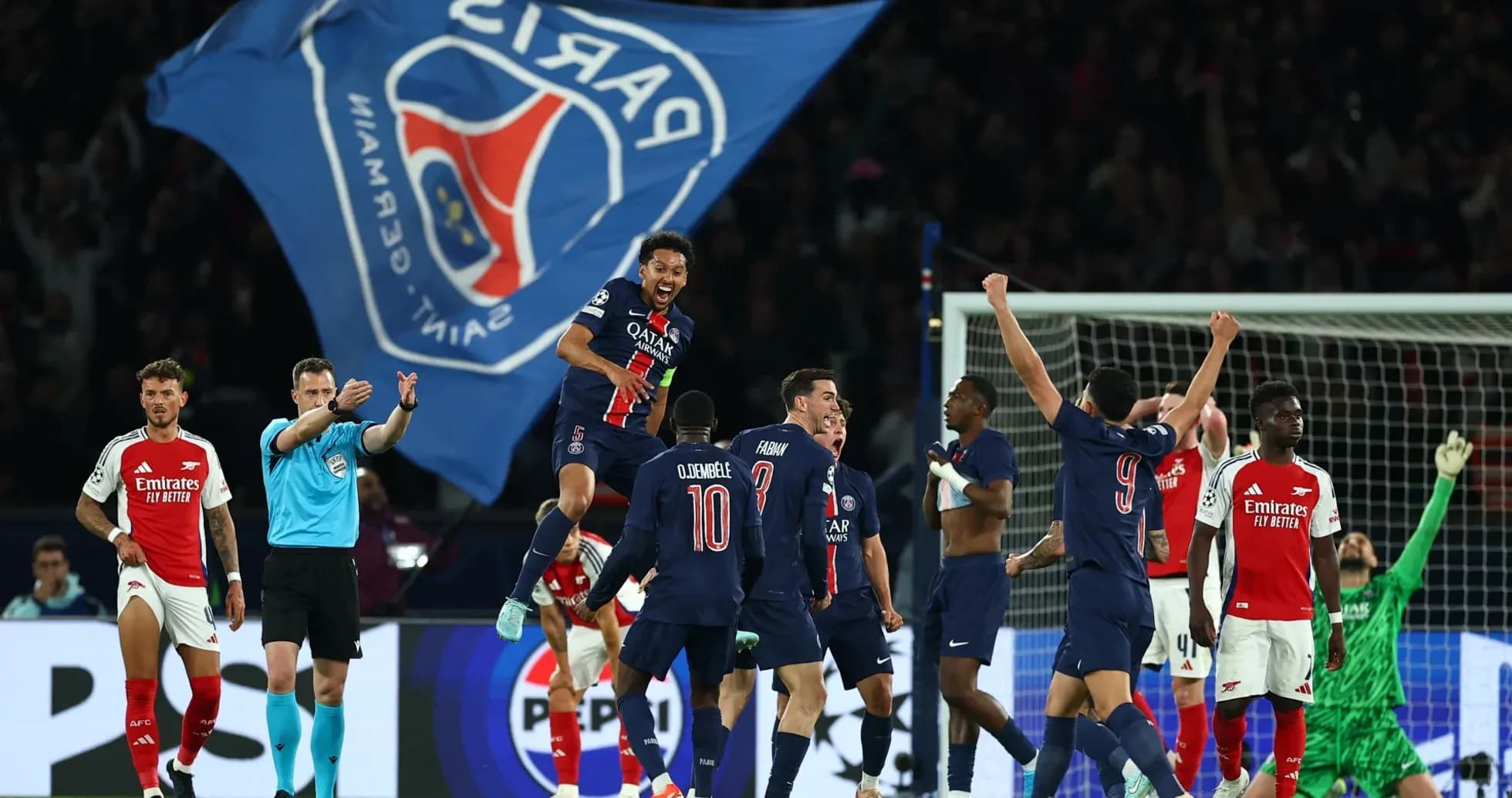
At Puskas Arena in Budapest, Paris Saint Germain and Arsenal meet in the UEFA Champions League Final, with Arsenal arriving as the dominant league-phase side and PSG as the more volatile challenger. In the league phase, Arsenal finished 1st with 24 points from 8 games and a +19 goal difference (23 goals for, 4 against), while PSG came through as 11th with 14 points and a +10 goal difference (21 goals for, 11 against). This turns the final into a clash between the competition’s most complete league-phase performer and one of its highest-ceiling, but less consistent, contenders.
Head-to-Head Tactical Summary
The recent head-to-head history is heavily shaped by Champions League meetings. In 2025, the sides met in the semi-finals: on 29 April 2025 at Emirates Stadium, Arsenal 0–1 Paris Saint Germain (HT 0–1), a cagey away win for PSG built on protecting an early advantage. The return on 7 May 2025 at Parc des Princes ended Paris Saint Germain 2–1 Arsenal (HT 1–0), with PSG edging the tie again at home.
Earlier in the 2024 Champions League league stage, on 1 October 2024 at Emirates Stadium, Arsenal 2–0 Paris Saint Germain (HT 2–0) showed Arsenal’s ability to jump on PSG early and then control the game. In non-knockout context, on 28 July 2018 at The National Stadium (Singapore) in the International Champions Cup, Arsenal beat Paris Saint Germain 5–1 (HT 1–0), a friendly but still indicative of how open this matchup can become when PSG over-commit. Going further back, on 23 November 2016 at Emirates Stadium in the Champions League group stage, Arsenal 2–2 Paris Saint Germain (HT 1–1) reflected a more balanced contest with both sides trading control phases. Overall, Arsenal’s bigger wins have tended to come at Emirates, while PSG’s more recent edge has appeared in knockout ties, including a crucial away victory in London.
Global Season Picture
- League Phase Performance: In the league phase, Paris Saint Germain’s 11th-place finish came with 14 points from 8 matches (4 wins, 2 draws, 2 losses), scoring 21 goals and conceding 11. That output underlines a high-powered attack (21 goals) but a defense that can be exposed (11 conceded). Arsenal, by contrast, were flawless in the league phase: 1st place, 24 points from 8 matches (8 wins, 0 draws, 0 losses), with 23 goals for and only 4 against. Their defensive record (4 conceded) marks them as the most controlled, low-risk side in the competition’s league phase.
- Season Metrics: Scope detection shows team_statistics games played (PSG 16, Arsenal 14) exceed league-phase totals (both 8), so these describe performance across all phases of the competition. Across all phases of the competition, Paris Saint Germain have played 16 matches, winning 10, drawing 4 and losing 2, with 44 goals scored and 22 conceded. That points to a very aggressive but occasionally vulnerable profile (2.8 goals scored and 1.4 conceded on average). Arsenal, across all phases of the competition, have played 14 matches, with 11 wins and 3 draws, remaining unbeaten, scoring 29 and conceding 6 (2.1 scored and 0.4 conceded on average). While explicit possession and xG figures are not provided, Arsenal’s low goals-against and high clean-sheet count (9) suggest a controlled-possession, chance-suppressing approach, whereas PSG’s higher concession rate (22 goals against) indicates a more open, risk-tolerant style.
- Form Trajectory: In the league phase, PSG’s form string “DLDWL” shows inconsistency: only 2 wins in their last 5 league-phase matches, mixed with 2 losses and a draw, reflecting a side that fluctuates between high-impact performances and costly lapses. Arsenal’s “WWWWW” league-phase form is perfect: 5 straight wins, reinforcing an upward, stable trajectory. When combined with their broader unbeaten run across all phases, Arsenal enter the final on a sustained high, while PSG rely more on knockout resilience and individual quality than on a smooth league-phase curve.
Tactical Efficiency
Across all phases of the competition, Paris Saint Germain’s attacking output (44 goals in 16 matches, 2.8 per game) marks them as one of the most explosive units in the tournament, but the 22 goals conceded (1.4 per game) highlight a defense that can be stretched when their front line is blunted. Arsenal’s 29 goals in 14 matches (2.1 per game) are slightly less spectacular numerically, but combined with just 6 goals conceded (0.4 per game) and 9 clean sheets, their efficiency is rooted in balance and control rather than volume.
Without explicit Attack/Defense Index values from the comparison block, the implied picture is clear: any pre-calculated model would rate Arsenal’s defensive index extremely high, supported by their low concession rate and unbeaten record, while their attack, though less prolific than PSG’s, converts pressure into goals at a stable rate. PSG’s attack index would project as elite in raw output, but their defensive index would be moderated by the volume of chances and goals they allow. In tactical terms, Arsenal’s season suggests a high-efficiency, low-variance structure that limits opponent xG and card exposure, whereas PSG accept more volatility: more goals for, more goals against, and a higher card load, particularly late in matches, which can tilt tight games.
The Verdict: Seasonal Impact
This final is the culmination of two contrasting seasonal paths. For Arsenal, victory would crown a campaign where they dominated the league phase (24 points, 23–4 goal balance) and remained unbeaten across all phases, confirming them as the competition’s benchmark side and reinforcing a trajectory towards sustained European contention. A loss, while not erasing their progress, would turn an almost flawless statistical profile into a narrative of missed opportunity at the decisive hurdle.
For Paris Saint Germain, whose league-phase position (11th with 14 points) undersold their knockout potential, winning the final would radically reframe their season: from an inconsistent league-phase performer with a high-risk profile (21–11 goals in the league phase, 44–22 across all phases) into a champion whose attacking volatility proved decisive in the biggest moments. Defeat, by contrast, would reinforce the existing data story: a side with one of the competition’s best attacks but not quite the defensive control or stability to match Arsenal’s title-level standard.
Looking forward, the result will shape the competitive hierarchy. An Arsenal win would consolidate a model built on defensive control and consistent league-phase dominance as the template to beat in future years. A PSG triumph would validate a more aggressive, high-variance approach that leans on knockout pedigree rather than league-phase perfection, signaling that in this Champions League format, peak performance in the final stages can outweigh a less dominant early campaign.