.svg&w=384&q=75 "Pitchgist logo")
2026 World Cup: Seven Nations Battle for Glory
The 2026 World Cup has reached the sharp end. Seven nations remain, six from Europe and one giant carrying an entire continent’s hopes on its shoulders. No more safety nets, no more second chances. One bad night and the dream is gone.
What’s left is a bracket loaded with pedigree, laced with upstarts, and dominated by some of the biggest individual talents the sport has ever seen.
France: Mbappé chases history
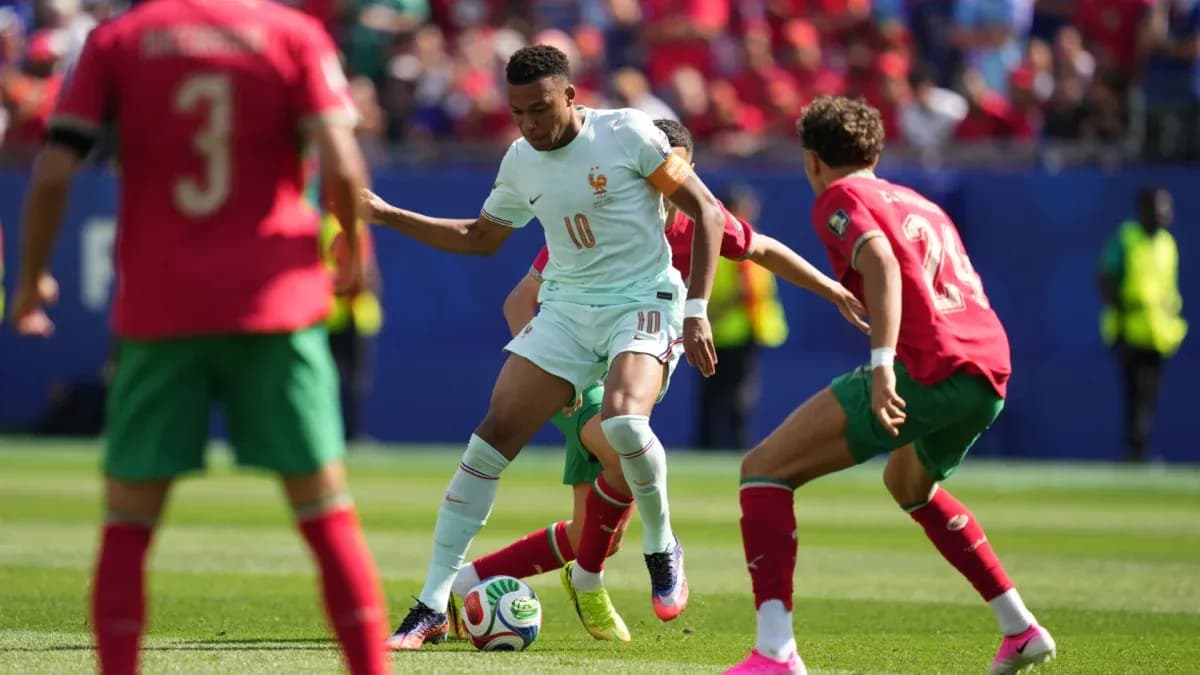
France are already waiting in the semi-finals, businesslike and ominous. A 2-0 win over Morocco on Thursday pushed the two-time champions within two victories of a historic three-peat, and they have barely broken stride getting there.
Les Bleus have not lost a game all tournament. They walked through Group I, dispatching Senegal 3-1, Iraq 3-0, and Norway 4-1. In the knockouts, they shut down Sweden 3-0, squeezed past Paraguay 1-0, then handled Morocco without conceding.
At the heart of it all, again, is Kylian Mbappé.
The captain is France’s all-time leading scorer and the tournament’s most dangerous forward so far. He has already set the pace in the 2026 Golden Boot race and matched Lionel Messi’s mark of 17 non-penalty World Cup goals across his career. He still insists Messi and Cristiano Ronaldo sit above him in the game’s hierarchy, but the numbers keep dragging him into their company.
An ankle scare against Morocco jolted French nerves, yet Mbappé quickly moved to calm them, declaring himself “completely fine.” France will expect him fully fit when they step into AT&T Stadium in Dallas on Tuesday, July 14. Waiting for them will be either Spain or Belgium. Whoever survives that side of the draw must then find a way to stop a striker chasing legends and a team that looks increasingly inevitable.
Spain: La Roja lean on a prodigy
Spain’s route to that showdown runs through Los Angeles.
La Roja face Belgium in the quarter-finals on Friday, July 10, at SoFi Stadium, carrying both history and expectation. World champions in 2010, they arrived in the United States ranked just behind Argentina in FIFA’s standings and have largely played to that billing.
Their Group H campaign built quietly but efficiently: a goalless draw with Cabo Verde, then a 4-0 demolition of Saudi Arabia and a controlled 1-0 win over Uruguay. In the knockouts, they brushed aside Austria 3-0 and edged Portugal 1-0 in a high-stakes Iberian clash.
The name on everyone’s lips is Lamine Yamal.
The 18-year-old right winger entered the tournament still nursing a hamstring injury and admitted he was not yet ready for 90 minutes every game. Even so, his previous performances for club and country had already marked him as Spain’s next great attacking talent. Every touch now feels like a glimpse of what he might become.
If Spain are to get past a rugged Belgium side and then stare down France, Yamal’s growth from promising youngster to decisive match-winner may have to accelerate in real time.
Belgium: Lukaku against the noise
Belgium arrived at this World Cup under a cloud of doubt. They are leaving that behind, step by step, and their 4-1 dismantling of the United States on Monday may have been the moment the noise turned into belief.
On American soil, against a U.S. team buoyed by FIFA’s decision to suspend Folarin Balogun’s red card so he could play — a move Donald Trump publicly claimed involvement in — De Rode Duivels simply tore up the script. The betting markets had leaned towards the hosts. Belgium did not.
Their World Cup began more modestly: a 1-1 draw with Egypt, a 0-0 stalemate with Iran, then a 5-1 thrashing of New Zealand to seize control of their group. In the knockouts, they edged Senegal 3-2 before sending the U.S. home with that ruthless 4-1 win.
Even then, coach Rudi Garcia noted that “everyone thinks [they] are going home.” That line has hung over this team like a dare.
Romelu Lukaku has taken it personally.
Belgium’s all-time top scorer has come off the bench in each of their last three games and scored in all of them, becoming the first player in World Cup history to net as a substitute in four separate matches. Impact player undersells it; he has become their closer, their hammer.
Against Spain, the stakes rise again. Beat La Roja and a semi-final against France awaits. For Lukaku, that means another chance to add records, and perhaps to drag a doubted generation into territory Belgium have long promised but rarely reached.
Norway: Haaland’s moment
Norway stand on unfamiliar ground. A quarter-final at the World Cup is already their greatest achievement, yet the way they have played suggests they are not content to treat this as a sightseeing tour.
Landslaget meet England on Saturday, July 11, at Hard Rock Stadium in Miami. The heat will be fierce, the pressure fiercer.
Drawn with France in Group I, Norway took a heavy 4-1 defeat to the reigning champions but refused to fold. They bounced back with a 4-1 win over Iraq and a dramatic 3-2 victory against Senegal to reach the knockouts. There, they eliminated Côte d’Ivoire 2-1 and then stunned Brazil by the same scoreline.
Those results have turned heads. One name already had.
Erling Haaland, their spearhead, is the obvious focal point. Norway’s all-time top scorer has piled up 60 goals in just 53 senior international appearances, hitting his 60th in the win over Côte d’Ivoire. Messi and Ronaldo needed more than twice as many games to reach that figure.
Haaland shrugs off comparisons with those icons, but his output is impossible to ignore. If he drags Norway past England and into a semi-final, the conversation around him will shift again — from potential heir to active disruptor of the old order.
England: Kane hunts another crown
England know this stage. They also know how quickly it can vanish.
The Three Lions face Norway in Miami with a semi-final place on the line and a possible clash with either Argentina or Switzerland waiting beyond. The path is clear. The margins are not.
They emerged from Group L with authority, beating Croatia 4-2, drawing 0-0 with Ghana, then controlling Panama in a 2-0 win. The knockouts have been tighter: a 2-1 victory over the Democratic Republic of Congo, followed by a 3-2 triumph against Mexico in a game that tested their nerve.
Harry Kane remains their anchor.
England’s captain and all-time leading scorer has six goals at this World Cup, trailing only Mbappé, Messi, and Haaland in the charts. He already owns a Golden Boot from 2018, and his club form coming into the tournament was extraordinary: 73 goals in the 2025-26 season so far, second only to Messi’s legendary 2011-12 haul.
This World Cup offers Kane something different — not just individual awards, but the chance to convert years of near-misses into a trophy that has eluded England since 1966. To get there, he must outgun Haaland in Miami and then survive whatever comes from the other side of the bracket.
Argentina: Messi and the last stand of South America
Six European nations, one South American colossus.
Argentina enter their quarter-final against Switzerland on Saturday, July 11, at Arrowhead Stadium in Kansas as the world’s No. 1-ranked team and the last non-European side standing. They are no underdog, but they are alone.
La Albiceleste have played like a top seed. They swept Group J with a 3-0 win over Algeria, a 2-0 victory against Austria, and a 3-1 success versus Jordan. In the knockouts, they held their nerve in two 3-2 wins, first over Cabo Verde and then Egypt.
Everything still orbits around Lionel Messi.
Head coach and captain, Argentina’s all-time top scorer, and the man many consider the greatest footballer in history, Messi has added fresh chapters to an already swollen record book in this tournament. He now holds the record for most World Cup goals with 21, a tally still rising, and he has become the first player ever to score in eight consecutive World Cup matches.
He was also the first to win the Golden Ball twice, awarded to the tournament’s best player. Now, in what may be his final World Cup, he is pushing for one more deep run with a team built to maximize his genius.
Argentina carry a continent’s hopes and the weight of their own standard. If anyone can bear it, it is the man who has made the extraordinary feel routine for nearly two decades.
Switzerland: Xhaka and the giant-killing dream
Standing in Argentina’s way is a team that has already broken its own ceiling.
Switzerland, ranked 19th in the world, have reached their first World Cup quarter-final since 1954. Now Nati must attempt the improbable: topple the top-ranked side and the sport’s most iconic active player.
Their campaign began steadily in Group B with a 1-1 draw against Qatar. From there, they accelerated, beating Bosnia and Herzegovina 4-1 and Canada 2-1. In the knockouts, they controlled Algeria 2-0, then held Colombia to 0-0 before edging through 4-3 on penalties.
This is a team that trusts its structure and its spine. At the center of that is Granit Xhaka.
The captain and defensive midfielder is not in the side to score goals, yet his influence is everywhere. He has driven Switzerland to this stage with his passing range, his positioning, and his ability to slice through opposition lines to create chances for others. His leadership has underpinned their composure in tight games.
Facing Messi is a thrill for the Swiss players, but they have been clear: they are not here for photographs. Xhaka has already led them back to a stage they have not seen in more than 70 years. Now he aims to take them further, at the expense of a legend.
Seven nations, seven storylines, one trophy. The European powers circle, the last South American giant roars, and the sport’s brightest stars drive the narrative forward. In a tournament where one misstep ends everything, whose story survives the next chapter?