.svg&w=384&q=75 "Pitchgist logo")
Tuchel's Left-Flank Concerns Ahead of Panama Clash
Thomas Tuchel did not bother dressing it up. England’s left side, he said, simply has not been good enough.
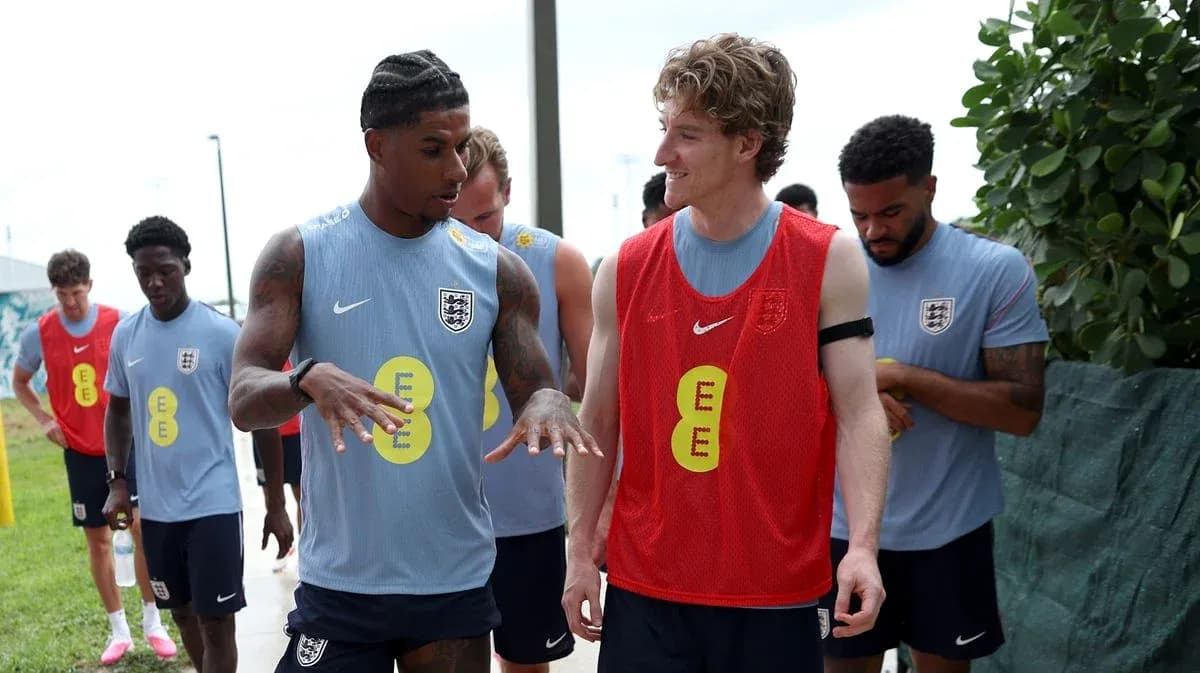
The Three Lions manager tore into his misfiring flank, name‑checking Anthony Gordon, Marcus Rashford, Nico O’Reilly and Djed Spence in a withering assessment that laid bare his biggest concern heading into the final Group game against Panama.
Tuchel’s left‑flank problem
Tuchel thought he had cracked it. Gordon dazzled in the final warm‑up against Costa Rica, the combinations flowed, and the manager walked away convinced the issue was solved.
“I saw the game against Costa Rica and thought: ‘OK, left side is solved, this unit, they find their link,’” he said.
That certainty has evaporated. Two Group matches in, Tuchel sees a flank stripped of its spark.
“The unit on the left side hasn't provided the same quality as they did against Costa Rica,” he admitted. “It was not the same amount of connection, not the same amount of penetration, not the same amount of verticality, and this was the same in the second match.”
Gordon has not reproduced his warm‑up form. Rashford has not convinced when given the chance from the start. Behind them, the full‑back slot has become a revolving door: O’Reilly out, Spence in against Ghana, neither able to ignite that channel.
Tuchel’s frustration is aimed at the collective, not just the winger.
“We had a very good match against Costa Rica with Anthony and the unit, it's more a unit on the left side than it is individuals or ‘the winger didn't do enough,’” he said. “The left side in general, no matter who plays, needs to click a bit more and provide a bit more threat.”
Rashford: weapon or starter?
Rashford sits at the heart of the debate. On talent and reputation, he should be undroppable. On output, Tuchel cannot ignore the contrast between his impact off the bench and his struggles from the first whistle.
“Marcus is in a good place, but when he started he was not as decisive as Anthony, that's just it,” Tuchel said bluntly.
He pointed back to the Costa Rica game again, to the illusion of depth that has yet to carry into the tournament itself.
“Then Marcus came on the left side, together with Eberechi Eze and Djed Spence, and they did so well. So I thought: ‘Oh, we have two units. They know what they're doing and they're clicking.’
“It turns out we played the first match and they're not clicking, I’m not even sure why.”
That uncertainty is striking. Tuchel insists he still trusts all of them, but he also knows what the evidence shows: Rashford is a different animal when unleashed late.
“He struggled to have the same influence for us from the start, and yet from the bench he was always pushing,” Tuchel said. “Marcus is just also very good from the bench, and it's sometimes nice to hold someone back.”
Rashford, he insists, remains “a candidate to start.” The reality, though, is that England go into a decisive Group game with their left side still a riddle.
Wrestling with the low block
The other problem is more familiar. England, like so many elite sides at major tournaments, are running into walls.
Ghana’s deep, disciplined block turned their second Group game into a stalemate and left Tuchel’s team needing to beat Panama at the MetLife Stadium to secure top spot. Ghana are ranked 65th in the world. Panama, at 42, represent a step up on paper. Tuchel expects something similar on the pitch.
“It is difficult to accelerate the match against these low blocks,” he said. “You see this in the Champions League as well, you see it in the Premier League. I saw many matches that looked like this.”
He knows what is missing. Precision. Timing. Ruthlessness.
“It needs this one moment of quality and a bit more precision with the crossing. A bit more timing with the crosses, maybe a bit more awareness with the crosses,” he explained. “Who is arriving with the cross? Are we arriving aggressively enough with the cross? How can we shoot more from outside the box, have a deflection and force this goal in.”
Tuchel freely admits he has not discovered a magic formula.
“I haven’t found the recipe where ‘they do this, then we do this - and then we are fine,’” he said. “Maybe I am proven wrong but I don’t think anyone likes to play against Ghana.”
Ghana celebrated every foray over halfway “like it was a goal,” Tuchel noted. At full-time, they treated the 0-0 as a triumph. England trudged off frustrated. That contrast told him everything about the nature of the contest.
He refuses to treat it as a crisis.
“The highs should not get too high. The lows should not get too low. I don’t think it was a low,” he said. “We did enough to win the Ghana game and we also had to control their counter attacks. Twice they were dangerous. But it is time to believe and time to keep on going.”
Selection questions and a warning text
As soon as the whistle went against Ghana, the debate exploded. Why no Cole Palmer? Where is Trent Alexander-Arnold? Why not a technician like Phil Foden to unlock a packed defence?
Tuchel has heard it all. He is not buying it.
“I cannot engage this after a draw,” he replied when asked directly about the absent playmakers. “Spain had a draw. Brazil had their draw. Portugal had their draw.”
Instead, he leaned on a message that landed on his phone when Ghana appointed Carlos Queiroz.
“Honestly, we had a message from a very famous colleague, a very well respected colleague, after Ghana changed their coach. He texted us: ‘Your most difficult game is now the second game, I tell you that.’”
Tuchel took that seriously. He wants everyone else to do the same.
“So I have a bit of respect for what we’re playing here, and then we need to trust also our players and respect them. It helps no-one if we question things now.
“It’s a reflex, things don’t go well and then the guys on the bench are suddenly the winners or the guys at home are the winners. That’s not it.”
The squad, he stressed, was picked on evidence, not hindsight.
“They made life very difficult for us. We selected a group from the evidence that we had. It cannot be that you’re not selected as a player and suddenly you will be. This is not how it works.”
Panama and the next examination
Now comes Panama, and another examination of England’s patience and imagination.
“We will try to find a very active and aggressive approach now against Panama but we cannot just be stupid and naive,” Tuchel said.
He expects another massed defence, another game of chess in the final third.
“We will face another deep block in another kind of formation. We now see a back five. For many moments in the match we see a back six, we see a back seven.”
The challenge is clear. Break the block, and the group should fall into place. Fail, and the questions over tactics, selections and that malfunctioning left flank will grow louder.
Tuchel has made his verdict on that side of the pitch brutally clear. The response now has to come from the players who own it.