.svg&w=384&q=75 "Pitchgist logo")
Tuchel's Bold England World Cup Squad Decisions
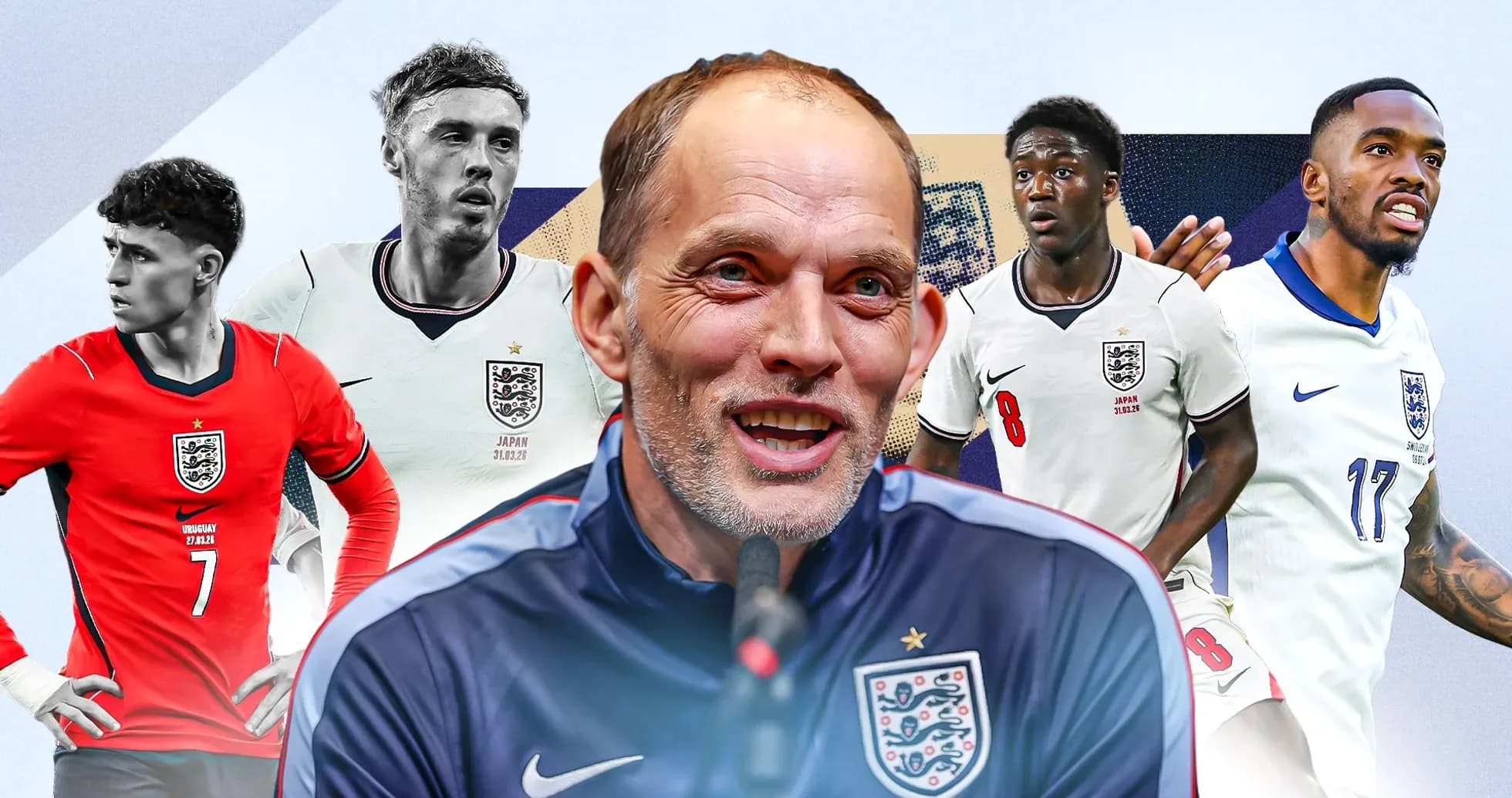
When the World Cup kicks off on June 11, it will be a year and a day since Ivan Toney last pulled on an England shirt – two forlorn minutes in a friendly defeat to Senegal at Nottingham Forest’s City Ground. He disappeared from the international scene after that. No squads, no cameos, barely a mention.
Now he’s back. At a World Cup. As Harry Kane’s deputy.
Thomas Tuchel has swerved sharply, turning to the 30-year-old Al-Ahli striker after a 40-plus-goal season in Saudi Arabia that he could no longer brush aside. For 12 months he did exactly that. Then the goals piled up, the World Cup loomed into view, and Toney’s argument that he is battle-hardened for North America’s heat began to sound a little less like self-promotion and a little more like logic.
The No.10 earthquake
The real tremor, though, hits behind Kane.
Tuchel always had a brutal decision to make at No.10. Morgan Rogers was effectively inked in. Jude Bellingham, with his ability to slide between midfield and attack, never looked in danger. That left a knife fight between Eberechi Eze, Cole Palmer, Phil Foden and Morgan Gibbs-White.
Gibbs-White, despite his form, had long been painted as the outsider. His omission is a disappointment, not a shock. What followed was both.
Palmer out. Foden out.
Two of the most naturally gifted English playmakers of their generation, both watching the World Cup from home. Social media erupted, of course, but strip away the noise and the logic is cold.
Palmer’s season has been a stop-start grind. Injuries clipped his rhythm, England minutes have been scarce since Euro 2024, and only in recent weeks has he resembled the player who once ripped through the Premier League with Chelsea.
Foden’s decline has been longer and more worrying. His form for club and country has sagged since the Euros two years ago, when he drifted through games and many demanded he be dropped. The slump never really ended.
Eze survives. A reward for a debut season at Arsenal that veered between flashes of brilliance and frustrating lulls, but still convinced Tuchel he could trust him when it matters.
The argument will rage that Gibbs-White, Palmer and Foden all offered more off the bench than several who made it. Tuchel’s response is blunt. “We tried to have a balanced squad and not to bring five No.10s and make them play out of position. Because whom would we do a favour with that? The player? Ourselves? I don't think so."
He has chosen structure over stardust.
Mainoo outlasts Amorim – and the pack
Kobbie Mainoo looked finished as an England hopeful halfway through the season. Ruben Amorim, then Manchester United manager, barely glanced in his direction. In a rigid back-three system, the midfielder didn’t fit. Mainoo considered leaving in January.
He stayed. Amorim didn’t.
Michael Carrick’s arrival as interim coach changed everything. Mainoo walked straight back into United’s midfield, played with a calm that belied his 21 years and earned a new contract as he helped drag his boyhood club back into the Champions League.
That surge has carried him all the way into Tuchel’s World Cup squad. He has edged out Adam Wharton and James Garner for the final central midfield berth. He will not dislodge Declan Rice or Elliot Anderson from the starting XI, but he is now on the plane, a late-season revival rewarded.
A few months ago, that felt impossible.
Trent shut out again
For Trent Alexander-Arnold, the writing had been on the wall for some time. It still stings.
Injuries to others seemed to offer him a lifeline, a route back into an England set-up that had cooled on him. Tuchel shut the door again. The Real Madrid right-back stays at home while Djed Spence of Tottenham goes to the World Cup.
The warning came in March, when Tuchel left Alexander-Arnold out of a bloated 35-man squad. This is the full stop on a brutal first season in Madrid. He left Liverpool to chase the Ballon d’Or conversation; instead, he finds his international career stalled, perhaps broken, under this manager.
Ben White is injured. Tino Livramento will only just have shaken off his own fitness issues. Still Tuchel turns away from Trent. The calculation is familiar: the attacking genius against a low block weighed against the defensive lapses that have haunted him for years. Once again, the weaknesses win.
As long as Tuchel is in charge, Alexander-Arnold’s England future looks bleak.
Chelsea’s unexpected winner
Not everyone is mourning these calls.
At Cobham, Xabi Alonso will quietly be delighted. The new Chelsea manager starts work on July 1 with a luxury few international summers allow: almost his entire English contingent available for a full pre-season.
Reece James is the only Chelsea player in Tuchel’s World Cup squad. Palmer stays behind, as do Levi Colwill and long-shot Trevoh Chalobah. For Alonso, that’s a gift. Palmer needs careful handling after an injury-hit campaign. Colwill has only just returned from a serious ACL tear.
With Joao Pedro, Andrey Santos and Estevao all ignored by Brazil boss Carlo Ancelotti, Chelsea’s World Cup travellers are likely to be limited to James, Marc Cucurella, Jorrel Hato, Enzo Fernandez, Moises Caicedo, Pedro Neto and Nicolas Jackson.
The club season may have ended, but Alonso’s work with his core group will start early and uninterrupted.
Maguire’s fall from certainty to shock
Harry Maguire thought he was safe.
A recall for the last international break, a strong second half of the season at Manchester United, and the familiar sense that – whatever the public debate – he remained a trusted figure for England.
Tuchel saw it differently.
The German had already hinted in March that Maguire sat low in his hierarchy and that nothing had changed his mind. Now he has acted, dropping the centre-back entirely. Whispered concerns about Maguire’s ego – that he would not accept a back-up role – have swirled around the decision, along with doubts over his ability to play out from the back in Tuchel’s system.
The response from the player and his camp was immediate and emotional. On the eve of the squad announcement, Maguire posted that he was “shocked and gutted” and insisted he could have played “a major part” this summer. Some of his family echoed the anger.
For Tuchel, those reactions may only reinforce the sense that this group needed a different type of personality at its heart.
O’Reilly’s rise and Tuchel’s gamble
If Maguire’s story is of a reputation slipping away, Nico O’Reilly’s is of one exploding into life.
The 21-year-old has been England’s breakout player of 2025-26, delivering 15 goal involvements from the left side of Manchester City’s defence. Now he heads to the World Cup as the likely starting left-back.
Lewis Hall and Myles Lewis-Skelly, both tipped to travel, have been cut. Many expected at least one of them to push O’Reilly for the role. Instead, the City man has a clear run at making the position his own, with Spence likely to provide cover.
There is risk here. O’Reilly is a midfielder by trade. Tuchel is taking a World Cup squad without a single orthodox left-back. Spence is happier on the right. If O’Reilly struggles under the unique pressure and pace of a major tournament, there is no natural replacement.
Tuchel is betting that talent, form and tactical flexibility will outweigh convention. It is a bold call, even by his standards.
Tuchel’s England, Tuchel’s risk
From the moment he took the job, Tuchel promised to build an England team in his own image, not one shaped by sentiment, social media or history. This squad is the purest expression of that stance.
He has not ducked the big calls. He has embraced them.
Leave out Palmer, Foden, Alexander-Arnold, Gibbs-White, Wharton, Maguire? Accept the fury, the disbelief, the endless debate? He has done it anyway, convinced that clarity and balance matter more than reputations or nostalgia.
On paper, the core is strong. The first-choice XI almost picks itself. Kane up front. A clearly defined No.10 role, with Bellingham and Rogers likely to share the creative burden. Rice and Anderson anchoring midfield. O’Reilly given the left flank to make his own.
There will be no daily drumbeat demanding Palmer starts. No constant argument over Foden’s best position. No confusion about where Alexander-Arnold fits. Tuchel spoke of “clarity” when unveiling his 26-man group, and he has achieved that, at least.
The cost is depth. In a tournament where late substitutes often decide tight knockout games, England will look to Jordan Henderson, Spence and Noni Madueke rather than the more explosive, more fashionable names left behind. That trade-off may define the summer.
Tuchel has taken ownership of this squad in a way few England managers have dared. If they reach the semi-finals or beyond, he will be hailed as the man who cut through the noise and finally imposed a ruthless, coherent plan on a talented generation.
If they fall short, the inquest will start here, with this list of names and the ones missing from it – and the question of whether, in his quest to build the perfect team in his own vision, Tuchel pushed his luck one gamble too far.