.svg&w=384&q=75 "Pitchgist logo")
Tottenham Faces Relegation Threat on Final Day
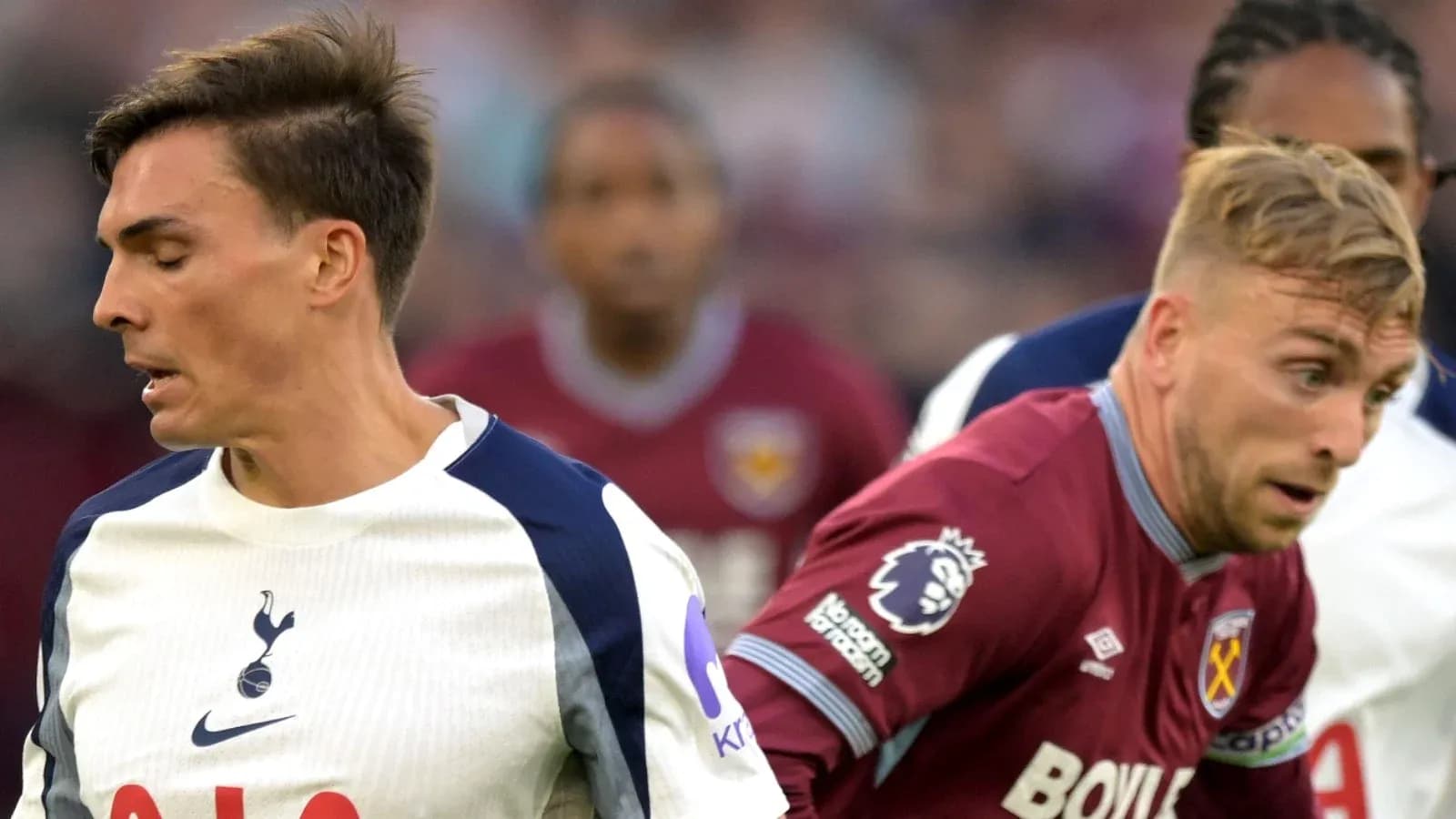
The final day always arrives with a certain madness. Ten games kicking off together, radios hissing out half-heard updates, stadiums twitching at every murmur from elsewhere. Normally you get an absurd 5-4 somewhere that means absolutely nothing. This year, you might get something far more serious: Tottenham Hotspur, a club that once measured itself by European nights and title tilts, staring down the barrel of relegation.
Not a “mathematical possibility” in the abstract. A real one.
Thanks largely to Tottenham being relentlessly, almost artistically Tottenham, the title race has fizzled but the bottom of the table has teeth. The permutations are simple enough: Spurs need a point. West Ham need help. And across the country, ten games will grind through 90 minutes that feel like 900.
Game to watch: Tottenham v Everton
James Maddison called it “embarrassing”. It’s hard to improve on that. Spurs, who finished 17th last season with the same total they sit on now, have contrived to arrive at the final day still sweating. Last year, three teams were cut adrift and the jeopardy never really touched them. This time there are only two truly hopeless cases, and Tottenham have spent the spring methodically dragging themselves into danger.
Last season’s late slump could at least be filed under “Europa League distraction” once safety was effectively secured in February. They leaned into the European campaign, let the league form disintegrate, and got away with it.
There is no such neat alibi now. Just an injury list that has run all year, and a hierarchy that saw the carnage coming in January and folded its arms.
Spurs already had a broken squad by the turn of the year and chose not to act, terrified of looking like they were panicking. They opted for the illusion of calm over the reality of help. It has been a ruinous choice.
The most damning example sits on the right flank. Selling Brennan Johnson early in the window, for good money, felt uncharacteristically decisive. His work at Spurs and then Crystal Palace hardly screams “huge mistake”. But when Mohammad Kudus suffered a serious injury in the very next game, Tottenham simply watched. Three more weeks of the window passed and they never really tried to replace either. If the worst happens on Sunday, that sequence will be pinned to every post-mortem wall.
Even if they survive, the questions do not vanish. Chief executive Vinai Venkatesham and sporting director Johan Lange have overseen a season of startling mismanagement. Scraping to 17th again will not disguise it. A club of this size, with this wage bill, should never be anywhere near this conversation.
Roberto De Zerbi has at least imposed some structure and intent since arriving, but his work keeps slamming into the same brick wall: a thin, short-on-quality attack. Once more he is likely to send out a front three of Richarlison, Mathys Tel and Randal Kolo Muani, and then glance over his shoulder at a half-fit Maddison around the hour mark, praying that when he does turn to him it’s to twist the knife, not to save the season.
Maddison’s brief cameos against Leeds and Chelsea have been revealing. For 20 minutes or so in each game, Tottenham suddenly looked like a functioning attacking side again. He is clearly nowhere near full sharpness, but even at 70 per cent he has made everyone around him look better – and, by extension, exposed just how little invention this squad has without him.
On paper, the task is straightforward. One point keeps them up, unless West Ham put 12 past Leeds, which would be a level of cosmic cruelty even Spurs might struggle to summon. Everton, chasing Europe a few weeks ago, have run out of steam. They have not won since early March and those hopeful Thursday nights at the Hill-Dickinson have drifted out of view.
Yet nobody who has watched Tottenham this season would use the word “guarantee”. This is a side whose confidence lives on a knife-edge. Under De Zerbi, they have crumpled at Sunderland and Chelsea after conceding first, having been relatively comfortable before the setback. Against Leeds at the Tottenham Hotspur Stadium, they went from cruise control to rattled and second best as soon as the visitors equalised.
The pattern is clear. Spurs do not respond to punches; they fold. Which is why the first goal on Sunday feels enormous. Score it, and the nerves might just loosen. Concede it, or even hear that West Ham have struck early, and the tension inside that stadium will become something suffocating.
You can picture it already: a murmur, then a roar, then a howl as word of a West Ham goal seeps through. Every sideways pass greeted with groans, every misplaced touch with fury. A squad already fragile, suddenly playing not just Everton but the noise in their own heads.
There are nine combinations of results between Tottenham and West Ham that settle relegation. Eight of them keep Spurs safe. The odds, by any rational measure, favour them.
But rationality and Tottenham have rarely shared the same postcode. You do wonder whether there is one last catastrophe left in this group, one final implosion to outdo all the others.
If they do find a way to lose, the spotlight swings instantly to…
Team to watch: West Ham
West Ham’s fate is not their own. That much is clear. They face Leeds, who on current form present a far stiffer examination than Everton. Yet after their abject surrender at Newcastle last weekend, even having a puncher’s chance on the final day feels like a reprieve.
The equation for them is brutally simple: win, and hope. Hope that Leeds, with nothing tangible to chase, drift through the afternoon in end-of-season mode. Hope that Spurs, with everything to lose, seize up.
The problem is that Leeds do not look like a team built for flip-flops and cigars. They had nothing at stake last weekend either, and still rolled over a Brighton side with everything on the line. Eight games unbeaten tells its own story. This is not a group that has been in the habit of gifting wins to anyone.
So West Ham must produce the performance they conspicuously failed to deliver at St James’ Park. No more half-measures, no more vague talk of “reaction” followed by the same old errors. This is an all-or-nothing occasion that demands an all-or-nothing effort.
The plan almost writes itself: strike early, crank up the pressure on Tottenham, and see what happens when the anxiety in north London meets the roar in east London. It is long-shot territory, yes, but not fantasy. If West Ham take care of their job, the mathematics and the psychology leave just enough room for chaos.
Manager to watch: Pep Guardiola
Away from the bottom, another farewell. For the final time, Pep Guardiola steps out onto a Premier League touchline. Like Sir Alex Ferguson, Arsène Wenger and Jürgen Klopp before him, it is almost impossible to picture him prowling any other technical area in this league. This has been his stage for a decade.
The game itself, against Europa League winners Aston Villa, is stripped of jeopardy. Manchester City’s spluttering draw at Bournemouth – a point that flattered them – killed off any last chance to turn Arsenal’s title procession into a stumble. The champions’ lap will be undisturbed.
Guardiola leaves with a domestic cup double and a squad in transition that still found ways to win. By most standards, that is a strong season. By his own, it is something less than that. This is the man who normalised 95-point title races, who collected six championships in seven seasons and made excellence feel routine.
The final two years have not hit that bar. One season without a title challenge, another with a patchy one that never truly convinced. It will irritate him, you suspect, that his last act in England is not a coronation but a handover.
Yet his place in the league’s history is secure. He walks away as the second-greatest manager the Premier League has seen. Given who occupies top spot, that is not a bad epitaph.
Player to watch: Mohamed Salah
Another goodbye, this one more sour than sentimental. Mohamed Salah, a Liverpool and Premier League great by any reasonable measure, has spent his final season at Anfield in a permanent scowl. Without Trent Alexander-Arnold dovetailing behind him, he has often looked marooned on that right flank, his influence dulled, his frustration increasingly public.
The football has been patchy; the optics worse. Post-match interviews have turned spiky, social media posts have stoked debate, and the farewell of another modern icon feels unnecessarily messy, echoing the cloud that hung over Alexander-Arnold’s own departure a year earlier.
From a neutral’s perspective, though, Salah remains unmissable. He has become a story within the story. As Liverpool chase the single point they need to secure Champions League football, he will dominate the narrative whether he starts, sulks on the bench, drifts on for half an hour or doesn’t appear at all.
On a day when all 20 Premier League sides are in action, he is still the player everyone will be checking for. Sometimes the most compelling figure is the one not on the pitch.
Football League game to watch: Hull City v Southampton Middlesbrough
Wembley never needs help to make the Championship play-off final feel enormous. The stakes – promotion, and the £200m windfall that comes with it – do that all by themselves. This year, though, the drama has been laced with farce.
Southampton’s Spygate fiasco has been expensively stupid. No cutting-edge surveillance, no Hollywood cloak-and-dagger. Just a staffer with a phone, caught in the most small-time way imaginable, and a punishment that has bitten hard. The price of that idiocy could be counted in nine figures.
Middlesbrough, cast as victims in one sense, have been remarkably fortunate in another. While the debate rages over whether Southampton’s sanction fits the crime, there is an equally valid argument that Boro have enjoyed a remarkable reprieve.
The real innocents are Hull City. They did everything the old-fashioned way: turned up for their semi-final, won it over two legs, prepared for Wembley. And then waited. While Southampton and Middlesbrough at least knew they would either be there or not, Hull had to plan for a final without knowing their opponent until less than 72 hours before kick-off.
Southampton cheated. Middlesbrough lost. Traditionally, the latter ends your season. Yet both will line up at Wembley, and Hull are the ones who have had their preparations shredded by the fallout.
Football, with its unerring sense of mischief, tends to lean into these scripts. You can almost see it now: Middlesbrough, the semi-final losers, riding the wave of controversy and walking away with promotion, the first team in play-off history to do so from that position.
European game to watch: Bayern Munich v Stuttgart
Across the border, Harry Kane stands in another final, chasing another medal. Bayern Munich, runaway Bundesliga champions, face holders Stuttgart in the DFB Pokal showpiece.
It is easy to treat a Bayern win as a formality, but the cup has not belonged to them for a while. Their last Pokal triumph came in 2020, their 20th in total. They have not even reached the final in the five seasons since.
Stuttgart arrive with momentum of their own. They lifted the trophy last year, their fourth success, and now stand in back-to-back finals for the first time. Twice before, in 1986 and 2013, they have run into Bayern at this stage and lost.
Kane, Stuttgart, Bayern, history. For once, the script in Germany is not entirely pre-written.
Back in England, though, all eyes will keep flicking to that scoreboard in north London, to a club that has made chaos its calling card. With eight out of nine outcomes in their favour, can Tottenham finally do the simple thing – or will they find a new and spectacular way to fall?