.svg&w=384&q=75 "Pitchgist logo")
Ternana W's Statement Win Against AC Milan W
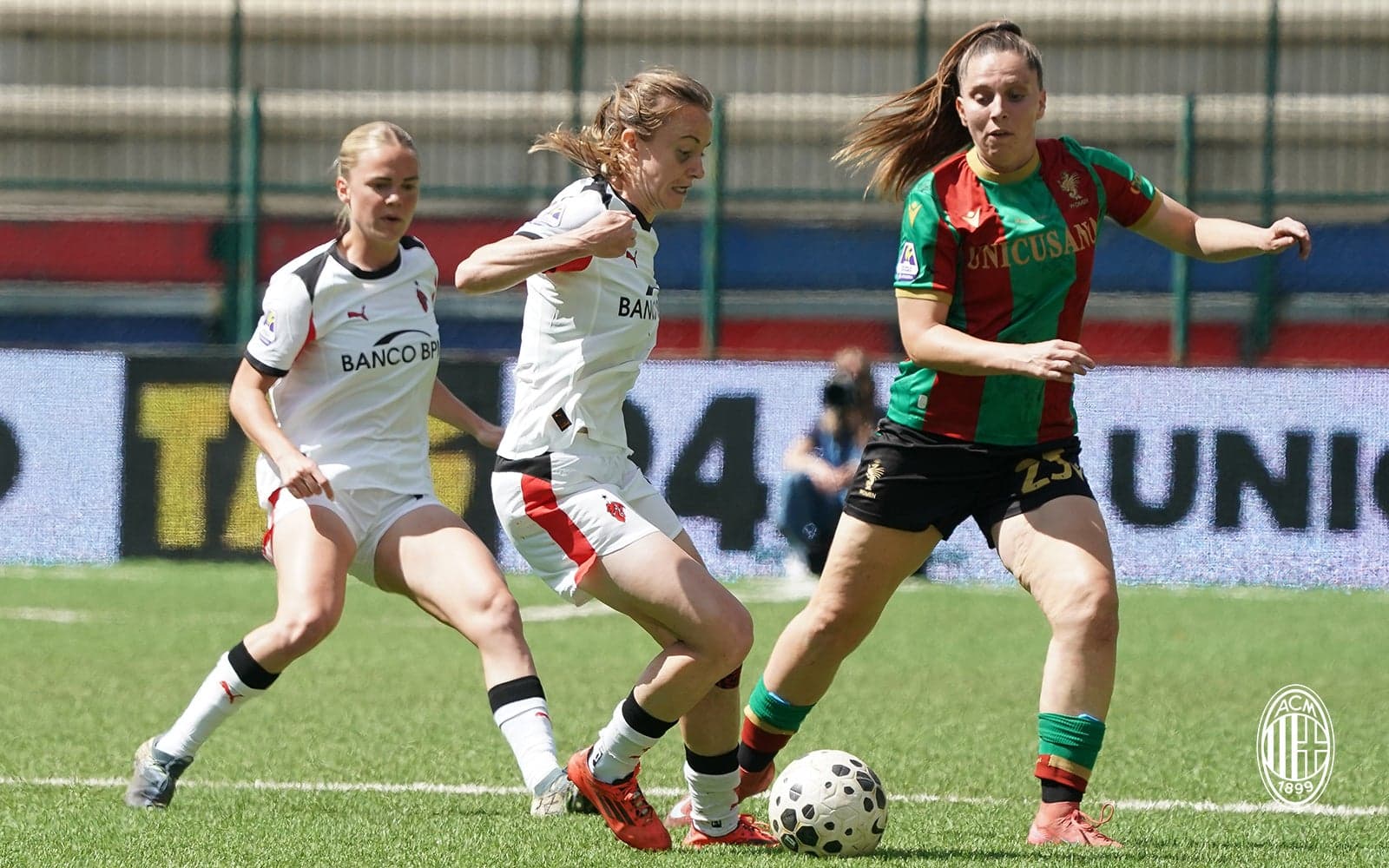
Under a bright May sky at Stadio Libero Liberati, Ternana W closed their Serie A Women campaign with the kind of statement win that reshapes a dressing room’s belief. A 1–0 victory over AC Milan W might look slender on the scoreboard, but in context it felt like a season-long arc finally snapping into focus: a team that had suffered, tightened up, and then, on the final day, outlasted a more established opponent.
Heading into this game, the table told a stark story. Ternana sat 10th with 17 points and a goal difference of -21, their overall record a fragile 4-5-13. Yet at home they had been a different animal: 3 wins, 4 draws, 4 defeats, with 15 goals for and 17 against. On their travels, Milan arrived as a solid mid-table force, 7th with 32 points and a positive goal difference of 5, having won 4, drawn 2 and lost 5 away, scoring 13 and conceding 11. This was a clash between a relegation-battler that leaned on its own ground and a visitor whose away numbers spoke of control and balance.
I. The Big Picture – A season distilled into 90 minutes
The match itself, finished in regular time under the watch of referee M. Picardi, unfolded as a tight tactical duel. The goalless first half reflected the season’s pattern: Ternana often needing time to grow into games, Milan comfortable keeping contests in their structure. Ternana’s season-long averages framed the stakes: overall they had scored 19 and conceded 40, while Milan’s total of 31 for and 26 against underlined their comparative stability.
The final 1–0 scoreline, however, inverted the expected script. Milan, who on their travels had averaged 1.2 goals for and 1.0 against, were shut out by a Ternana side whose overall defensive record (1.8 goals against per game) had been one of the league’s softest. This was less about chaos and more about a collective recalibration.
II. Tactical Voids and Discipline – Edges at the margins
There were no listed absentees, so both coaches could lean into their preferred profiles rather than emergency solutions. For Mauro Ardizzone, that meant a spine built on resilience and experience. K. Schroffenegger started in goal, shielded by a back line including E. Pacioni, M. Massimino, L. Peruzzo and S. Breitner. Ahead of them, the double utility of C. Ciccotti and A. Regazzoli provided ballast, while M. Porcarelli and A. Gomes offered verticality and counter-threat.
Suzanne Bakker’s Milan, by contrast, resembled a possession-first unit. S. Estevez anchored from the back, with E. Koivisto and M. Keijzer giving width and progression from deep. In midfield, V. Cernoia and M. Mascarello carried the responsibility to set tempo, while C. Grimshaw and T. Kyvag were asked to join the front line and break Ternana’s compact shape.
Discipline, for both sides, has been a season-long subplot. Ternana’s card profile shows a worrying late-game spike: 25.00% of their yellow cards coming between 76–90 minutes, and both of their red cards arriving in the 31–45 window. Milan mirror that late-game edge, with 30.00% of their yellows in the final quarter-hour and red cards distributed across 46–60, 61–75 and 76–90. This was always likely to be a match where the final stretch would be as much about emotional control as tactical detail – and Ternana, for once, kept their nerve when it mattered.
III. Key Matchups – Hunter vs Shield, Engine Room vs Enforcer
The season’s “Hunter vs Shield” narrative was embodied more by profiles than by direct duels. For Ternana, the attacking identity has revolved around V. Pirone, the league’s joint-sixth-rated forward. Overall, Pirone produced 6 goals and 1 assist, with 23 shots (9 on target) and 14 key passes. Crucially, she won 5 penalties and converted 5, but also missed 1 – a reminder that even her ruthlessness carried a human margin. Against a Milan defence that, away, had allowed only 11 goals in 11 matches, the idea was clear: draw contact, live off transitions, and let Pirone’s penalty-box craft tilt the odds.
On the other side, Milan’s main scoring reference across the season was K. van Dooren, with 5 goals from midfield and 18 shots (12 on target). Yet she did not appear in the starting XI here, pushing more creative responsibility onto C. Grimshaw and E. Kamczyk. Grimshaw, one of the league’s top assist providers with 2 assists and 11 key passes, became the de facto conduit between Milan’s structured build-up and their front line.
The “Engine Room” duel crystallised around Grimshaw and Mascarello against Ternana’s rotating midfield cast. Mascarello’s season numbers – 368 passes at 77% accuracy, 15 key passes, and 4 yellow cards – mark her out as Milan’s metronome and enforcer rolled into one. Opposite her, Ternana’s Giada Cimò (not in this matchday squad but central to their season identity) had been the all-action heartbeat: 3 goals, 1 assist, 25 tackles, and 72 duels won overall. Her season-long presence has clearly influenced how Ternana now defend and break; that tactical DNA could be seen in how Ciccotti and Petrara snapped into duels and refused to let Milan’s midfield settle.
At the back, the “Shield” role for Milan was epitomised by M. Keijzer. Across the season she had made 23 tackles, 3 successful blocks and 10 interceptions, winning 41 of 77 duels overall. Yet her inclusion in a back line that ultimately conceded the game’s only goal underlined the fine margins: one misread cross, one slow cover, and the numbers give way to narrative.
IV. Statistical Prognosis – xG in disguise and the defensive turn
Without explicit xG values, the Expected Goals story has to be read through structure and season trends. Milan, averaging 1.4 goals per game overall and 1.2 away, typically generate enough volume to score at least once. Ternana, with only 0.9 goals per game overall but 1.4 at home, tend to need a controlled game-state to create high-quality chances.
This match followed Ternana’s preferred script. They leaned into their improved home attacking average, trusted Schroffenegger’s command of the box, and compressed space between lines. Milan’s away defensive average of 1.0 goals against per game held roughly true, but their attacking baseline did not. Ternana’s defensive block, marshalled by Pacioni and Massimino, finally performed like a unit that had learned from a season of punishment.
Following this result, the raw numbers still say Milan are the more rounded side across the campaign. But the tactical lesson belongs to Ternana: when their defensive concentration holds for 90 minutes and their front line is allowed to play in shorter, sharper bursts, they can drag even a positive-GD side into a game decided by one moment.
In narrative terms, this 1–0 is less an upset and more a culmination. A team with a -21 overall goal difference, conceding 1.8 goals per match across the season, finished by delivering a clean sheet against a top-seven attack. The story of Stadio Libero Liberati on this final day is simple: structure, discipline and a single decisive strike can, for one afternoon, override an entire season’s statistical gravity.