.svg&w=384&q=75 "Pitchgist logo")
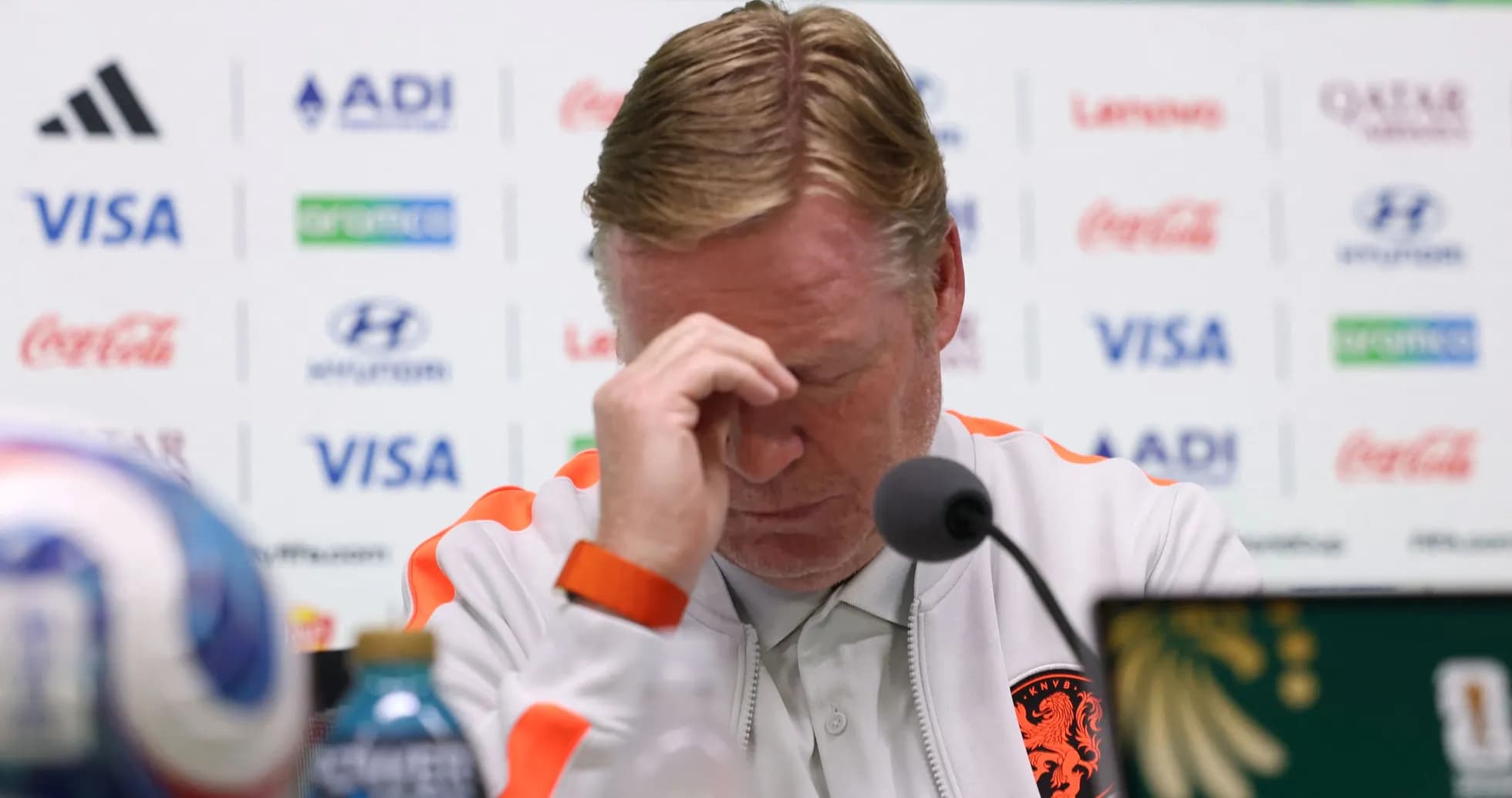
Ronald Koeman Steps Down as Netherlands Head Coach
Ronald Koeman has never been afraid of big decisions. As a player, he struck the free-kick that sealed a European Cup. As a coach, he walked into some of the most pressurised jobs in European football. But the choice he revealed this week, taken alone in the quiet of the previous night, cuts far deeper than any tactical gamble.
The 63-year-old has stepped down as head coach of the Netherlands and openly admitted he may be walking away from the dugout for good, his life reordered by a family health battle that has stripped football of its usual importance.
“Last night I took the decision to end my stint as head coach of the Dutch national team,” Koeman announced on Instagram. The sentence landed with the blunt finality of a whistle. No committee, no long goodbye. His call. His responsibility.
The context is brutal. The Oranje had travelled with the shared dream of “making history at this World Cup”, as Koeman put it, and fell short. For a man who has lived his entire adult life under the floodlights, the failure bites hard. “No one is more disappointed by that than I am. As head coach, the responsibility ultimately rests with me.”
This is not the usual, polished exit statement of a coach manoeuvring towards his next contract. Koeman’s words carry the weight of a man who has watched the game he loves shrink in the shadow of something far more serious.
“The past few years have made me realise once again that there are more important things than football,” he wrote. “Football has been my life, but health is priceless. When someone you love dearly is fighting a tough battle, your perspective changes.”
At the centre of that perspective stands his wife, Bartina. Koeman laid bare how her illness, and her response to it, has quietly underpinned his final years on the touchline. “Despite her own illness, my wife Bartina supported and encouraged me every day to finish my work as head coach. That shows incredible strength. I am more grateful to her for that than I could ever put into words.”
For a figure often judged in terms of systems and selections, it was a rare, moving glimpse behind the public façade. The image is not of the stern tactician in a technical area, but of a husband watching his partner fight, and deciding that the next phase of his life belongs with her, not with the Oranje.
Koeman did not leave without turning back to the dressing room one last time. He reserved warm words for the players who carried his ideas onto the pitch. “I want to thank all the players I had the pleasure to work with. Your efforts, character, and confidence have motivated me every day.” That line reads like a coach who still feels the daily rhythm of training, the small improvements, the shared frustrations.
He widened that gratitude to his staff, the KNVB, the unseen workers who keep a national team moving, and the clubs that released their players into his care. And then, as every Dutch coach must, he addressed the people in orange.
“But above all thanks to the supporters. For being supportive even in times when it was difficult. It was a great honor to be able to represent the Netherlands as a head coach.” Honor, not burden. Even in disappointment, he clings to that.
Koeman admitted he leaves with “mixed feelings”. How could it be any other way? This is a man who once dreamed, quite realistically, of lifting a world title as the figurehead of a footballing nation that helped define his career. “Naturally, I would have preferred to conclude my time with the Oranje with a world title. Unfortunately, that dream remained unfulfilled.”
Yet he refuses to walk away bowed. “Above all, pride prevails,” he insisted. Pride in what football has given him. Pride in the people he has met. Pride in the extraordinary privilege of turning a childhood passion into a lifetime’s profession.
“Thank you for all those years of trust, criticism, support, disappointments, successes, and so on,” he concluded. It is a line that captures the full, messy arc of a football life: the cheers and the boos, the trophies and the near-misses, the scrutiny that never really stops.
If this is the last time Ronald Koeman steps away from a dugout, he does so on his own terms, guided not by the roar of a crowd but by the quiet, unshakeable pull of home.