.svg&w=384&q=75 "Pitchgist logo")
Cristiano Ronaldo's World Cup Journey: Triumphs and Trials
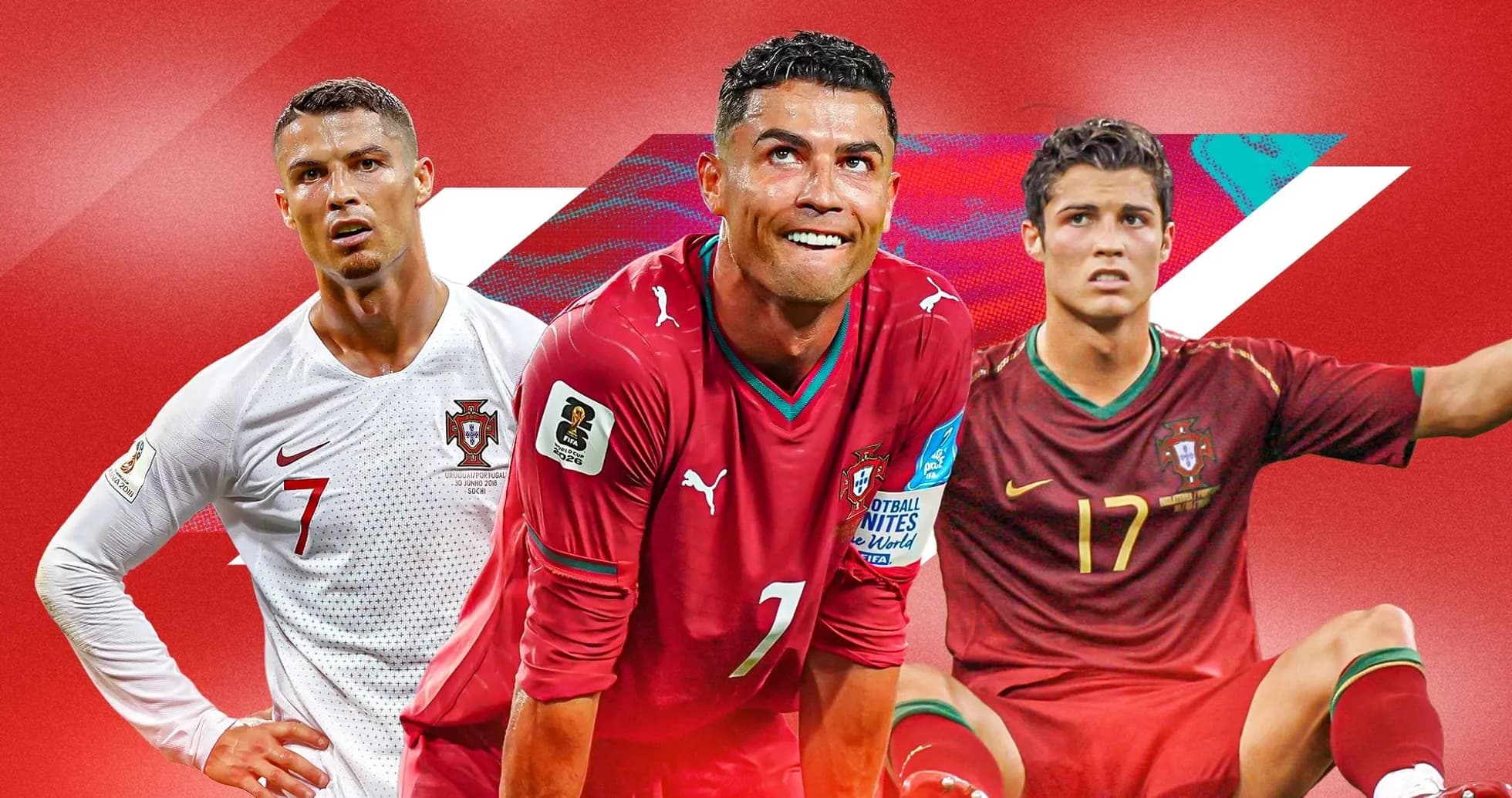
Cristiano Ronaldo’s World Cup story has never been a straight line. It has been talent and turmoil, goals and glares, a career-long argument played out on the biggest stage football can offer.
It began in 2006 with history. A 21-year-old winger, still more stepovers than statistics, became Portugal’s youngest-ever World Cup scorer when he rolled in a late penalty in a 2-0 win over Iran. One goal. That was it for the tournament. Nobody made much of the lack of end product. He was raw, electric, and part of a team that finished fourth. The conversation quickly moved away from his finishing to something else entirely: his character.
Germany turned on him. Every touch in the semi-final against France drew a chorus of boos, the fallout from Wayne Rooney’s red card in the quarter-final against England. Ronaldo had sprinted towards the referee after Rooney’s foul on Ricardo Carvalho. He then appeared to wink towards the Portugal bench once the dismissal came.
In England, the reaction was venomous. Steven Gerrard accused him of being “bang out of order” and said he would be “absolutely disgusted” if Ronaldo were his team-mate. Frank Lampard questioned how a Manchester United colleague could act like that towards Rooney. The sense of betrayal was as strong as the sense of injustice.
Ronaldo insisted he had done nothing wrong. FIFA’s technical study group took a different view. In the name of sportsmanship, they handed the young player of the tournament award to Lukas Podolski instead of the Portuguese prodigy. Holger Osieck, the group’s head, made the message clear: behaviour mattered, and players were supposed to be role models.
By 2010, Ronaldo had become captain, the face of a nation rather than just its future. The responsibility weighed heavily. Portugal went out with a whimper in the last 16, beaten 1-0 by eventual champions Spain. Ronaldo’s only goal in South Africa came in a 7-0 demolition of North Korea, his first for the national team in 16 months. For a man already judged by his numbers, that drought was brutal.
The exit hurt him. “Completely disconsolate, frustrated and an unimaginable sadness,” he said afterwards. Then came the flashpoint. Asked to explain the defeat, he was caught on camera saying: “Ask that question of Carlos Queiroz.” At home, the line landed badly. It looked like a captain throwing his coach under the bus.
Ronaldo later tried to cool the storm, insisting he meant no disrespect and stressing his right to suffer in private. He reminded everyone that he understood his responsibilities as captain and would always accept them. Queiroz was less forgiving. He spoke of never tolerating anyone placing themselves above the national side, warning that if the Portugal shirt unnerved a player, they had no place in the team. He also underlined the mutual dependency: Portugal needed Ronaldo, and Ronaldo needed Portugal.
Four years later, that relationship was tested again. Ronaldo dragged his country to the 2014 World Cup almost single-handedly, scoring all four goals across two epic play-off games against Sweden. He arrived in Brazil insisting he was “100 percent fit” despite knee and thigh concerns. The pitch told a different story.
He was a shadow of himself in the 4-0 collapse against Germany. He created Silvestre Varela’s late equaliser against the United States and then scored the winner against Ghana, but the damage was done. Portugal finished third in Group G and went home early.
The criticism came as predictably as the goals once had. Missed chances, heavy legs, questions over whether he had tried to play through too much pain. Coach Paulo Bento refused to make Ronaldo the scapegoat. He spoke of collective errors over three games, took responsibility himself and refused to “deem one player responsible”. Ronaldo, he said, was usually ruthless; this time, it just had not happened.
Russia in 2018 looked like a rebirth. Ronaldo exploded into the tournament with a hat-trick in a wild 3-3 draw against Spain, including his first free-kick goal at a major international tournament. One man, one game, and the World Cup had its headline act again.
He called it a personal best but shifted the spotlight onto the team, stressing the value of a point against one of the favourites and expressing confidence that Portugal would go far. The optimism faded quickly. Portugal reached the last 16, but Ronaldo failed to score or assist in the knockout stage. Uruguay beat them 2-1 in Sochi, and the questions returned, this time wrapped in the reality of age. He was 33. Was that his final World Cup act?
Ronaldo refused to answer. He told FIFA it was not the right moment to talk about his future, but backed the squad’s quality, ambition and youth. It sounded like a man leaving a door ajar, not slamming it shut.
By Qatar 2022, the narrative had shifted again. He arrived under a cloud, his second spell at Manchester United having ended in acrimony. This was supposed to be the last great mission: silence the critics, win the one trophy missing from his collection, rewrite the ending.
Instead, the World Cup mirrored the chaos at club level. He scored from the penalty spot against Ghana in the opening game, but his performances faded. When Fernando Santos substituted him in the shock group-stage defeat to South Korea, Ronaldo’s furious reaction was there for the world to see.
Then came the moment that shook Portugal. Santos dropped him for the last-16 clash with Switzerland. Goncalo Ramos came in, scored a hat-trick, and Portugal ran riot in a 6-1 win. Reports emerged that Ronaldo had threatened to leave the camp. His body language, his substitutions, his stares – everything fed the idea of a superstar struggling to accept a reduced role.
After the quarter-final defeat to Morocco, he walked straight down the tunnel in tears. The next day, he tried to reclaim the narrative. On social media, he insisted his dedication to Portugal had never wavered, that he would never turn his back on his team-mates or his country. He thanked Portugal and Qatar, then left a final line hanging: time would be the adviser; others could draw their own conclusions.
Most drew the same one. At 37, with only a single penalty goal in the tournament and no knockout-stage impact, many believed the World Cup chapter had closed. Ronaldo himself wrote that his dream of winning it for Portugal had ended. Five tournaments, 16 years, everything left on the pitch, and still that one prize out of reach.
Yet here he is again.
In a 5-0 win over Uzbekistan, the final whistle had barely sounded when Ronaldo turned to the nearest camera and roared: “I’m back! I’m back!” It was pure theatre, a familiar defiance. Not everyone bought it. He had been poor in the opening draw with DR Congo, and Uzbekistan, ranked 60th in the world, were hardly elite opposition, even if he scored twice.
The caution proved justified when a more serious test arrived. Against Colombia, who calmly held Roberto Martinez’s side to a 0-0 draw in Miami and took top spot in Group K, Ronaldo struggled again. The old burst, the inevitability in front of goal, flickered rather than burned.
Now comes Croatia. Luka Modric’s team is ageing, creaking in places, but still clever, still dangerous. The same description fits Ronaldo. At 41, he has already shown he can still score at a World Cup. What he has never done is score in a World Cup knockout game.
For two decades, he has bent careers, clubs and competitions to his will. This time, the task is narrower and more brutal: one goal, on the stage that has always eluded him when it matters most.
Over to him.