.svg&w=384&q=75 "Pitchgist logo")
Real Madrid's Pursuit of Rodri: A Gamble or a Strategic Move?
For a club that calls itself “the biggest in the world”, Real Madrid live off an addiction: the next superstar. The next statement. The next summer that feels like a coronation.
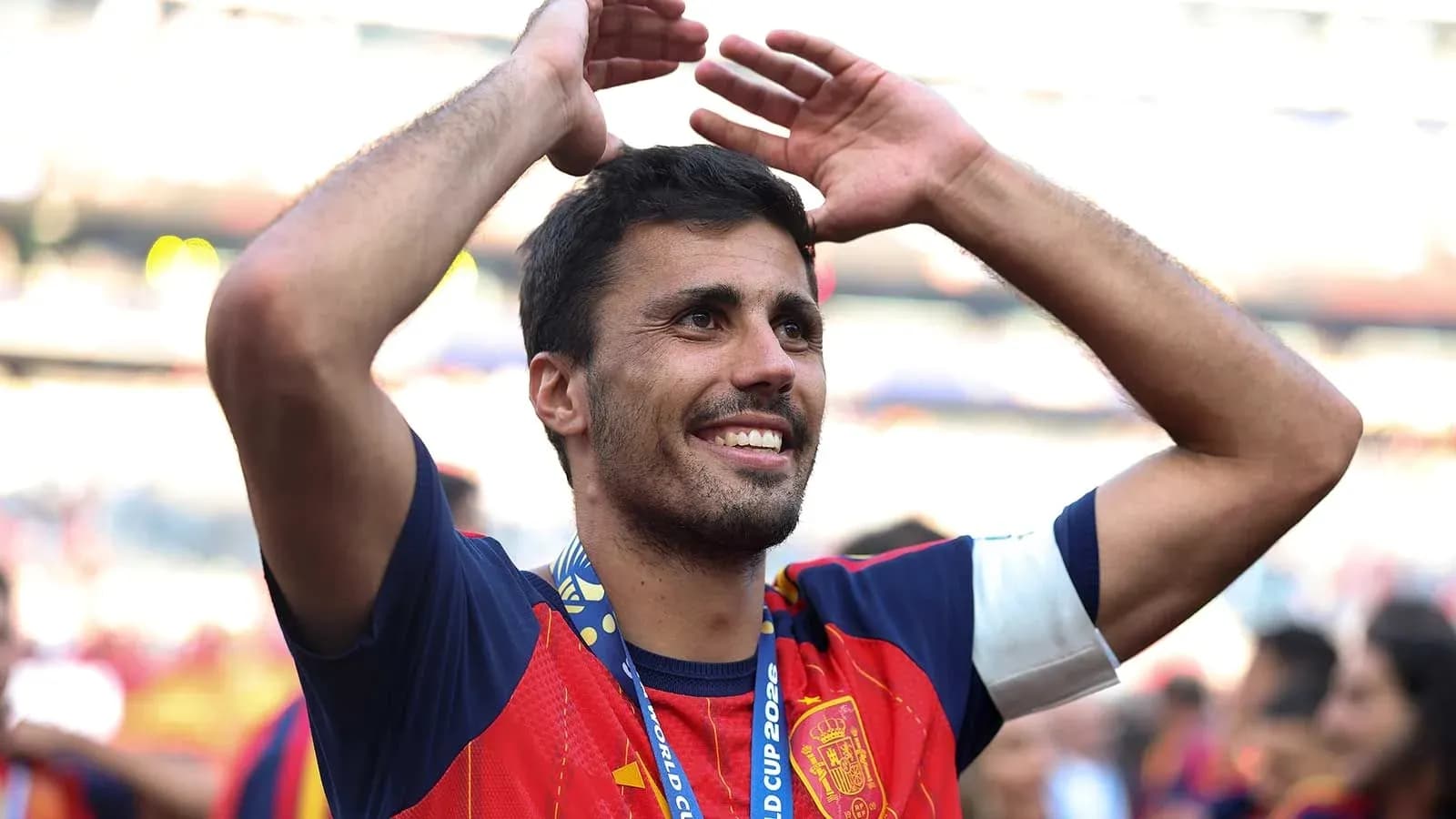
So when Rodri walked away from Spain’s World Cup triumph in North America with the best player of the tournament award, it did more than burnish his reputation. It lit up the radar in the president’s box at the Santiago Bernabeu. If you’re Real Madrid and you watch that level of control on the biggest stage, you at least make a few calls.
Whether you should actually sign a 30-year-old recovering from serious injury for a nine-figure fee is a different debate.
Perez’s Promise and the Transfer That Never Came
This whole Rodri saga is tangled up with one man: Florentino Perez.
At the start of June, the Real president was still locked in an election battle with Enrique Riquelme. He won comfortably, but not before promising something spectacular. Perez told members he wanted to put €150 million on the table for a top star, explicitly evoking the calibre of Cristiano Ronaldo or Kaka. It was a classic Perez flourish, designed to stir memories of the galactico era and soothe a fanbase scarred by two trophyless seasons.
The reality has been less romantic.
That €150m figure was quickly attached to Julian Alvarez, with Real reportedly preparing to pay Atletico Madrid that amount. Their city rivals, unimpressed and unconvinced, shut the door. Hard. The feeling in Madrid and beyond was that the offer was as much political theatre as genuine bid.
The blockbuster never landed.
Instead, Real turned to volume. Jose Mourinho returned to the Bernabeu, a familiar face with a familiar promise of steel and siege mentality. On the pitch, Marc Cucurella arrived from Chelsea and Denzel Dumfries from Inter Milan, the pair costing around €75m between them. Ibrahima Konate joined from Liverpool on a free, as did Bernardo Silva from Manchester City, the Portuguese playmaker now 31 and very much a short-term luxury.
Useful players. Experienced players. But not the kind of signing that makes a club reprint its season-ticket brochures.
Rodri would.
Rodri: Control, Risk and a Tactical Earthquake
On pure footballing merit, the case is simple. Even after an anterior cruciate ligament rupture in 2024, Rodri remains one of the most complete midfielders in the world. At the World Cup in the USA, Canada and Mexico, he again showed why. He dictated games, set the tempo, and made elite opponents look like they were playing to his rhythm.
Manchester City know what they have. According to Sky Sport, they have offered him a new contract beyond his current deal, which runs until 2027. So far, there is no agreement. The same report says Real have put a contract on the table through to 2030 and are preparing an offer in the €50–60m range.
At the same time, other reports in Spain push back on the whole story. AS cites club sources who insist the Rodri talk is more a product of Spain’s World Cup glow than a genuine pursuit. The line from those voices is clear: the speculation is riding the wave of national euphoria.
Strip away the noise and one football truth remains: if Rodri walks into the Bernabeu dressing room, Mourinho’s blueprint gets ripped up and rewritten.
With Rodri, you buy the ball. You buy control. Every attack starts at his feet. He decides when to accelerate, when to suffocate, when to slow everything down. He is a metronome who also tackles, covers and organises.
Recent Real sides, from Carlo Ancelotti onwards, had learned to live without that kind of conductor. They were happy to let opponents have the ball, then spring forward in transition through the raw pace and chaos of Vinicius Junior and Kylian Mbappe. It was a vertical, ruthless model, not a possession sermon.
Drop Rodri into that and you’re not just adding a piece. You’re changing the entire conversation.
Age, Price and the Mourinho Question
There are two obvious red flags.
First, the money. A fee drifting towards €100m for a 30-year-old is a huge call, even for Perez. This isn’t a 24-year-old you can build a decade around. It is a bet that Rodri’s peak will stretch far into his thirties, that his brain and positioning will outlast any physical dip. His performances this summer suggested he still has several elite years in him. But the margin for error is thin.
Second, the fit with Mourinho.
The new-old Real coach has built his career on compact lines, aggression and verticality. His best teams have had excellent midfielders, but they were often destroyers and runners, not pure conductors. Rodri is different. He wants the ball, all the time. He wants teammates close, angles everywhere, a side that breathes in possession.
Does Mourinho bend towards Rodri, or does Rodri bend towards Mourinho? That is not a small question for a club trying to find a new identity after Toni Kroos and Luka Modric finally walked away.
Rodri himself has never hidden from the idea of crossing the Madrid divide again. “The fact I played for Atletico doesn't stop me from playing for Real. There are other players who have taken that path,” he said in the spring. It was a pointed remark that lit the first fuse of speculation about a return to the Spanish capital.
Surgery, PSG and a Softening Stance at City
Then came the twist.
Last week, Manchester City announced Rodri would undergo immediate back surgery and would be sidelined for an indefinite period. Coach Enzo Maresca spelled it out: “He will have the operation on Monday. Then he needs a holiday, has to rest and recover. And then he will come back to us.” On Tuesday, City confirmed the procedure had gone well and wished him a speedy recovery.
Back surgery on a 30-year-old midfielder would scare most buyers. It hasn’t stopped the sharks circling.
RMC reports that Paris Saint-Germain are also in the race, even with a midfield already boasting Vitinha, Fabian Ruiz and Joao Neves. Two straight Champions League titles underline their strength, yet they still see room — or perhaps a need — for someone who can run a game from the centre circle.
Rodri, after seven years in England, is said to prefer a return to Spain. That alone tilts the board towards Real. Persuading the player, by all accounts, would not be the hard part.
The real shift is at City. Early noise suggested they would flatly refuse to negotiate, that they had no intention of entertaining any offer. According to Marca, that stance has softened. The report claims the “English club, which holds the player in the highest regard, will accept his departure should that be his decision.”
If that is accurate, the door is no longer bolted. It’s on the latch.
Perez’s Last Big Swing?
This is where Perez comes back into focus.
He has built his presidency on the idea that when he really wants something, he gets it. He has also built it on theatre: the unveiling on the Bernabeu pitch, the packed stands, the cameras, the sense that Real Madrid are not just signing a player but asserting a hierarchy.
Right now, that promise of a mega signing still hangs in the air, unfulfilled. The squad has been reinforced, but the statement transfer — the one that says Real are ready to dominate Europe again, not just compete — has not arrived.
Rodri would be that statement. He would also be a gamble on age, on health, on tactical chemistry with a manager who has never truly worshipped at the altar of possession.
Perez has rarely shied away from risk. The question now is simple: does he double down on his word and reshape Real around a 30-year-old midfield general, or does he let the best controller in world football slip into someone else’s colours and live with the consequences?