.svg&w=384&q=75 "Pitchgist logo")
Pep Guardiola's Impact on Premier League Tactics
When Premier League managers are asked who shaped their ideas, the same name keeps coming back at them like a rebound off the crossbar: Pep Guardiola.
When he finally walks away from Manchester City, he won’t just leave behind a dynasty of trophies. He’ll leave a league that looks, feels and thinks differently about the game. From the top end of the Premier League to windswept non-league pitches and Sunday mornings on council fields, his fingerprints are everywhere.
And it all started with a goalkeeper.
The keeper who changed everything
Guardiola arrived at City, looked at Joe Hart – a title-winning, fan-favourite England No 1 – and decided he wasn’t the future. Claudio Bravo came in first, then Ederson. Both were chosen less for their hands than for their feet.
At the time, it felt radical. Reckless, even. English football still loved the big, booming kick downfield and the shot-stopper who stayed on his line.
Guardiola wanted something else: a playmaker in gloves.
He took the criticism, stuck to the idea and waited. Ten years on, it would now be a bigger controversy to claim a top-flight side doesn’t need a goalkeeper who can pass under pressure.
By the early 2020s, the dominoes had fallen. Manchester United moved from David de Gea to Andre Onana. Arsenal swapped Aaron Ramsdale for David Raya. Chelsea cycled from Edouard Mendy to Kepa Arrizabalaga to Robert Sanchez. Across the division, traditional keepers gave way to ball-players, with very mixed results but the same underlying logic: if you can’t help build the attack, you’re a problem.
Then the game twisted again.
High pressing from goal-kicks became more aggressive, more man-to-man, more unforgiving. The risk in playing short grew. Space for attackers shifted higher up the pitch. And at City, of all places, the symbol of the revolution was quietly moved aside.
Ederson – the archetype of the Guardiola goalkeeper – gave way to Gianluigi Donnarumma, a giant of a shot-stopper, but far less natural on the ball. Donnarumma’s one-on-one brilliance had underpinned Paris St-Germain’s Champions League triumph the previous season. Guardiola decided the trade-off was worth it.
City didn’t abandon their principles. Against high-pressing teams they still sometimes played short, but now with an even more choreographed look: Bernardo Silva or Rodri dropping into the box, collecting straight from the keeper, turning a goal-kick into something that resembled a tight, five-a-side game. It was risky, but controlled risk, tailored to the moment.
The calculation shifted. In City’s eyes, the marginal gains of an elite shot-stopper in tight matches outweighed the pure passing upside. Others followed. Manchester United, having gone all-in on Onana’s distribution, moved to Senne Lammens, a more orthodox keeper. A decade on, the league had gone full circle, but only after Guardiola had dragged it through a different era entirely.
Full-backs, centre-backs and the birth of the “inverter”
Guardiola’s first title at City, the 100-point season in 2017-18, is remembered for its relentlessness. Less talked about is how much of it was born from a problem.
Injuries ripped through his full-back options. Big-money signings weren’t available. The textbook solution didn’t exist. So he did what he does best: he re-drew the textbook.
He scanned his squad for left-footers who were calm in possession and comfortable inside the pitch. Oleksandr Zinchenko and Fabian Delph emerged as answers. Neither was a natural left-back, so he changed what “left-back” meant.
Instead of bombing down the touchline, his left-back stepped inside, tucking next to the holding midfielder. From there, City gained an extra passer in central areas, tighter control of transitions and cleaner build-up play. The winger stayed wide, stretching the pitch. The puzzle clicked.
Opponents didn’t know whether to press inside, hold their shape or follow runners. By the time they worked it out, the ball was already in the net.
That idea – the inverted full-back – escaped the Etihad and spread. When Mikel Arteta took Zinchenko to Arsenal, he built some of his most fluid football around that same movement. The left-back stepping into midfield, the winger hugging the touchline, the structure bending but never breaking.
Ange Postecoglou, another Guardiola admirer, did something similar at Tottenham. Pedro Porro and Destiny Udogie narrowed into midfield in possession, flanking the holding player, turning Spurs’ build-up into a three-man central carousel.
Guardiola kept stretching the concept. In 2018-19, when Zinchenko was injured, Aymeric Laporte – a centre-back by trade – played at left-back. In the Treble-winning 2022-23 campaign, Manuel Akanji and Nathan Ake operated at right-back and left-back, with Ruben Dias and John Stones between them. Stones regularly drifted into midfield, creating a shape that was part back four, part back three, part double pivot.
From there, a new trend emerged: big, rugged centre-backs being trusted out wide. Newcastle’s 6ft 7in Dan Burn became a left-back who turned into a third centre-back in possession and a conventional full-back without the ball. A decade earlier, that role simply didn’t exist in English football.
Guardiola also pushed the other way, using attack-minded defenders like Joao Cancelo and now Nico O’Reilly as full-backs who move centrally but higher up the pitch. Instead of just recycling possession, they arrive in the box, create overloads and threaten goal themselves.
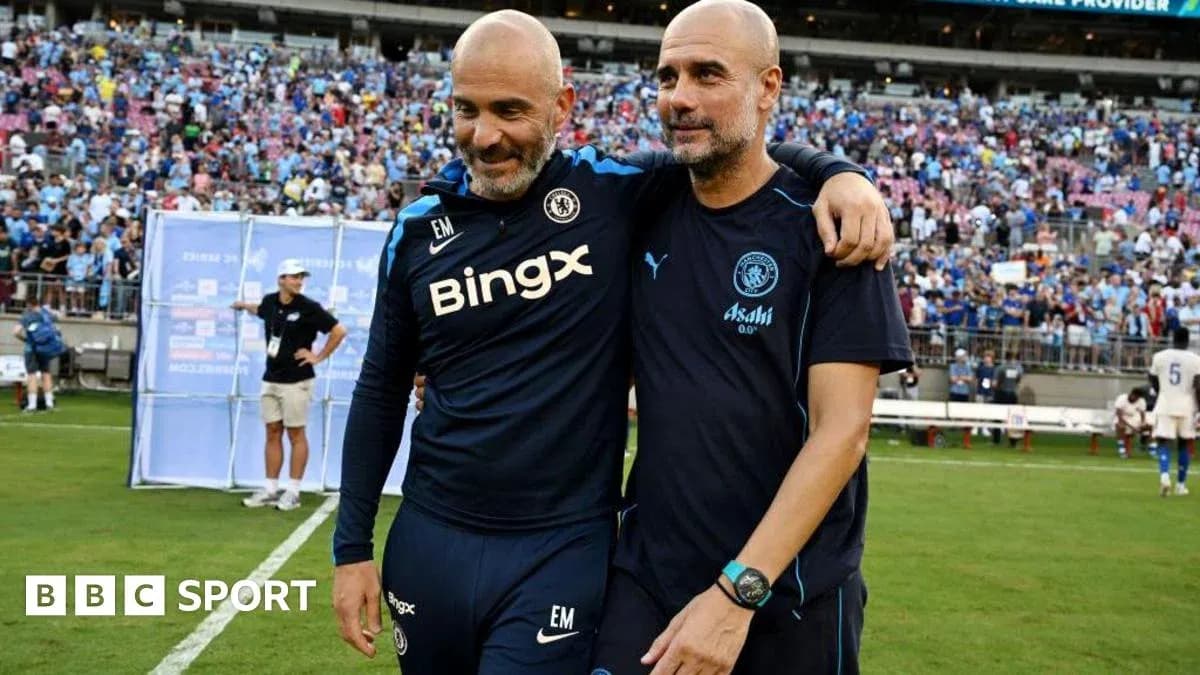
Arteta has used Jurrien Timber and Riccardo Calafiori at Arsenal in a similar fashion. At Chelsea, Malo Gusto and Marc Cucurella were deployed in those same aggressive, inside channels under former Guardiola assistant Enzo Maresca. Full-backs stopped being just defenders or just wide runners. They became playmakers in disguise.
Owning the ball, owning the league
From his earliest days at Barcelona, Guardiola built his teams on a simple conviction: if he had the ball, the opponent couldn’t hurt him. When he deviated from that, he felt it deeply.
Privately, he admitted he had betrayed himself in a Champions League tie against Inter Milan when he picked Zlatan Ibrahimovic and leaned into a more direct, quicker attacking style. The lesson stuck. If he was going to fail, he decided, he would do it on his own terms – with the ball at his team’s feet.
At City, that belief hardened into habit. With midfielders stepping into full-back zones and technical players spread across the pitch, his sides strangled games with possession.
In 2017-18, City averaged 71.9% of the ball per league match. Since then, they have never dropped below 60% across a season. Six Premier League titles in seven years followed. The message was clear: control the ball, control the trophies.
The rest of the league listened.
Liverpool under Arne Slot claimed the title in his first season by leaning closer to those principles than Jurgen Klopp’s more chaotic, transition-heavy football. The pressing remained, but the relationship with the ball shifted. Liverpool started to look more like a Guardiola-era side in how they used possession.
Arteta’s Arsenal, renowned for their defensive record, also suffocate games with the ball. Their solidity is as much about denying opponents the chance to attack as it is about blocks and tackles.
At Brighton, the club’s entire model rests on hiring coaches who want to impose themselves with possession. Roberto De Zerbi and Fabian Hurzeler both built teams that treat the ball as a weapon, not a burden.
Scott Parker, Vincent Kompany and Russell Martin all clung to that same philosophy in the Premier League. Their projects faltered, not because the ideas were inherently flawed, but because the quality of player and the willingness to adapt didn’t match the ambition. Still, their adherence underlines how deeply Guardiola’s vision has seeped into the coaching psyche.
From Ferguson’s England to Guardiola’s Premier League
Before Guardiola, English football’s identity was clear: intensity, directness, quick attacks. Sir Alex Ferguson’s Manchester United embodied that era, tearing through teams with pace and verticality.
Michael Carrick’s United have reconnected with those roots, leaning into counter-attacks and quicker transitions. Yet the wider picture tells a different story. Guardiola walked into a league shaped by Ferguson’s ideas and, over time, bent many of its best sides towards his own.
He did not do it by simply imposing a rigid style and daring others to follow. That’s one of the great misconceptions. His principles are firm – dominate the ball, control space, use technical players in every line – but the way he applies them is constantly shifting.
Injuries, new signings, tactical trends, and even the evolution of pressing have all forced him to adjust. Traditional wingers or inverted ones. False nines or classic strikers. Inverted full-backs or old-school ones. Ball-playing keepers or one-on-one specialists. He has used them all, often within the same club cycle.
That ability to adapt while staying true to his core ideas is what has allowed him to keep winning in a league that changes every season.
Other managers copy what works. They study the build-up patterns, the rest-defence structures, the rotations between full-backs and midfielders. They drill their teams to look like Manchester City.
By the time they get close, though, Guardiola has usually moved on to the next evolution.
That, more than the trophies, might be his defining legacy in England: not just that he changed the Premier League, but that he never stopped changing it, even as everyone else tried to catch the version of him that no longer existed.