.svg&w=384&q=75 "Pitchgist logo")
Nicolás Otamendi's Warrior Farewell to Argentina
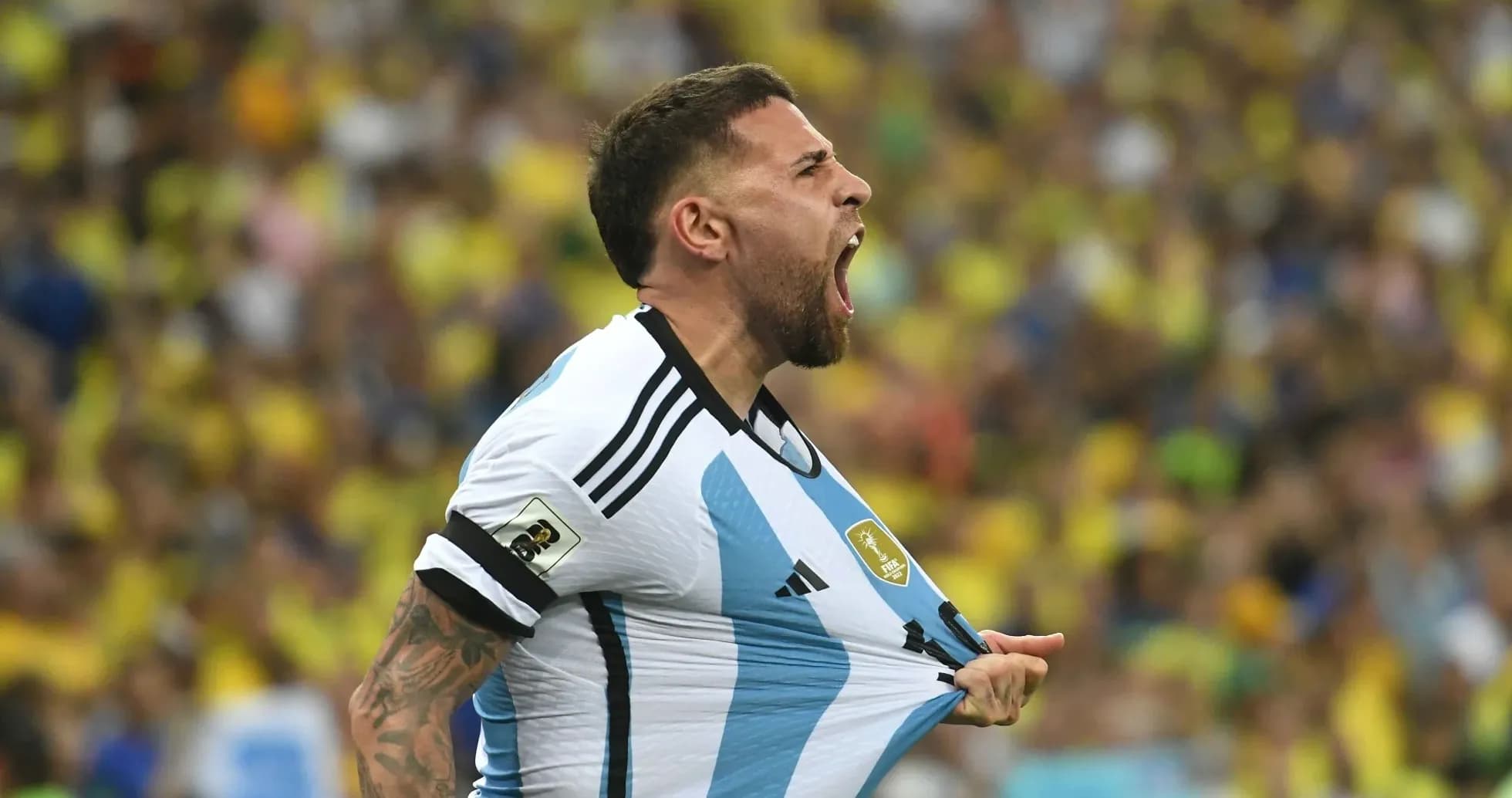
Nicolás Otamendi has never been one for soft landings. He went into tackles, into duels, into tournaments with the same blunt force. On Wednesday, he chose to go out the same way he came in: head-on, no half measures.
In a long, emotional message on Instagram, the 38-year-old defender announced he will retire from the Argentina national team after the 2026 World Cup, closing a chapter that began in 2008 and helped carry the Albiceleste back to the summit of world football.
“Today, I’m writing the most difficult words I’ve ever had to,” he began, framing a goodbye that felt as inevitable as it was painful. For a kid who once dreamed of simply pulling on the shirt, this was the final line in a story that took him from Vélez Sarsfield to the Maracanã, Lusail and beyond.
A childhood dream, fulfilled in full
Otamendi called wearing the Argentina shirt “a childhood dream’’ and “the greatest privilege” he has had in football. He stressed that he defended it “with all my heart, with pride, and with a sense of responsibility, knowing what it means to millions of Argentines.”
That sense of duty defined his international career. He was never the most elegant defender of his generation, never the smoothest passer or the quickest over the ground. He was something else: rugged, relentless, unapologetically combative. A centre-back who treated every aerial ball as if it were the last of his life.
His farewell message carried one clear regret. Otamendi admitted the pain of Argentina’s defeat in the 2026 World Cup final, a loss that denied him a second world title on what will be his final major stage. Yet he insisted he leaves “with the peace of mind that comes from giving it all.”
He thanked supporters and family for standing by him “through the good times and the bad,” and turned his attention to the dressing room he will soon leave behind. To the next generation, he sent a simple instruction: “never stop believing.”
He closed with a line that will echo around a country that watched him grow old in its colours: “Thank you, Argentina. Thank you for letting me fulfill my dream of becoming a world champion and wearing the most beautiful jersey in the world.”
An outpouring from a golden generation
The response was immediate. His Instagram post drew a wave of affection from former teammates, fans and fellow professionals who lived that golden cycle by his side.
Alexis Mac Allister saluted him as “an exemplar of fight, resilience and love for the shirt,” a neat summary of the traits that kept Otamendi in the side across four World Cup cycles. Germán Pezzella went further, calling him “a guide for us all,” a nod to the leadership that never needed a captain’s armband to be obvious.
Paulo Dybala, Marcos Senesi, Mariano Andujar and Gianluca Prestianni all joined in with their own messages of gratitude, each one a small testimony to the influence of a defender whose work rarely made the highlight reels but often set the tone.
Rodrigo De Paul, one of the emotional engines of the current team, dedicated a separate Instagram story to Argentina’s vice-captain. He recalled the day he arrived in the national team and Otamendi “opened the door” to his room, a gesture that turned into a ritual and a bond.
“My thanks to you, my brother, are eternal,” De Paul wrote. “You were an example to follow and one of the leaders of the beautiful story this team built. Thanks for everything, I’ll miss you.”
It was a glimpse into the inner life of a squad that climbed from heartbreak to glory together, with Otamendi a constant presence in the background, then the foreground, then the huddle.
From Vélez to the world stage
For those who have followed his career from the start, this exit does not come as a shock. At 38, Otamendi was always among the likeliest veterans to step aside as Lionel Scaloni reshapes his side for the next cycle.
He first burst onto the scene with Vélez Sarsfield in 2008, quickly earning a reputation in the Argentine Primera División as a no-nonsense centre-back. That form opened the door to Europe, and later to Manchester City and Benfica, but the national team was where his story truly took on weight.
Otamendi became a staple of the Albiceleste backline through eras, coaches and tactical fashions. He survived generational shifts, criticism, and the scars of lost finals. He stayed when others drifted away. He kept coming back.
At Qatar 2022, Scaloni entrusted him with a starting role in the heart of defence. Otamendi repaid that faith with a tournament of grit and concentration, anchoring a back line that carried Lionel Messi to the one trophy that had eluded him. Four years later, his role had changed. Lisandro Martínez stepped in alongside Cristian “Cuti” Romero as the preferred pairing, and Otamendi slid into the background as an experienced backup, a voice and presence as much as a pair of legs.
Yet even as his minutes shrank, his influence did not.
A defender built for the fight
Otamendi’s style never pretended to be subtle. He was rugged, uncompromising, abrasive. He relished physical contact, thrived in chaos, and turned every cross into a personal challenge.
One image sums him up better than any statistic. In the round of 16 at Qatar 2022, against Australia, cameras caught him rising above 1.98m Harry Souttar to win a header. Otamendi stands at 1.83m. In that frozen frame, he seems to defy not just gravity but logic, a smaller man towering over a giant through timing, aggression and sheer will.
That duel became an instant snapshot of his career: never the tallest, rarely the flashiest, always the one who refused to accept his limits.
For Argentina, he offered something that cannot be measured easily: tenacity. The kind that spreads through a back line, then a midfield, then an entire stadium. The kind that convinces teammates that, whatever else happens, the man behind them will not back down.
A place among Argentina’s greats
With his decision, Otamendi steps into the company of names that defined the position for Argentina. Daniel Passarella, Oscar Ruggeri, Roberto Ayala. Different eras, different styles, the same ruthless commitment to defending the shirt.
He leaves behind a blueprint for the defenders who will follow: fierce in the duel, relentless in concentration, proud of the scars. Determination, fierceness, competitiveness – those are the pillars of the legacy he hands over.
The next generation will have to build their own story now, without the bearded figure who spent more than a decade throwing himself in front of crosses and careers. They inherit a world champion’s jersey and the memory of a centre-back who treated it as both armour and burden.
Otamendi has chosen his finish line: the 2026 World Cup, one last campaign in sky blue and white. After that, the shirt will move on.
The question is simple, and brutal in its honesty: who will be brave enough to wear it the way he did?