.svg&w=384&q=75 "Pitchgist logo")
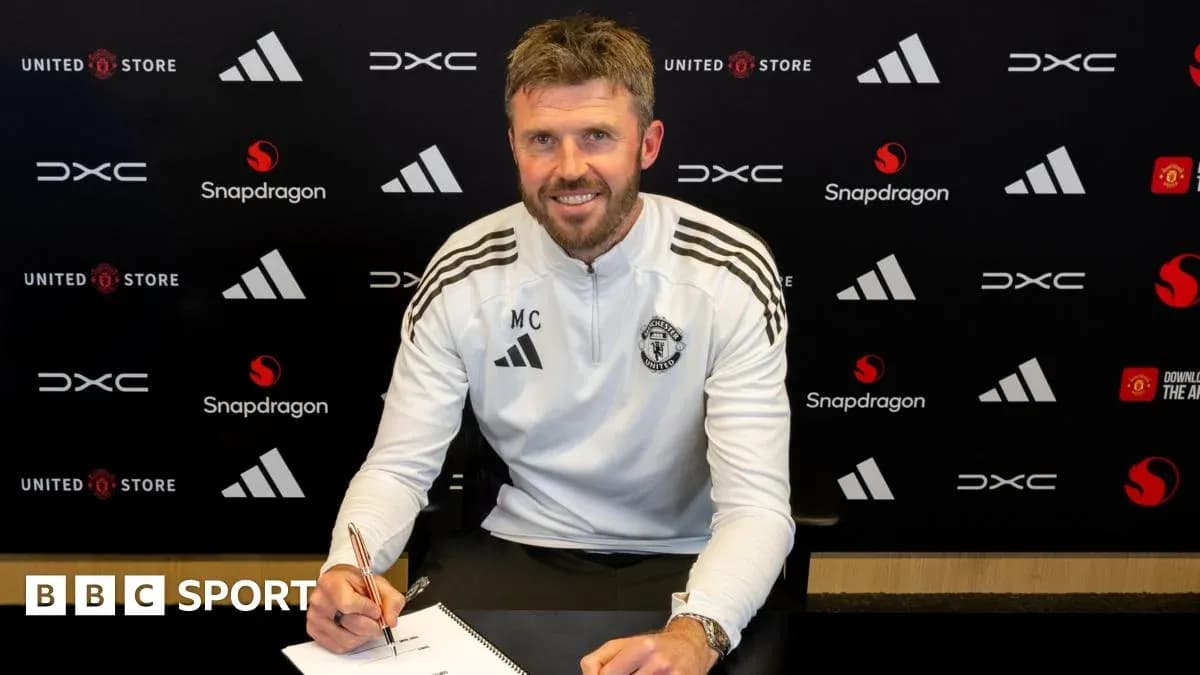
Michael Carrick Confirmed as Permanent Manchester United Head Coach
Manchester United have turned to a familiar face for their future. Twenty years after he first walked into Old Trafford as a player, Michael Carrick has been confirmed as the club’s permanent head coach on a two-year contract.
The decision ends months of speculation and rewards a blistering run as interim boss. Since stepping in after Ruben Amorim’s sacking in January, Carrick has quietly rebuilt a season that looked ready to collapse.
He has done far more than steady the ship. He has pointed it back towards Europe’s elite.
From caretaker to Champions League
Carrick, 44, took charge on 13 January and immediately altered the mood around Carrington. The numbers tell one story: 11 wins in 16 matches, third place in the Premier League secured, and Champions League football guaranteed after Sunday’s breathless win over Nottingham Forest.
No top-flight side has taken more points than United’s 36 in that period. Not Arsenal. Not Manchester City. Not Liverpool.
That surge has pushed Carrick onto a six-man shortlist for the Premier League’s manager of the season award, a nod to the scale of the turnaround he has overseen in just five months.
For Carrick, this is not just another job. It is a full-circle moment.
“From the moment that I arrived here 20 years ago, I felt the magic of Manchester United. Carrying the responsibility of leading our special football club fills me with immense pride,” he said, as the club confirmed his appointment.
“Throughout the past five months, this group of players have shown they can reach the standards of resilience, togetherness and determination that we demand here.
“Now it's time to move forward together again, with ambition and a clear sense of purpose. Manchester United and our incredible supporters deserve to be challenging for the biggest honours again.”
The words fit the occasion. The work behind them has earned it.
A calm hand in a turbulent season
Carrick has been asked about his future so often in recent weeks he could almost have answered on autopilot. He never did. He stayed on message, kept the focus on the next game, the next performance, the next step.
That same calm has seeped into the dressing room. The panic that often swirls around Old Trafford in difficult moments never quite took hold this time. United still had no European football and went out of both domestic cups at the first hurdle, but under Carrick they found rhythm, structure and a sense of direction.
Some statistical analysis has suggested United have not been as strong as their results imply since Amorim’s departure. On paper, maybe. On the pitch, the transformation has been obvious: fewer wild swings in performance, more control in key phases, a team that no longer looks permanently on edge.
Carrick has given United something they have craved for years – stability.
Now comes the hard part.
The scale of the next step
Third place in a 40-game season, without the strain of Europe and with early exits in both cups, is one challenge. Matching or improving on that when the calendar could stretch to 60 matches is another level entirely.
The new head coach knows he cannot do it alone. Recruitment will define whether this promising surge becomes a genuine resurgence.
Central midfield sits at the heart of it. Casemiro is leaving. Manuel Ugarte has not convinced at the required level. Kobbie Mainoo, for all his promise, cannot be asked to carry the midfield across every competition, every three days, across an entire season.
United must find the right profile and personality to anchor that area, to support Mainoo and to give Carrick the flexibility he needs.
The issues do not end there. If Patrick Dorgu continues to be pushed into a more advanced role, Luke Shaw needs serious competition at left-back. The situation in goal also demands a clear decision: Senne Lammens requires a challenger, yet Radek Vitek, outstanding on loan at Bristol City, wants to play every week. That will not happen if he returns to sit on the bench at Old Trafford.
These are not minor tweaks. They are structural calls that will shape Carrick’s first full campaign.
Help from within – but not only from within
United’s academy will play its part, as it always has. Jacob Devaney, just 18, has caught the eye in the Scottish Premiership with St Mirren and looks ready for a closer look. Shea Lacey, already a promising England Under-20 international, is expected to get more opportunities next season.
Those young legs can inject energy and hunger into Carrick’s squad. They cannot, on their own, carry the burden of a club determined to rejoin Europe’s elite.
The academy can supplement. It cannot substitute. Carrick needs the recruitment department to match his clarity with theirs.
Pride, pressure and possibility
Strip away the numbers and the narratives, and the picture is simple. United have found a head coach who understands the club, who has restored order in a fractured season, and who has earned the right to lead the next phase.
The league table says third. The fixture list next year will say more. With extra games, heavier travel and higher stakes, finishing in the same position would represent a significant step forward, not a repeat.
For that to be realistic, Carrick needs players – the right ones, in the right positions, at the right time.
He has brought calm. He has brought belief. Now Manchester United must decide whether they are willing to match his ambition in the market, or risk watching this promising revival stall just as it begins to gather pace.