.svg&w=384&q=75 "Pitchgist logo")
Mexico's Tactical Mastery in 2-0 Victory Over Ecuador
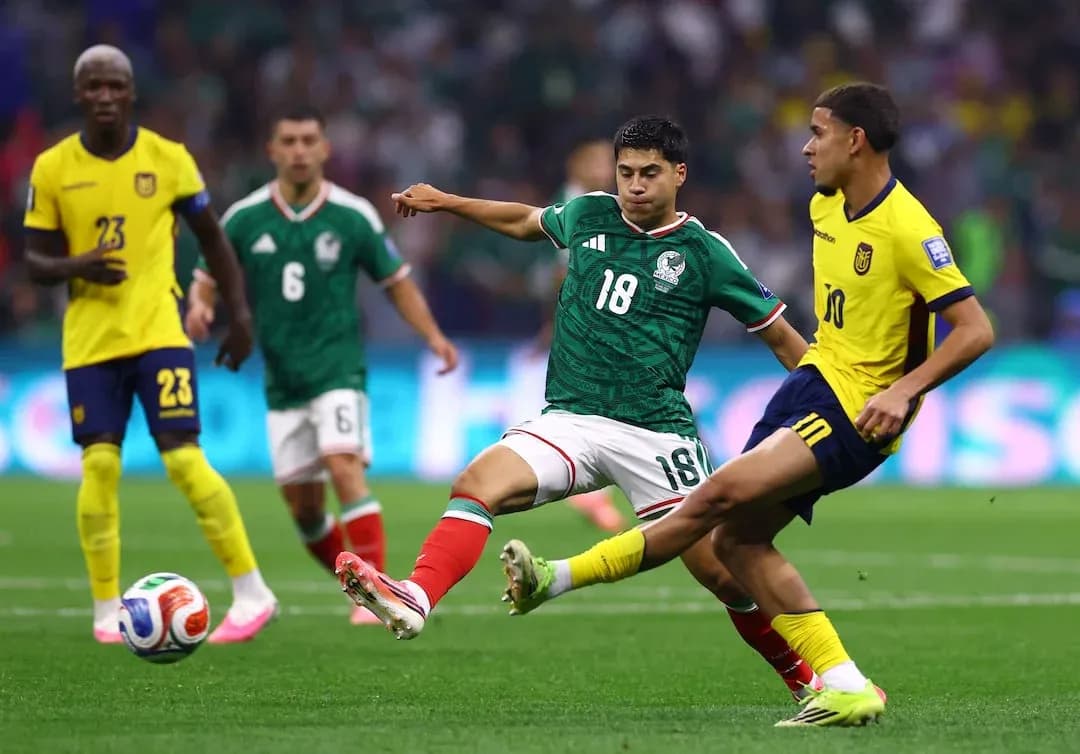
Mexico’s 2-0 win over Ecuador at Estadio Banorte in this World Cup Round of 32 tie was a classic case of early attacking clarity beating territorial control. Javier Aguirre’s side built a decisive two-goal cushion inside half an hour, then managed the game with compact spacing and controlled risk, while Sebastian Beccacece’s Ecuador dominated the ball but rarely broke through structurally.
Mexico lined up in a 4-3-3 that behaved like a narrow 4-1-4-1 without the ball. Erik Lira anchored in front of the back four, with Gilberto Mora and Luis Romo stepping higher to press Ecuador’s double pivot and wide midfielders. The front three of Roberto Alvarado, Raúl Jiménez and Julián Quiñones set the tone: they allowed Ecuador’s centre-backs to have possession but jumped aggressively on vertical passes into Moisés Caicedo and Pedro Vite, forcing Ecuador to circulate wide and cross from less dangerous zones.
The attacking plan was direct and purposeful. Despite only 43% possession, Mexico generated 15 total shots to Ecuador’s 7 and a higher xG (1.02 to 0.73). The key was how Mexico attacked the space between Ecuador’s full-backs and centre-backs. On the 22nd-minute opener, J. Quinones drifted into the left half-space from his starting position in the front line, receiving the decisive ball from R. Alvarado and finishing a move that exploited Ecuador’s horizontally stretched back four. For the second goal on 31 minutes, the pattern inverted: R. Jimenez finished after link play from J. Quinones, again attacking the channel as Ecuador’s defensive line tried to step up but left gaps between units.
In possession, Mexico were selective rather than expansive. Their 319 passes at 78% accuracy show a willingness to go forward early rather than recycle endlessly. The midfield three often formed a staggered triangle: Lira stayed close to the centre-backs to help build under pressure, while Mora and Romo ran beyond the first line, creating vertical lanes for wall passes with the forwards. Full-backs Jorge Sánchez and Jesús Gallardo did not bomb on recklessly; instead, they chose their moments, ensuring rest defence was stable against Ecuador’s counter-attacking threat through Gonzalo Plata and Enner Valencia.
Defensively, the structure was disciplined. Mexico committed only 10 fouls, stayed card-free, and limited Ecuador to just 1 shot on goal from 7 attempts. The back four kept distances tight, with César Montes and Johan Vásquez holding a relatively deep line once Mexico were two goals up, inviting Ecuador to play in front rather than in behind. Raúl Rangel (Mexico) was rarely exposed; his 1 save reflects how effectively the block in front of him reduced the quality and volume of Ecuador’s chances, even though the goals prevented figure of -0.57 indicates that the one effort on target carried some danger.
Ecuador’s 4-4-2 had the ball (57% possession, 407 passes at 84% accuracy) but struggled to convert circulation into penetration. The front pairing of Enner Valencia and Gonzalo Plata often became isolated as the wide midfielders, John Yeboah and Nilson Angulo, were pinned back by Mexico’s full-backs and wingers. Moisés Caicedo and Pedro Vite saw plenty of touches but were repeatedly forced sideways, with Mexico’s front three screening central lanes effectively.
Beccacece’s adjustments at half-time were aggressive: Alan Franco and Joel Ordoñez were withdrawn at 46', with Yaimar Medina and Ángelo Preciado introduced to add more thrust from the back and the right flank. Later, Kevin Rodriguez replaced Enner Valencia at 59', and Kendry Páez and Jordy Caicedo came on for John Yeboah and Nilson Angulo at 79', morphing the structure towards a more fluid, attack-heavy shape. Yet the statistical outcome barely shifted: Ecuador finished with 5 shots off target, only 1 blocked shot and still just 1 effort on goal, underlining that the problem was occupation of the final third zones rather than simple personnel.
Hernán Galíndez (Ecuador) also faced only 3 shots on goal and made 1 save, with a goals prevented figure of -0.57 mirroring Rangel’s. That symmetry underlines that this was not a game of repeated high-quality chances at either end; instead, Mexico’s superior execution in the decisive attacking moments, combined with Ecuador’s lack of incision, defined the contest.
Set pieces and wide play told a similar story of sterile control for Ecuador. They earned 8 corners to Mexico’s 3 but rarely created clean looks, as Mexico’s zonal scheme in the box, anchored by Montes and Vásquez, dominated aerially and cleared first balls consistently. Ecuador’s 14 fouls and late flurry of discipline — yellow cards for A. Franco, K. Paez and M. Caicedo plus a red card for P. Hincapie — reflected growing frustration as Mexico slowed the tempo and closed central spaces.
Statistically, the match reinforces Mexico’s efficiency: fewer passes, less possession, but more total shots, more shots on goal and the higher xG. Their ability to turn transitions and targeted half-space attacks into two first-half goals allowed them to shift into a compact, low-risk game state. Ecuador’s numbers with the ball looked healthy, yet the lack of penetration, minimal shot volume and a negative discipline balance underscored a tactical plan that never fully adapted to Mexico’s well-organized 4-3-3 block.