.svg&w=384&q=75 "Pitchgist logo")
France Dominates Sweden 3-0 in World Cup Match
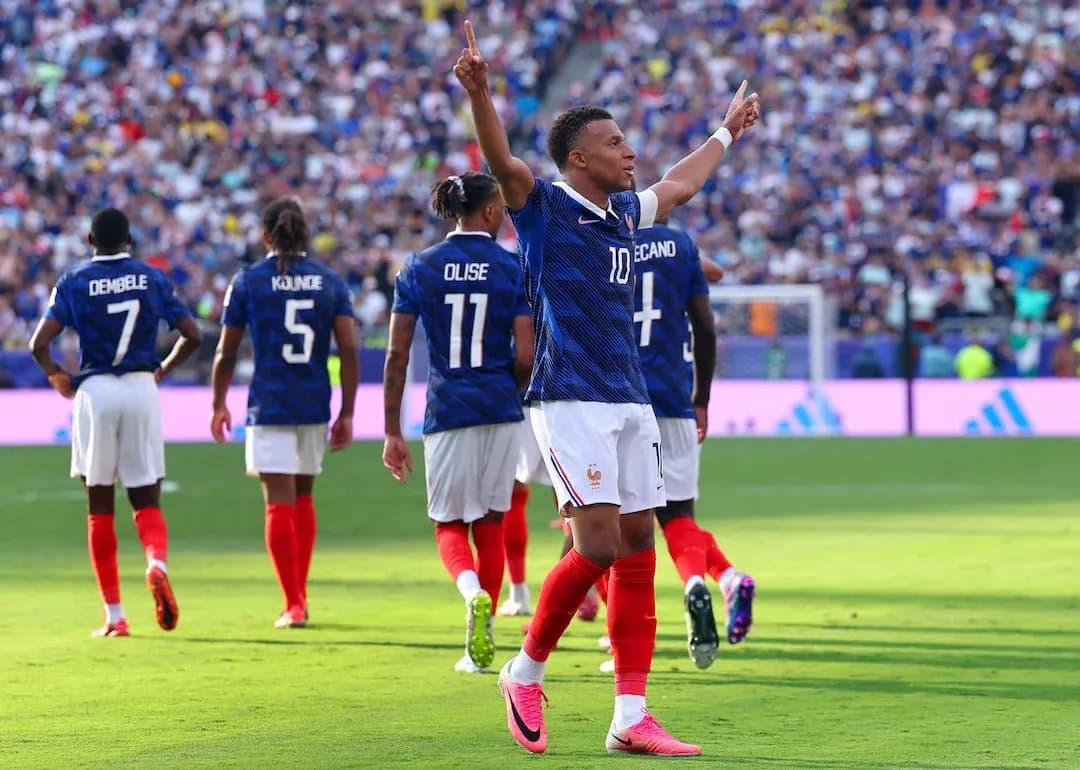
France’s 3-0 win over Sweden at MetLife Stadium in this World Cup Round of 32 tie was a controlled, structurally coherent performance built on territorial dominance and intelligent use of their 4-2-3-1 against Sweden’s 4-4-2. The scoreline matched the underlying data: France generated 25 shots to Sweden’s 8, with a 3.17 xG to 0.65 differential, and controlled 61% of the ball. The match evolved from patient first-half probing into a second-half display of vertical acceleration, with Kylian Mbappé and Bradley Barcola repeatedly exploiting the channels and Michael Olise knitting together the attacking third.
Executive Summary
France’s shape was classic Didier Deschamps tournament football: a double pivot for control, three mobile attacking midfielders, and Mbappé as the high reference point. Sweden, under Graham Potter, set up in a 4-4-2 that tried to stay compact centrally while using Anthony Elanga and Elliot Stroud to spring in transition towards Viktor Gyökeres and Alexander Isak. For 45 minutes Sweden largely contained France’s central progression, but once the French press began to bite and the wide rotations sharpened, the Swedish block was stretched beyond its limits.
Scoring Sequence & Disciplinary Log
There were no cards in this match, so the tactical story is told purely through goals and substitutions.
The breakthrough came on 45', a psychologically pivotal moment. France had been circulating possession with patience, and the wide trio finally combined with the precision Deschamps demands. Ousmane Dembélé, operating from the right in the line of three, provided the assist for Mbappé, whose timing between Sweden’s centre-backs was decisive. The 1-0 at half-time accurately reflected France’s territorial superiority but also underlined Sweden’s relative defensive discipline up to that point.
At 53', the second goal effectively changed the game’s tactical temperature. Bradley Barcola, starting on the left of the three behind Mbappé, finished a move created by Michael Olise. Olise’s role as a right-sided playmaker, drifting into the half-space, pulled Sweden’s midfield line out of its compact 4-4-2 shell. As the Swedish right side shuffled to deal with his positioning, Barcola could attack the far-side gaps with late runs, and this pattern produced the 2-0.
By 74', with Sweden forced to open up, France punished the stretched block again. Mbappé scored his second, this time assisted by Olise, underlining the growing synergy between the nominal right winger and the central striker. Olise’s repeated access to the inside-right pocket meant Sweden’s double pivot and right-sided central defender were constantly in dilemma: step out and leave depth, or hold the line and allow free reception between the lines. On this occasion, France exploited the hesitation ruthlessly to make it 3-0.
Substitutions then added a secondary tactical layer rather than changing the outcome. On 66', Sweden introduced Besfort Zeneli (IN) for Elliot Stroud (OUT) and Taha Abdi Ali (IN) for Lucas Bergvall (OUT), seeking more creativity and ball-carrying from midfield. France responded from a position of strength: at 75', Malo Gusto (IN) came on for Jules Koundé (OUT) and Désiré Doué (IN) for Dembélé (OUT), refreshing the right flank while maintaining the same structural idea. At 78', Theo Hernández (IN) replaced Lucas Digne (OUT), adding more thrust from left-back. Sweden’s double change at 82'—Benjamin Nygren (IN) for Yasin Ayari (OUT) and Mattias Svanberg (IN) for Daniel Svensson (OUT)—tilted their shape towards a more aggressive, ball-playing profile, but with the score at 3-0, France could simply defend higher and counter. At 85', Jean-Philippe Mateta (IN) for Olise (OUT) and Rayan Cherki (IN) for Mbappé (OUT) turned France’s front into a fresh, possession-secure unit. Sweden’s final switch at 89', with Gustaf Nilsson (IN) for Alexander Isak (OUT), added aerial presence but came too late to reshape the dynamics.
Tactical Breakdown & Personnel
France’s 4-2-3-1 was built around the double pivot of Aurélien Tchouaméni and Adrien Rabiot. Their job was twofold: control rest defence against Sweden’s front two and provide the platform for the advanced line to receive clean ball. With 551 passes (485 accurate, 88%), France’s circulation was both high-volume and high-quality. The centre-back pairing of Dayot Upamecano and William Saliba could hold a relatively high line because the pivot screened direct passes into Gyökeres and Isak, forcing Sweden to build wide and from deeper zones.
In possession, the full-backs Lucas Digne and Koundé provided width, allowing Dembélé and Barcola to attack half-spaces rather than hugging the touchline. This created constant 2v1 or 3v2 scenarios against Sweden’s wide midfielders and full-backs. Olise, nominally central in the band of three, often drifted to the right, overloading that side and leaving Mbappé to threaten the space between Victor Lindelöf and Gustaf Lagerbielke. The volume of France’s shots inside the box (16) reflected how consistently they managed to arrive in advanced central areas after stretching the Swedish block horizontally.
Without the ball, France’s pressing scheme was selective rather than manic. The front four would trigger pressure on backward or square passes from Sweden’s full-backs, funneling play towards one side and then collapsing. The 14 fouls committed show a willingness to break transitions early, but the absence of cards indicates these were generally well-timed and controlled. Sweden’s 352 passes (280 accurate, 80%) suggest they could escape the first line at times, but their progression rarely translated into sustained territory or high-quality chances.
Sweden’s 4-4-2 defensive block was initially narrow and disciplined. Elanga and Stroud tracked the French full-backs, while Ayari and Bergvall tried to screen passes into Olise. However, once France increased the tempo of their wide combinations and switches of play, the Swedish midfield four were forced into longer lateral shifts. That opened seams between the lines, particularly on the weak side after France switched from right to left. The fact that Sweden managed only 8 total shots, with 7 inside the box, points to a game plan relying on rare but dangerous entries rather than steady chance creation; France’s structure limited those entries effectively.
In goal, Mike Maignan (France) was largely protected by the block, facing only 3 shots on target and making 3 saves. The French defensive system prevented Sweden from generating repeated high-quality looks, aligning with Sweden’s modest 0.65 xG. At the other end, Jacob Widell Zetterström (Sweden) had a far more demanding evening. He made 9 saves against 12 shots on target and, with 1.16 goals prevented, was a key reason the scoreline stayed at 3-0 rather than becoming a rout. France’s own goals prevented figure of 1.16 underlines how Maignan’s interventions and the team’s last-ditch defending also shaved off Swedish scoring probability.
The Statistical Verdict
The raw numbers confirm the tactical impression. France’s 61% possession was not sterile; it was backed by 25 shots, 12 on target, and 4 blocked efforts, with an xG of 3.17 that closely matches the three goals scored. Their passing structure was efficient—551 passes at 88% accuracy—allowing them to keep Sweden running laterally and gradually eroding the compactness of the 4-4-2.
Sweden’s 39% possession and 352 passes at 80% accuracy show they were not completely overrun in build-up, but their attacking output was thin: 8 shots total, 3 on target, and just 1 blocked shot. The single corner kick compared to France’s 9 illustrates how rarely they established pressure in the final third. Both teams finished without yellow or red cards, aligning with the relatively controlled nature of France’s pressing and Sweden’s reactive defending.
From a season-profile perspective, France’s combination of high shot volume, strong xG, and low xG conceded fits the pattern of a heavyweight side asserting superiority in a knockout tie. Sweden’s compact but ultimately overwhelmed 4-4-2, coupled with reliance on their goalkeeper’s 9 saves and 1.16 goals prevented, paints the picture of a team whose defensive organisation could not withstand sustained elite-level pressure once the French attacking structure clicked after the interval.