.svg&w=384&q=75 "Pitchgist logo")
Martin O’Neill Returns as Celtic Manager
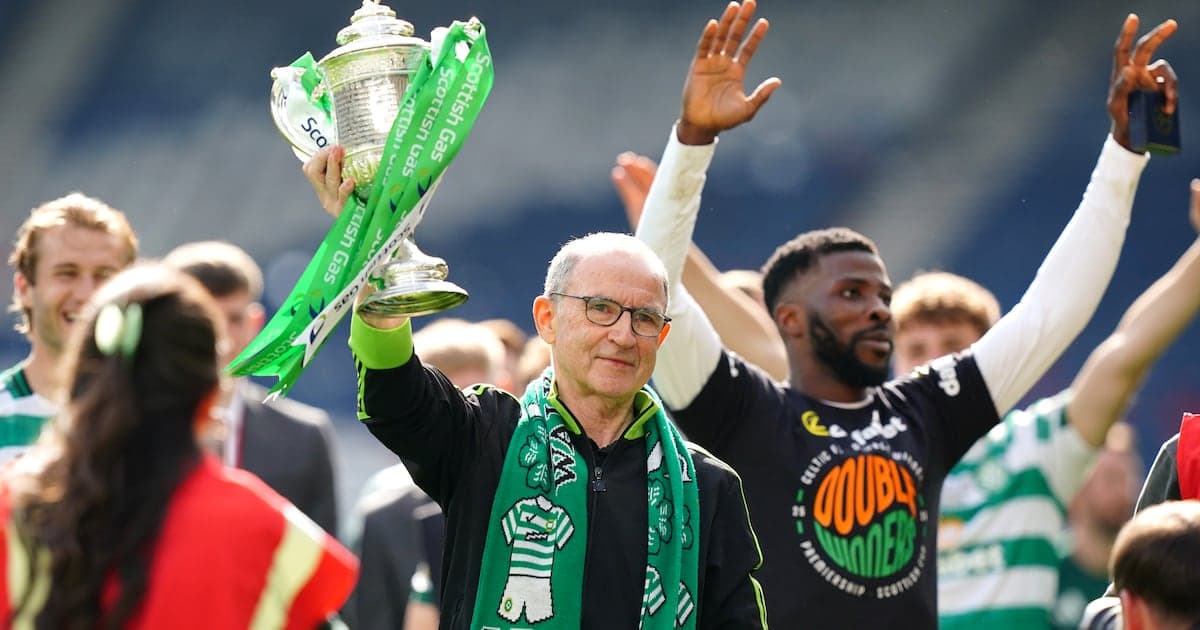
Martin O’Neill is set to complete one of the most remarkable managerial returns in modern Scottish football, with Celtic expected to confirm the 74-year-old as their permanent manager after he agreed a one-year deal to stay in Glasgow.
The contract, which includes an option for a second year, rewards O’Neill for stepping in twice this season and dragging a listing campaign back on course. His second interim stint ended with a domestic double and a Scottish Cup final win over Dunfermline that felt less like a farewell and more like a reintroduction.
A familiar face over a controversial choice
Inside Celtic Park, Robbie Keane had been pushed hard as a serious contender. The former striker held talks this week with Dermot Desmond, the club’s principal shareholder, and there was a genuine possibility of a bold, modern appointment.
Then the backlash hit.
Sections of the Celtic support reacted furiously to the idea, angered by Keane’s managerial spell in Israel with Maccabi Tel Aviv before his move to Ferencvaros in Hungary, where he resigned at the end of May. For a club so attuned to its identity and politics, those objections carried weight. The noise around Keane never really died down; it grew.
As the dissent swelled, the alternative looked more and more obvious. O’Neill was already in the building, already winning, already adored.
O’Neill’s second act
After the Scottish Cup final, O’Neill did not rush. He asked for time to consider his position, to weigh up whether he wanted the grind and scrutiny of the job on a longer-term basis. Yet there was always a sense of inevitability. The Northern Irishman had walked back into Celtic once more and immediately restored order. Why stop now?
His impending appointment is steeped in history. It comes 26 years after Desmond first persuaded him to leave Leicester for Glasgow, a decision that reshaped Celtic’s modern era. That first spell remains the benchmark: three Scottish titles, three Scottish Cups, two Scottish League Cups, and a run to the 2003 Uefa Cup final, where Celtic fell to José Mourinho’s Porto but left behind a legend of their own.
Those years turned O’Neill from a promising manager into a defining Celtic figure. The club is now betting that the same personality, sharpened by decades of experience, can once again impose standards on a squad that has lurched between stability and chaos.
From Rodgers’ exit to a rescue mission
The latest chapter began in turmoil. Brendan Rodgers resigned last October, leaving Celtic abruptly exposed. O’Neill came in on a short-term basis to steady the dressing room and the stands. It worked. He handed over to Wilfried Nancy with the title defence still intact and the mood cautiously optimistic.
Nancy’s reign imploded almost immediately. Eight games, and the Frenchman was gone. Results collapsed, performances sagged, and Celtic’s season threatened to unravel before winter had even bitten.
So they went back to the one man they knew could handle the storm.
O’Neill returned and, with minimal fuss and maximum authority, guided Celtic to a successful defence of their Premiership crown. By the time the Scottish Cup was lifted at Hampden, the question was no longer whether he could still do it. It was whether Celtic dared to look elsewhere.
They have their answer now. The club that once rode O’Neill’s intensity to the summit of Scottish football is preparing to hand him the keys again. At 74, he walks back into the job not as a romantic nod to the past, but as the manager trusted to shape what comes next.