.svg&w=384&q=75 "Pitchgist logo")
Canada faces South Africa in historic World Cup knockout match
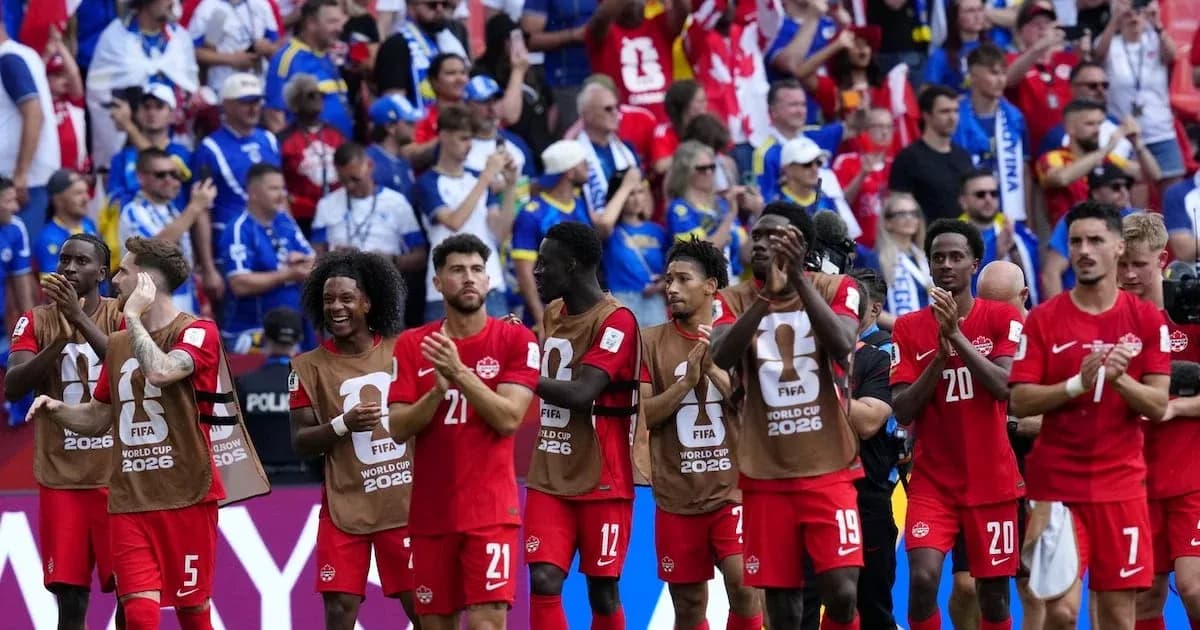
Canada walks into uncharted territory on Sunday. For the first time in their history, they will line up in a World Cup knockout match, facing a South Africa side that has already shown it has no interest in playing by the rankings.
This is where the tournament stops being a story about milestones and starts becoming a story about ambition.
A favourite on paper, a live threat on the pitch
By every metric, Canada should like this matchup.
They arrived at this World Cup 31st in the FIFA rankings. South Africa? Sixtieth. ESPN’s pre-tournament model put Canada 25th out of 48 nations and South Africa way back at 46th.
But rankings don’t clear your lines or track late runners.
South Africa’s route to the Round of 32 has been chaotic, stubborn and, in the end, impressive. They opened with a 2-0 defeat to Mexico, a match that turned ugly with two red cards and seemed to set the tone for a short stay. Hope thinned again against Czechia, until Teboho Mokoena buried a late penalty to salvage a point and keep the campaign alive.
The pressure finally told on Wednesday. Needing a win to climb into second in Group A, South Africa grabbed it with Thapelo Maseko’s decisive goal in a 1-0 victory over South Korea, despite having just 31 per cent of the ball. They bent, they absorbed, and they struck.
Canada has seen a different type of World Cup.
Jesse Marsch’s side eased into the tournament with a 1-1 draw against Bosnia and Herzegovina, then ripped apart a nine-man Qatar team 6-0. The real measure came against Switzerland on Wednesday. Canada fell 2-0 behind early in the second half, then surged back, pulling one back and spending the final minutes camped in Swiss territory, chasing the equalizer that would have delivered top spot in Group B.
They didn’t get it. But the way they chased it told its own story.
Striker Jonathan David called stoppage time “kind of intense” as Canada threw everything forward.
“You try not to look at the clock, because the more you look at it, the quicker time goes. But it’s garbage time,” David said. “You have to just have to crash the box and get the crosses and make sure you make your chances happen, and put shots on target, and hopefully something falls. And we came really, really close.”
That late push didn’t change the group table, but it did underline Canada’s identity: front-foot, aggressive, willing to risk.
On Sunday, that style meets a South African team that has already proved it can survive long spells without the ball and still land the decisive punch.
The Alphonso Davies question
Hanging over the build-up is one name: Alphonso Davies.
Canada’s captain and most electric talent has yet to play a minute in this World Cup, sidelined by a hamstring injury. His absence has forced Marsch to spread responsibility, but it has also given Canada a card to play in the shadows.
On Wednesday, Marsch admitted he had done exactly that.
“Alphonso wasn’t ready yet, but I wanted Switzerland to think about him and if you heard their press conference yesterday, they spoke about him a lot,” Marsch said. “He was never ready to play today, but I used him as a decoy.
“He will be ready for the next match, though. We didn’t want to be in a situation where he could be in danger, but he will be ready for the next match.”
Whether that is straight truth or more gamesmanship is the mystery. Canada stopped issuing injury updates before the win over Qatar, so the outside world has seen nothing of Davies’ progress for two weeks.
If he does step onto the pitch on Sunday, the entire dynamic of the match changes. South Africa would suddenly have to account for his pace in behind, his ability to break pressure with a single run, his threat on the counter.
If he doesn’t, Canada will again lean on the structure and depth that have carried them this far.
There are other fitness calls to make. Midfielder Stephen Eustáquio, so often the metronome in Canada’s midfield, came off the bench in the 58th minute against Switzerland. A return to the starting XI against South Africa would give Marsch a firmer grip on the centre of the pitch. Centreback Moise Bombito is another potential first-time starter in this tournament if he’s cleared to go, a move that could add athleticism and bite at the back.
What waits beyond South Africa
The bracket has finally taken shape, and it is unforgiving.
Canada and South Africa open the Round of 32 on Sunday. The winner gets six days to breathe before a Round of 16 showdown on Saturday, July 4, against the survivor of a heavyweight clash: the Netherlands vs. Morocco.
There are no soft landings there.
Both the Dutch and Morocco sailed through their groups with 2-0-1 records. Both came into the World Cup ranked inside FIFA’s top eight, Morocco at No. 7 and the Netherlands at No. 8.
Morocco arrive with recent World Cup scars and swagger. They reached the semifinals at Qatar 2022, knocking out heavyweights along the way, and have carried that form into this tournament: a 1-1 draw with Brazil, followed by a controlled 1-0 win over Scotland and a 4-2 victory over Haiti.
The Netherlands, meanwhile, remain one of the sport’s great tournament puzzles: rarely champions, almost never easy to eliminate. They have not lost a World Cup match in regulation time since the 2010 final, a 1-0 defeat to Spain. This time around they have flexed their attack, drawing 2-2 with Japan, crushing Sweden 5-1 and beating Tunisia 3-1.
Whoever emerges from Canada–South Africa walks straight into that storm.
And the path only steepens. Sitting above this mini-section of the bracket are two more giants, Germany and France, likely quarter-final opponents for whoever survives the Round of 16.
Germany have already locked up Group E. France will clinch Group I with a result against Norway on Friday, setting up a potential Round of 16 blockbuster between the third-ranked French and the 10th-ranked Germans. One of those two is expected to be waiting in the last eight for the team that claws its way through Canada, South Africa, Morocco and the Netherlands.
This is the company Canada now keeps. These are the names on their side of the draw.
History made, and a new bar set
For all the talk of brackets and future opponents, the reality is simple: Canada has already rewritten its own history at this World Cup.
First point. First win. First time out of the group stage.
Those boxes are ticked. The story has moved on.
“We’re going to focus on the response,” Marsch said after the loss to Switzerland. “We’re exactly where we want to be.”
Exactly where they want to be, but not yet where they want to go.
On Sunday, against a resilient South African side that refuses to bow to reputation, Canada has the chance to add the next line to a rapidly growing list of firsts: a World Cup knockout win.
The bracket beyond is brutal. The names are daunting. None of that matters if they stumble at the first knockout hurdle.
So the question now is not whether Canada belongs at this level. They’ve answered that.
The question is whether this team is ready to turn a breakthrough tournament into something more.