.svg&w=384&q=75 "Pitchgist logo")
Martin O’Neill Remains as Celtic Manager After Keane Consideration
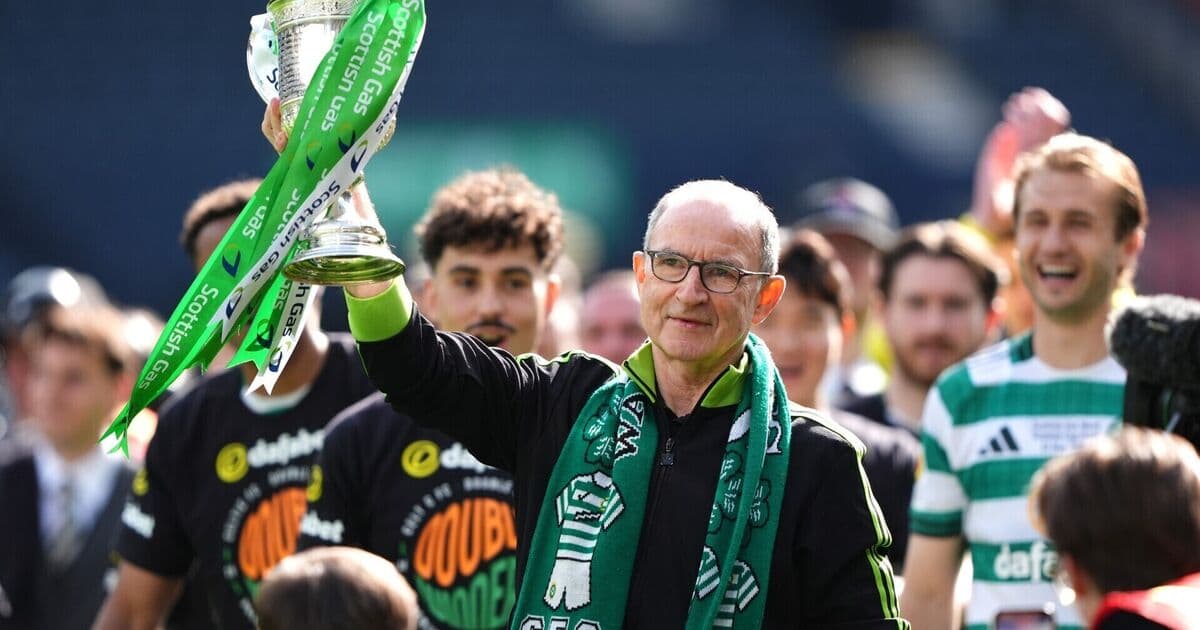
Celtic are set to turn back to the most familiar of faces. Martin O’Neill, the man who once reshaped the club at the start of the century, has agreed a one-year deal to remain as permanent manager in Glasgow, with an option for a second season.
At 74, O’Neill has already delivered again. Twice this campaign he was summoned as a firefighter; in his second interim spell he stitched together a season that could easily have unravelled, driving Celtic to a domestic double and successfully defending the Premiership title. That kind of rescue job tends to carry weight in boardrooms, especially when the alternatives come with baggage.
Alternative Candidates
One alternative in particular.
Robbie Keane had moved to the forefront of Celtic’s thinking in recent weeks. The former striker held talks with principal shareholder Dermot Desmond earlier this week and, on paper, offered a bold, modern choice: young, ambitious, and already blooded as a manager with Maccabi Tel Aviv and Ferencvaros.
But the romance never took hold.
A vocal section of the Celtic support reacted furiously to the idea of Keane taking over, objecting to his spell in Israel with Maccabi Tel Aviv. The backlash was sharp and immediate, a reminder that at Celtic Park, politics and identity can weigh as heavily as tactics and formations. By the time Keane’s resignation from Ferencvaros at the end of May became public, the mood music in Glasgow had already turned against him.
The pressure told. The board pivoted. And O’Neill, once again, was the steady hand.
O’Neill's Decision
After the Scottish Cup final win over Dunfermline, O’Neill did not rush into a decision. He asked for time, spoke about needing to consider his position. Yet inside the club there was a quiet confidence that the Northern Irishman wanted more than just a caretaker’s badge. The new agreement, understood to include an option for a second year, confirms that instinct.
There is a symmetry to it all that Celtic supporters of a certain age will feel keenly.
Desmond first persuaded O’Neill to leave Leicester City for Celtic 26 years ago. That move transformed the club’s modern history. Under O’Neill, Celtic collected three Scottish titles, three Scottish Cups and two Scottish League Cups, and marched all the way to the 2003 Uefa Cup final, where they fell only to José Mourinho’s Porto in Seville. His teams played with force and personality; his era still frames many fans’ idea of what a Celtic side should look like.
Chaotic Beginnings
This latest chapter began in far more chaotic fashion.
When Brendan Rodgers resigned last October, Celtic turned to O’Neill as a short-term solution, a veteran caretaker to steady the ship. Wilfried Nancy was then brought in as the supposed long-term answer, but his reign collapsed almost as soon as it began, lasting just eight games and leaving the season teetering.
O’Neill returned. The mood shifted. The title was retained and the Scottish Cup followed, restoring a sense of order that had threatened to disappear.
Now comes the commitment. Not a grand, sweeping five-year project, but a one-year contract with a possible extension — pragmatic, cautious, but rooted in trust. Celtic know exactly what they are getting with Martin O’Neill: authority, experience, and a manager who has already proved he can still win in the here and now.
The question is no longer whether he can still do it. It is how far, and how fast, he can push Celtic again, a generation on from the first time he changed the club’s course.