.svg&w=384&q=75 "Pitchgist logo")
Manchester City's Transition: The Future Without Rodri
Manchester City stand on the edge of a new era, and it feels anything but smooth.
Changing a manager after a decade is seismic in itself. Doing it while the spine of a Treble-winning side is quietly dismantled turns transition into upheaval.
Manuel Akanji, Nathan Ake, Bernardo Silva, John Stones: four starters from that 2022-23 machine have gone in one summer. In their place, City have pushed £116m on Elliot Anderson and handed the keys of their future to 17-year-old Jeremy Monga. The squad that once felt untouchable now looks unfinished.
And the most important question of all still hangs in the air.
Rodri at the crossroads
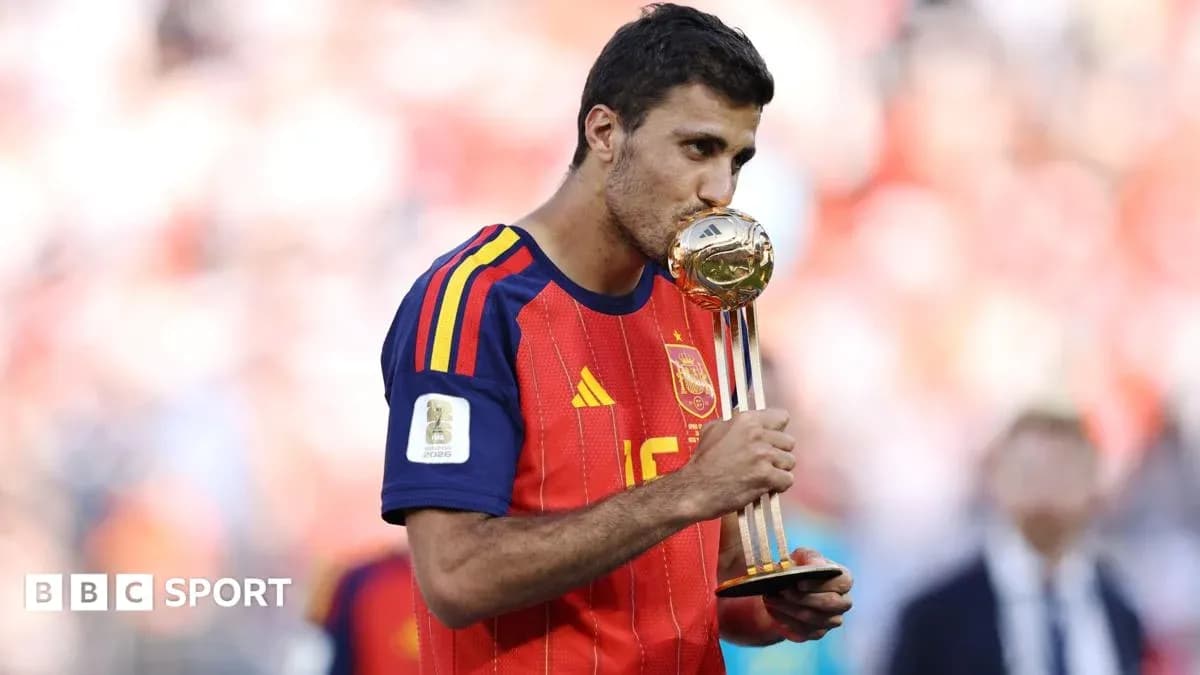
Rodri, fresh from lifting the World Cup as Spain’s captain and being named the tournament’s Golden Ball winner, goes under the knife on Monday for back surgery. He has a year left on his contract. His future is being debated more loudly outside the club than inside it.
Real Madrid are said to be operating on the assumption that he will eventually turn up in white. City, publicly at least, are pushing in the opposite direction.
New manager Enzo Maresca did not dance around the subject in his first news conference.
“I think every manager wants to have Rodri because he is a top player,” he said. Surgery, holiday, rest, recovery – and then, in his words, “he will be back with us.”
The message is blunt. City want to keep him. The reality is more complex.
No one yet knows how long the 30-year-old will be out. No one at City can ignore the possibility that an elite midfielder with a year on his deal, coveted by Madrid, might decide his decade in Manchester has run its course. Cash in when he returns to fitness, or double down on Maresca’s stance and try to build the new City around him again?
That decision will shape the entire project.
The Maresca blueprint
To understand what comes next, you have to understand Maresca.
He sees football like chess. Not as a lazy metaphor, but as a working method. Positional play, fixed reference points, pre-planned rotations. “Develop a plan, study counter-moves, choose the arrangement of the pieces,” he says. That is not a slogan; it is his job description.
On the ball, his teams gravitate towards a 3-2-2-3 shape. The routes into that structure change, but the picture repeats. Three at the back, two holding midfielders, two advanced interiors, three on the front line.
Rodri is almost purpose-built for that environment.
At the World Cup, he showed the full range. Dropping into the back line when Aymeric Laporte strode out with the ball. Sitting as the single pivot when Spain needed control. Stepping forward into space when the game demanded a line-breaking run. Always in the right square, always one pass ahead.
Maresca has worked with that before. During City’s Treble season, when he was on Pep Guardiola’s staff, the 4-4-2 out of possession morphed into a 3-2-2-3 in attack. Stones would step from centre-back into midfield, forming a double pivot with Rodri. The entire structure hinged on the Spaniard’s reading of space and risk.
At Chelsea, Maresca took the same idea and twisted it. Moises Caicedo started at right-back, defended in a back four, then slid inside to become one of the holding midfielders once they had the ball. The numbers on the teamsheet lied; the shape never did.
That is the game model Anderson and any new arrivals must learn. It is also the system that makes Rodri so hard to replace.
Life with – and without – Rodri
City will look more coherent with Rodri in the middle of it all. He has spent years refining the nuances of positional play, first under Fernandinho’s guidance and then as Guardiola’s on-field organiser. That education cannot be fast-tracked.
Anderson arrives with a hefty price tag and a clear role in Maresca’s thinking. Ayyoub Bouaddi, the 18-year-old Lille midfielder monitored by City after catching the eye with Morocco at the World Cup, fits the same profile: technically sharp, tactically flexible, young enough to be moulded.
But there is a gap between potential and orchestration.
Rodri understands when to drop into a back three, when to hold the pivot, when to step into the next line and overload. He knows when to slow a game to walking pace and when to punch a pass through the lines. That blend of timing, calm and aggression took him seasons to master in Manchester.
If he stays, Maresca has the perfect anchor for his chessboard. If he goes, City’s new manager will lean on another of his strengths: his eye for repositioning players.
The evidence is already there. Stones into holding midfield. Caicedo into full-back. Marc Cucurella pushed into attacking midfield. Maresca has repeatedly spotted roles that players could fill but never had the chance to explore. That kind of imagination will be essential if City are forced to rebuild the centre of their side on the fly.
A bigger squad, a different City
One clear shift is already emerging. Maresca appears comfortable with a broader squad than Guardiola, who preferred a tight, elite core. More pieces on the board mean more combinations to test, more tactical shapes to explore, more room for internal solutions if a star leaves.
Anderson, Monga, the pursuit of Bouaddi, the willingness to reassign positions: all of it points towards a manager prepared to experiment until he finds a new formula that works.
Whether Rodri is part of that search or the departure that defines it remains the great unknown.
What is certain is this: City are no longer the settled, monolithic side that rolled to a Treble. They are something more fragile, more intriguing, and far less predictable. Maresca has his board, his pieces, and his plan.
Now he has to prove he can win without the man who has so often moved first.