.svg&w=384&q=75 "Pitchgist logo")
Manchester City’s Title Reign Ends in Draw Against Bournemouth
Manchester City’s long reign is over. Not with a bang, but with a draw on a damp Tuesday night on the south coast, where Bournemouth’s rise met City’s fading grip and pushed the Premier League trophy firmly into Arsenal’s hands.
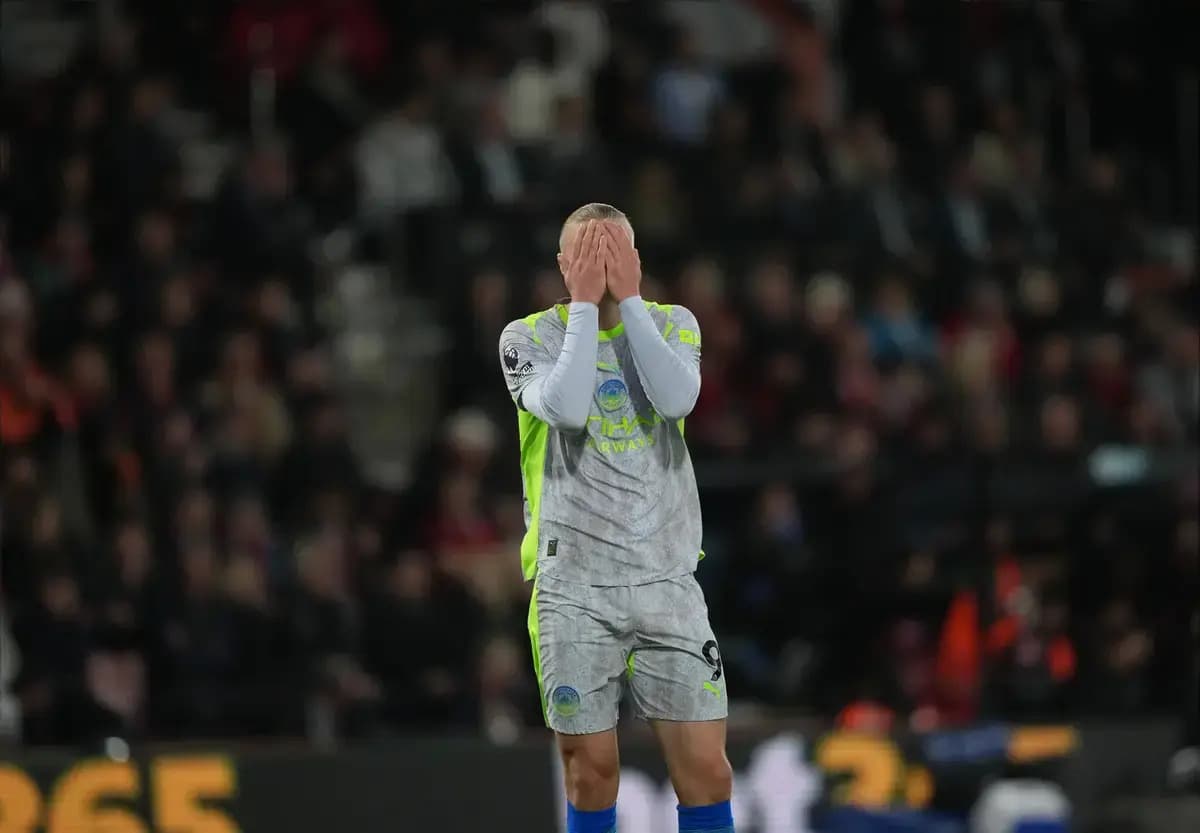
At the Vitality Stadium, City arrived knowing the equation was brutally simple: win, or watch the title slip away. They left with a 1-1 draw, a late Erling Haaland equaliser, and the cold realisation that this time the chasers had run out of road.
Bournemouth bite, City blink
For a while, it looked like the champions-in-waiting might still find a way. City started sharply, moved the ball crisply, and thought they had the perfect platform when Antoine Semenyo’s early strike was chalked off for offside against his former club.
That let-off should have jolted them. Instead, it emboldened Bournemouth.
Andoni Iraola’s side grew into the game, snapping into challenges, pressing high, refusing to be overawed by the occasion or the opposition. The Vitality, once a polite stopover for title contenders, has become something else entirely under the Basque coach: hostile, awkward, loud.
The breakthrough, when it came late in the first half, felt like a statement. Eli Junior Kroupi picked up the ball, shifted his weight, and sent a curling effort beyond Gianluigi Donnarumma and into the top corner. A goal of outrageous quality, delivered with the certainty of a player who has no interest in scripts written elsewhere.
City, so often the ones dictating the narrative, suddenly looked like extras in someone else’s story.
Haaland’s late strike, too late for the title
Pep Guardiola’s side emerged after the interval with the urgency they had lacked before the break. They pushed higher, moved quicker, took more risks. Nico O’Reilly had a glorious chance early in the second half, the kind that usually sparks one of those inevitable City comebacks.
He missed. The tension grew.
Bournemouth refused to retreat into their shell. They hunted a second goal, and David Brooks, once of City’s academy, twice came close to twisting the knife. His movement and timing stretched a defence that looked increasingly desperate.
Time drained away. The title, in effect, drained with it.
Then, deep into stoppage time, Haaland did what Haaland does. In the 90+5th minute, he finally found space, finally found a finish, rifling home to salvage a point and briefly ignite hope of one last twist.
But there was no grandstand finish, no late onslaught that bent the match to City’s will. The whistle went. The point was not enough. Arsenal, after 22 years of waiting, were champions.
For City, it was the most painful kind of result: not a collapse, not a humiliation, just another draw in a season where too many of them have cut deeper than any defeat.
Draws, not defeats, did the damage
Strip away the emotion and the numbers tell their own story. Four defeats across the campaign. No long, spiralling crisis. No extended losing run like last season. On the surface, it looks stable.
But titles are not lost only on bad days. They are lost on days that should have been better.
Tottenham away. Nights like this at Bournemouth. Matches where City created enough, controlled enough, and still walked away with only a point. One or two of those you survive. Accumulate them, and they become fatal.
Arsenal did not blow the league open with a freakish winning streak. They simply kept winning when City stalled. More consistent in the first two-thirds of the season, more ruthless when the margins were fine. The kind of consistency City used to own.
Guardiola’s side have rallied since their derby defeat in January, going domestically unbeaten for months, reminding everyone of their ceiling. But too many times, they hit the bar instead of the net. That is the standard now: anything short of relentless is punished.
A transition, but not a collapse
Context matters. This has been a season of change at City, a campaign that always carried the feel of a bridge between eras.
Last year’s problems forced a reset. Big personalities out, fresh faces in. That never clicks overnight, no matter how sophisticated the recruitment or how polished the coaching. New players had to learn the demands, the rotations, the weight of expectation in sky blue.
Over the course of the season, several of them have grown into the shirt. Roles have settled. Combinations have formed. The football, at times, has looked like the next iteration of a familiar machine.
And despite the disappointment of surrendering the league, this has still been a trophy-winning side. Two pieces of silverware already in the cabinet, two more than last year. That matters in a dressing room. It matters in the boardroom too.
This has not been a collapse of a dynasty. It has been a recalibration. An imperfect, sometimes frustrating, but ultimately progressive step in what is now clearly a two-year transition.
Life after Pep: what comes next
The question now is not just about this season, but the next era.
The Premier League title is gone. The club’s greatest manager is heading for the exit after a decade that has reshaped English football. The mood around the Etihad could easily sink into gloom.
Yet the foundations remain formidable. This is a double-winning squad built around young players, many of them only just entering their peak. They have experienced a season where perfection slipped, and that tends to sharpen, not dull, elite athletes.
Enzo Maresca is being lined up to step into the dugout. He knows the club, understands the positional play that underpins everything City do, and will want to put his own stamp on a group already steeped in Guardiola’s ideas. There will be arrivals to suit his blueprint. There will be departures to free space and salary.
What he inherits is not a fading force but a wounded one. A team with something to reclaim, not something to cling onto. For a new coach, that is not a bad starting point.
One last Etihad farewell
Before the reset comes the goodbye.
With the title race settled, Sunday’s final fixture against Aston Villa might look like a dead rubber to the neutral. It will not feel like that inside the Etihad.
Bernardo Silva, John Stones and Guardiola himself are expected to take their final bows in City colours. Three figures who have helped define the club’s greatest era, three players and a manager whose fingerprints are all over the modern identity of Manchester City.
There will be no tension over permutations or rival results. No glancing at phones, no counting goal difference. Just a chance for the sky blue faithful to fill the stadium, breathe, and say thank you.
No trophy lift, but a celebration all the same. Of titles won, records broken, standards set. Of a cycle that is closing, and another about to begin.
Bournemouth’s new reality
Amid all of this, Bournemouth deserve more than a passing mention in someone else’s coronation story.
This is a club that not long ago lived on the edge of the relegation zone. Now they sit in mid-table, glancing upwards, their form and football worthy of European conversation. That is not a fluke. It is the product of clear coaching, smart recruitment, and a squad that has bought into Iraola’s aggressive, front-foot style.
The Vitality used to be a routine away day for City, the kind of fixture pencilled in as three points before a ball was kicked. Those days have gone. Trips to the south coast now come with a warning label for the elite.
Bournemouth stood toe-to-toe with the champions, refused to fold under pressure, and almost took all three points. On this evidence, they will not be sneaking into Europe if they get there. They will be striding in.
City leave with regret, Arsenal with the title, Bournemouth with respect. Next season, all three will be chasing something different. Only one question really lingers: who learns most from nights like this?