.svg&w=384&q=75 "Pitchgist logo")
Lionel Messi's Historic Hat Trick Against Algeria
KANSAS CITY, Mo. — Lionel Scaloni has lifted the World Cup, survived La Liga title races and Copa del Rey finals, and played hundreds of games in the white and blue of Deportivo La Coruña. He has seen most of what this sport can throw at a man.
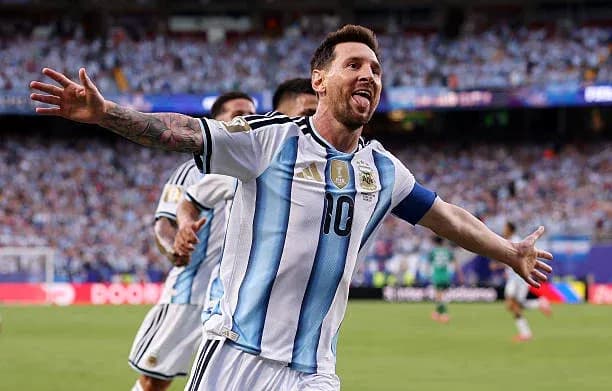
Yet nothing quite prepared him for the sight of Lionel Messi walking off the field on a warm Tuesday night in the Midwest, ball under his arm, hat trick secured, Argentina 3, Algeria 0.
Scaloni met him at the touchline, wrapped him in a hug, and cracked.
The Argentina manager is not one to hide what he feels. At 48, he wears his emotions like a captain’s armband. But this was different. This was the opening match of a tournament Argentina expects to stretch to eight games, not a final, not a farewell. Still, the tears came.
That is Messi. He doesn’t just move crowds; he moves the men who share a dressing room with him, the staff who build teams around him, the coaches who have to find new words to describe the same miracle.
“I know he has a group of friends by his side, people who are going to give their all for him,” Scaloni said. “They see him as if he were a god and also see him as though he were a dude from the neighborhood.
“It’s difficult to explain what he transmits to the group. I could be here an hour trying to explain, but you’ve got to be there to see what is felt. The atmosphere, the aura generated being by his side. That’s daily.”
Daily, yes. But not ordinary.
A Hat Trick and a History Lesson
This was Messi bending another World Cup night to his will. Three goals, each one another step into the record books, his first-ever World Cup hat trick, a performance that overshadowed Kylian Mbappé’s earlier double and carried him past Ronaldo of Brazil and into a tie with Miroslav Klose for most goals in men’s World Cup history.
He did it with the familiar mix of inevitability and surprise. The runs from deep that defenders see coming and still cannot stop. The quick give-and-go, the snap of the shot, the sense that he is both everywhere and somehow invisible until it is too late.
Around him, the noise swirled. On the field, Algeria tried to hang on. In the stands, 69,045 people roared at every touch. On the touchline, Scaloni fought back tears on what Messi later described as a difficult day for his coach for reasons away from the pitch.
Messi, as usual, refused to be drawn into the numbers game.
“Honestly, no,” he said when asked if he dwells on the historical tallies. “It’s an honor to be there for what it means, to be alongside Klose. Ronaldo is there, too. I don’t think it means anything. Mbappe scored two today. Ultimately, it’s a statistic and nothing more. It’s an honor to be able to compete with them. For me, Ronaldo was a very great one, and he’s not first, so ... it shows what a statistic does.”
He shrugs at history while rewriting it in real time. That, too, is Messi.
‘Messi Things’
Algeria didn’t collapse. They competed, they pressed, they tried to squeeze space. Ibrahim Maza, one of their attacking sparks, walked off with the feeling that his side had not disgraced itself.
“We weren’t too bad,” he said, before admitting they simply couldn’t overcome “Messi things.”
What are “Messi things”?
“I don’t think I need to explain it,” Maza replied. “I think you just need to watch the game, and then you know what ‘Messi things’ means.”
The phrase hangs there, perfect in its vagueness and absolute in its clarity. It covers the full package: the way Messi starts a move on the halfway line and somehow finishes it in the box; the way he ghosts into pockets of space even when every eye in the stadium is trained on him; the way a foul that might have drawn a card on another day goes unpunished and, in the next heartbeat, the ball is in the net.
He does not just score. He tilts the field. He takes games that feel balanced and rips them out of shape.
That is why comparisons to Klose, to Ronaldo, to anyone, really, feel incomplete. The numbers are one thing. The control over the entire rhythm of a match is another.
The Aura and the Demand
For Argentina, this cannot be the peak. It has to be the opening note.
The defending champions came into the tournament with a flicker of concern around their captain’s fitness after an injury with Inter Miami. On this evidence, the worry already feels like a footnote. Messi looked sharp, hungry, relentless, a 36-year-old still playing as if every World Cup minute might be his last.
But he cannot do it alone, and he knows it. The aura Scaloni talks about is not a comfort blanket; it is a demand. The players around Messi, the ones who see him as both god and neighbor, have to match that level, or at least chase it as far as they can.
“This national team is here to compete. We never get ahead of ourselves. We go game by game,” Messi said. “This national team, the group keeps showing that it’s not relaxing, that it will compete the same way no matter who the opponent is — sometimes better, sometimes worse, but always competing.
“There’s no doubt. We’re going to fight until we can’t.”
The next fight comes on June 22, against Austria in North Texas. Messi refuses to look beyond it. The rest of the world will, of course, already be sketching out knockout brackets and dream scenarios, but inside this Argentina camp the message is simple: no shortcuts, no complacency, no nostalgia.
They have been to the summit. They know how hard it is to get back.
Scaloni’s tears on this first night of the title defense said as much as any tactical tweak or postgame soundbite. This is not just about repeating a triumph from 2022. It is about savoring, and maybe extending, the last great chapter of a once-in-a-century player.
If Messi stays healthy and brilliant, if that aura keeps pulling everyone in the shirt a level higher, Argentina will give themselves a chance. And if they reach another final, if the confetti falls again and Messi stands there with another trophy in his hands, Scaloni will almost certainly cry once more.
He will not be alone.