.svg&w=384&q=75 "Pitchgist logo")
Kylian Mbappé Aims for World Cup Glory
Kylian Mbappé is hunting history, but not the kind that fits neatly into a record book.
On a humid night in the round of 32, he tore through Sweden with the cold efficiency of a striker who knows exactly where he’s going. Two goals, a 3-0 win, and France cruising into the last 16. Eighteen World Cup goals in 18 games now, one behind Lionel Messi’s all-time record of 19 and level with the Argentine on six in this tournament.
The numbers are outrageous. Mbappé barely wants to talk about them.
“The goal is to go as far as possible – to make it to July 19th and come back here,” he said, eyes fixed on New York and the final, not the scoring charts. The message was clear: the trophy matters, the rest is noise.
He acknowledged the obvious – score more, climb higher in the rankings – but quickly pushed the conversation back to what lies ahead. “I’m also convinced that Leo is going to score more goals, so I don’t focus too much on that. I’m more focused on the opponents we might face and how close we’re getting to our goal: the final.”
Messi’s Argentina now face Cape Verde in the last 32 on Friday. France head to Philadelphia, where a very different kind of challenge awaits.
France brace for Paraguay’s wall
Paraguay just showed the world how dangerous they can be when they shut the game down and drag giants into the mud. Germany, four-time world champions, found that out the hard way on Monday, suffocated for 120 minutes and then dumped out on penalties.
No one in the French camp expects Paraguay to suddenly open up.
There will be no swashbuckling from the South Americans on Saturday. They will sit deep, spoil, and wait. France know it, and Mbappé made it clear they will not stroll into this one.
“I think we’ll keep working between now and the Paraguay match to see what we can improve, because there are still some sequences that aren’t quite clear enough, there’s room for improvement,” he said.
France’s attack looks ruthless enough that even an ultra-defensive block may not be safe. “Still, I think it’s positive overall, and our ability to score goals means we always have the chance to take the lead in matches.”
That ability was on full display against Sweden. Beyond the goals, there was a moment that said even more about this France side. After one of Mbappé’s strikes, the players sprinted straight to Didier Deschamps, wrapping their coach in a tight embrace, a gesture loaded with meaning after the recent death of his mother.
“I think that reflects the spirit of this group – it’s part of our DNA. We are all together,” Mbappé told beIN Sports. “We know the coach has been through a difficult experience; unfortunately, everyone goes through that at some point and it’s very hard.”
For all the talk of systems and stars, this is a team playing with a shared purpose – and for a coach they clearly care about.
Belgium’s golden generation on the clock
While France stride on, Belgium’s so-called golden generation is walking a tightrope.
They have already done something they failed to do in Qatar: get out of the group. A 5-1 demolition of New Zealand sealed top spot in Group G and restored a measure of authority after the disappointment of 2022. It also ticked off coach Rudi Garcia’s first objective.
“We wanted to finish first in the group stage and we succeeded,” Garcia said in French. “Of course we wanted to win more — we know the story of our World Cup so far. Now it is time for the knockout phase. Senegal is a big team. But, you have to beat them, too, if you want to go far in a World Cup.”
The stakes are sharper now. For Kevin De Bruyne, Romelu Lukaku and the rest of this ageing core, there may not be another shot at this stage.
Belgium’s group record – one win, two draws – was solid rather than spectacular, but it was enough. On Wednesday in Seattle, they face a Senegal side that finished third in Group I yet emerged from one of the tournament’s most unforgiving groups, sharing the stage with France and Erling Haaland’s Norway.
“We know it will be a tough match,” Lukaku said in French. “Senegal has a lot of top-level players, and the coach is, too. I think it’s 50-50. We really shouldn’t underestimate them.”
Events in the round of 32 have underlined that warning in bold. Germany, gone. The Netherlands, gone. Both toppled by underdogs – Paraguay and Morocco – who refused to accept the script.
“It doesn’t matter who the favorite is,” said forward Charles De Ketelaere. “We have confidence and need to be sharp. Yesterday showed that it doesn’t matter if you are the favorite.”
Belgium have looked secure enough at the back, conceding just twice in three games with Thibaut Courtois anchoring them. They will need that solidity again against a Senegal team that just smashed Iraq 5-0 and arrive with Sadio Mané in form and full of intent.
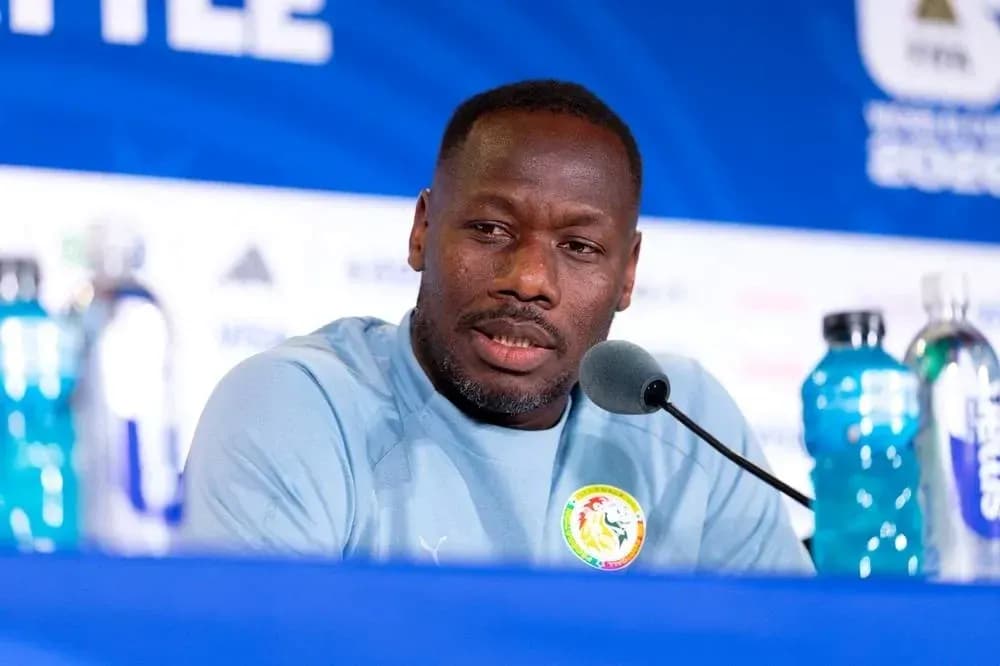
Senegal, though, have their own problems. First-choice goalkeeper Édouard Mendy, injured in a 3-2 defeat to Norway, remains out. Coach Pape Thiaw confirmed that reserve keeper Mory Diaw, who kept a clean sheet against Iraq, is set to continue.
“Mory had a great performance,” Thiaw said in French. “He kept a clean sheet and I think (as) the goalkeeper tomorrow, we hope that we’ll also come up with a clean sheet.”
There is no fear in Thiaw’s voice, only opportunity. He has watched Paraguay and Morocco rip up reputations and sees a door opening.
“It’s not because you finished top of your group that you’re not going to be knocked out in the next round,” he said. “That’s exactly what happened with the Netherlands. It’s another tournament starting. We are looking for the win tomorrow so that we can continue our journey.”
Garcia, for his part, will have one more defensive option available. Center back Zeno Debast has recovered enough from a left leg injury to rejoin training, though he is not expected to start.
“Zeno Debast is with the group, but tomorrow is still too soon,” Garcia said. “He is making progress, though. He still needs time to get fully fit, as was anticipated. I am very satisfied with the defenders we have already called upon.”
The light is dimming for Belgium’s stars. Senegal, with pace, power and belief, are ready to test just how much they have left.
England walk into a trap game
Elsewhere, England step into a last-16 tie that feels as much psychological as tactical.
They face the Democratic Republic of Congo in Atlanta on Wednesday, with a place in the last 16 on the line and the ghosts of Germany and the Netherlands fresh in the air. Two European giants, both favorites, both knocked out on penalties by sides who refused to bow.
The Three Lions are chasing the end of a 60-year drought without a major trophy. They know the path is open. They also know it can close in an instant.
“I feel it is a privilege to be in these situations. I think we can just accept it, we are the favorites (against DR Congo),” coach Thomas Tuchel said.
Then came the warning. “The games so far in round of 32 speak a very clear language. It’s narrow, narrow margins.”
England will lean heavily on Jude Bellingham and Harry Kane, their two world-class pillars. At the back, they will be without Reece James, an influential presence who misses out through injury. It is the kind of absence that can tilt a tight game.
DR Congo arrive with nothing like the same pressure. For them, this is already a triumph of resourcefulness and reach. Of the 26-man squad, 20 were born outside the country, many in France, where the talent pool runs deep. Yoane Wissa is familiar to English fans from the Premier League. Aaron Wan-Bissaka and Axel Tuanzebe once wore England colours at youth level before choosing the country of their roots.
Coach Sébastien Desabre has hammered home the message: the burden belongs to England.
“Our World Cup is already a success relative to our goals,” he said. “The pressure is on the England team.”
That dynamic – one side desperate to end decades of frustration, the other liberated by having already overachieved – has undone many a favorite before.
A defining night for the USA
Across the continent, the United States are preparing for a different kind of examination, one that stretches beyond tactics and lineups.
Football has spent years fighting for space in America’s crowded sports landscape. On Wednesday night in the San Francisco Bay Area, the national team get a stage that could change the conversation. Up to 30 million viewers are expected to tune in for the knockout clash with Bosnia-Herzegovina, a number that would have been unthinkable not long ago.
For Christian Pulisic, Gio Reyna and their teammates, this is more than a match. It is a chance to deliver the country’s first World Cup knockout win in almost 25 years and to do it with the nation watching.
“Everyone knows in the back of our minds what this could do for this country,” Reyna said. “We feel the country rallying around us. We see the momentum it’s bringing to the sport in this country, just through the group stage. But we also understand if we make a nice run in this tournament, what it could really do for the sport.”
The stakes are sporting and cultural all at once. Win, and the noise around this team could reach a level never heard before. Lose, and it becomes another “what if” in a long list.
Haaland breaks new ground for Norway
Away from the heavyweights and the host nation, another milestone quietly slipped into the record books.
Erling Haaland, the relentless spearhead of Norway’s rise, scored the goal that finally carried his country into the last 16 for the first time. A simple poke, a 2-1 win over Ivory Coast, and a historic step for a nation that has watched its star dominate club football and now sees him dragging the national team into new territory.
It was not the most spectacular strike of his career. It might be one of the most important.
From Mbappé’s chase of Messi to Belgium’s last stand, from England’s balancing act to the USA’s night of destiny, this World Cup is stripping away reputations and exposing realities. The question now is simple: who embraces the pressure, and who buckles under the weight of it?