.svg&w=384&q=75 "Pitchgist logo")
Kinsky's Redemption: From Madrid Collapse to Leeds Resilience
Antonin Kinsky walked off in Madrid like a man being escorted out of his own career.
Hooked after 17 minutes, two errors, two goals, and a Champions League last-16 tie seemingly gone, the Tottenham goalkeeper looked finished at this level. Peter Schmeichel, who knows the position’s scars better than almost anyone, called it a moment that would follow Kinsky “every time they see or hear his name”. The Loris Karius comparisons arrived on cue. Brutal. Inevitable. Apparently definitive.
They weren’t.
On Monday night, in a tense, nervous 1-1 draw with Leeds United, Kinsky didn’t just keep Tottenham alive in the relegation fight. He rewrote the story that was being told about him.
From Madrid wreckage to Leeds resistance
The road back started quietly. A recall against Sunderland last month when Guglielmo Vicario was injured. A few clean, unfussy games. A standout late save from a free kick in a 1-0 win over Wolverhampton Wanderers. Competent distribution. Signs of life, but not absolution.
Madrid still lurked in the background. Those images don’t vanish because you’ve had a solid afternoon at the Stadium of Light.
What Kinsky needed was a night that demanded greatness. Leeds provided it.
The first big moment came early and, in another narrative, might have been the headline act. Instead, it became the warm-up.
There were real doubts about Kinsky under the high ball. They were justified. His vulnerability from crosses had been exposed in the Carabao Cup defeat to Newcastle United in October, when he was beaten twice from deliveries he should have owned. The questions hadn’t gone away.
So when Brenden Aaronson swung a cross to the far post in the 21st minute and Joe Rodon – a former Spurs defender, no less – powered a header low towards the bottom-left corner, the script felt ominous.
Kinsky tore it up.
He dropped, fast and clean, down to his left, got a strong hand to the ball, then clawed it away before gathering. No spill, no second chance. It was a world-class save. And somehow, on this night, it was only the second-best thing he did.
A season hanging from a crossbar
The game became edgy. Mathys Tel bent in a superb finish to put Tottenham ahead, only to undo his own work with a reckless overhead-kick attempt in his own box. Dominic Calvert-Lewin buried the penalty. From control to chaos in a heartbeat.
The tension inside the stadium thickened with every minute. Spurs, locked in a survival scrap with West Ham United, could not afford to blink. Every point matters now. Every mistake is magnified.
Deep into stoppage time, with Leeds swarming forward and Tottenham clinging on, came the moment that may yet define their season.
Sean Longstaff, eight yards out, met the ball with a fierce, rising strike. It was the kind of effort that usually rips past a goalkeeper before he has fully processed the danger. Kinsky somehow got there.
He didn’t just block it. He redirected it, fingertips forcing the ball up and onto the crossbar. The rebound flew away, the danger cleared, and Tottenham’s two-point cushion over West Ham remained intact.
Matt Pyzdrowski, a former professional goalkeeper and specialist analyst, picked apart the save with a coach’s eye. What impressed him wasn’t just the reflex, but the calculation.
As the ball was slipped in behind, Kinsky didn’t panic and charge. He stayed connected to the turf, moving in short, controlled steps, sliding subtly toward his near post, always aligning himself with the ball. With Micky van de Ven recovering across, Kinsky understood his job: don’t overcommit, don’t guess, stay balanced, be ready.
His set position, Pyzdrowski noted, was textbook. Feet shoulder-width apart. Chest over knees. Hands at waist height. Neutral, but primed. That stance kept his hands free for the upper half of the goal and his legs ready to shut down the lower part, reminiscent of David de Gea at his peak for Manchester United.
If he had sunk lower or widened his base, he would have lost the explosive push needed to get up to the shot, and he might have blocked his own hands’ path to the ball. Instead, his compact, upright shape shortened the distance his hands had to travel. Reaction and coordination did the rest.
The remarkable part was the violence of the movement. The way he powered his right hand up, so late, so fast, to meet a ball that looked destined to decide the match. As Pyzdrowski put it, not every goalkeeper in that situation is capable of producing that save.
Kinsky is not every goalkeeper.
Mind over wreckage
That’s the point that now hangs over his story. His distribution has always suited a coach like Roberto De Zerbi, who wants his goalkeeper to act as a playmaker in possession. His shot-stopping, Madrid aside, has never been in doubt.
What Monday underlined was the steel behind the gloves.
Few, if any, expected him to rebound this quickly from the Metropolitano debacle. Nights like that can bury careers. Instead, Kinsky has spent the past month chiselling out a different identity: calm under crosses, authoritative in his area, decisive when the margins shrink to split seconds.
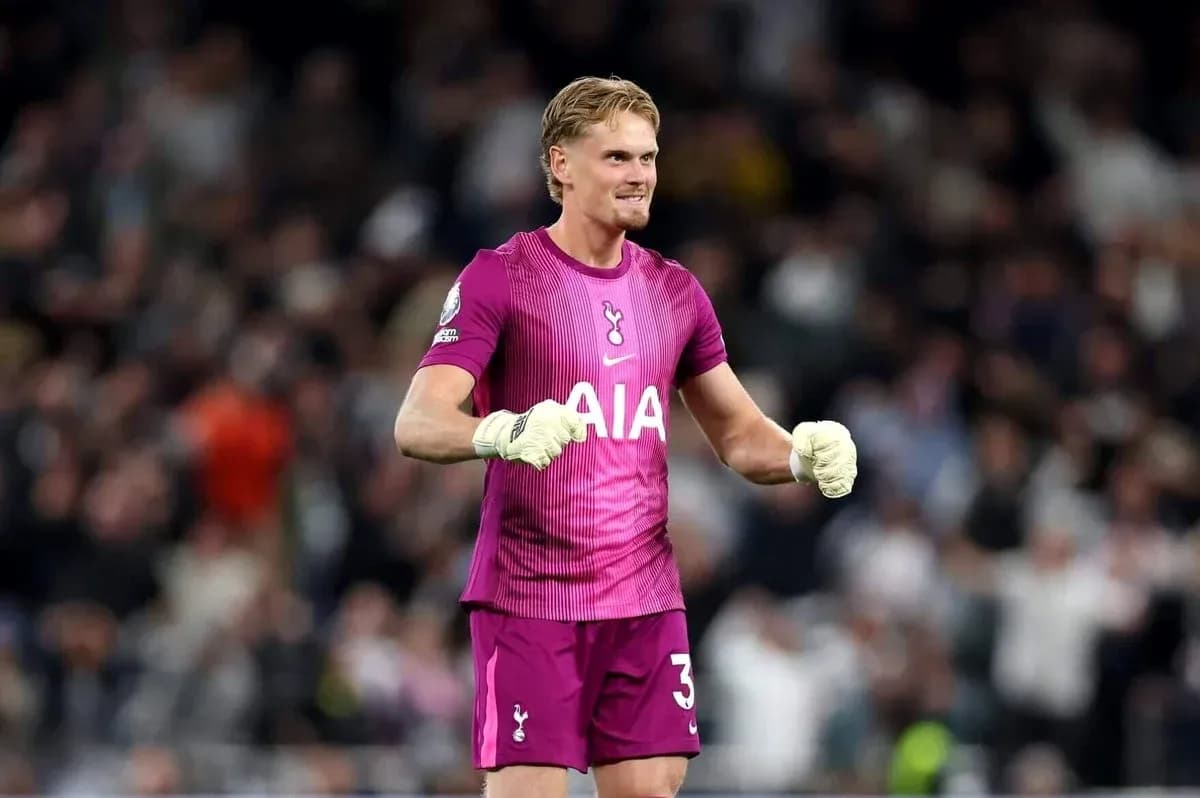
At full time against Leeds, he stood in front of the away fans and soaked in their applause. Not as a project. Not as a problem. As one of Tottenham’s most reliable performers in a desperate run-in.
On the same pitch, Tel was living the other side of the sport’s ruthlessness. A brilliant, curling opener that showcased his talent. A rash, ill-judged overhead clearance attempt that handed Calvert-Lewin the chance to level from the spot.
De Zerbi promised “a big hug and a big kiss” for the young forward afterwards. Tel will need that arm around his shoulder. He doesn’t have to look far for a template of how to respond.
Spurs’ fate, Kinsky’s next chapter
Tottenham sit just two points clear of West Ham, who head to Newcastle United on Sunday with survival on the line. This isn’t a comfortable mid-table spring. It’s a knife-edge.
Chelsea and Everton await Spurs in their remaining fixtures. Both games will test nerve as much as talent. Both will likely test Kinsky again.
His redemption arc, in many eyes, is complete. Madrid no longer feels like the final word. It feels like the first act.
If Tottenham stay up, they may look back at a right hand, an eight-yard rocket, and a crossbar that shook under the weight of a season. And they may ask how close they came to letting that goalkeeper, on that night in Spain, slip away for good.