.svg&w=384&q=75 "Pitchgist logo")
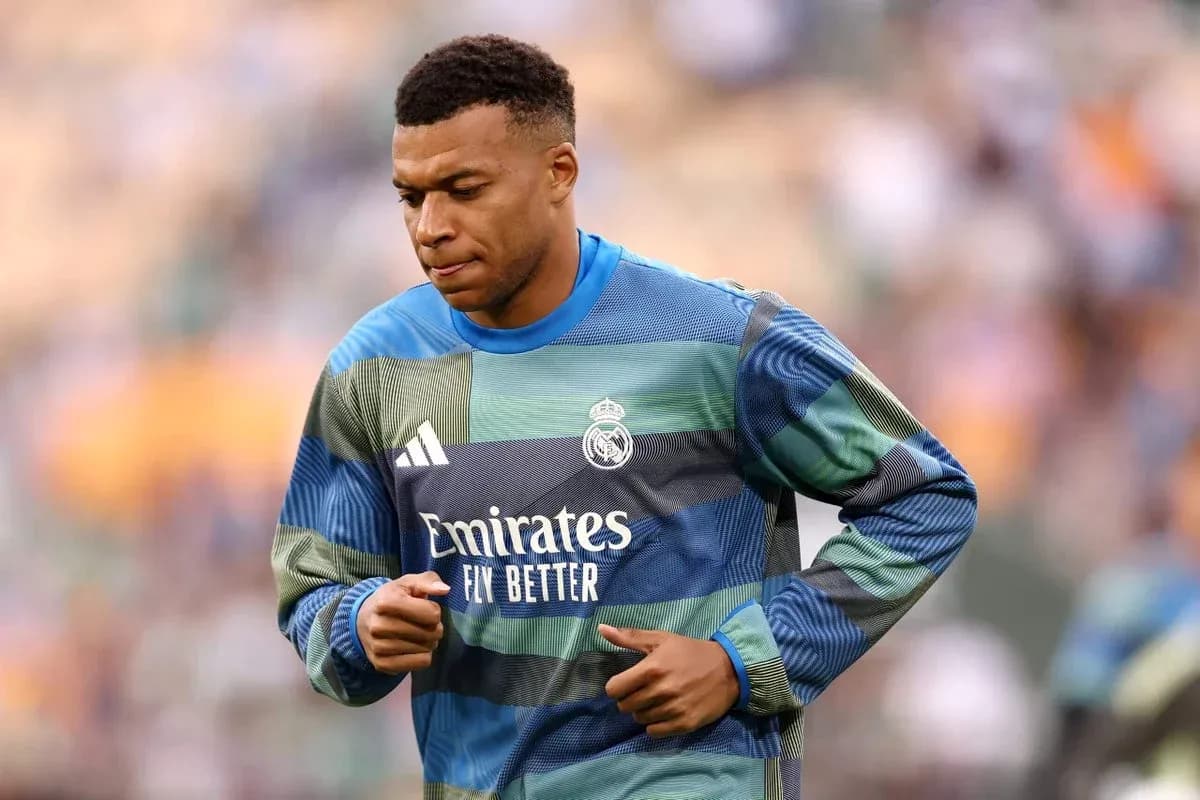
Kylian Mbappe: The Superstar at Real Madrid's Crossroads
As Real Madrid’s players file through the concrete hush of the Bernabeu tunnel, they pass the same line every day. Alfredo Di Stefano, immortalised in white paint on grey wall:
“No player is as good as all of you together.”
Once, it felt like a motto for a dynasty. Now, it reads more like a challenge.
A club built on galacticos is staggering towards the end of a second straight season without a major trophy. The stands that once reserved their fury for referees and rivals have turned inwards. Vinicius Junior, Jude Bellingham, Kylian Mbappe — all have heard the whistles. So has Florentino Perez, architect of the modern superstar project.
The tension is no longer just a murmur. It is visible, audible, physical. Aurelien Tchouameni and Federico Valverde traded blows on the training ground last week. That was not an isolated flashpoint; it was a snapshot.
And at the centre of the storm stands Mbappe.
A superstar under the microscope
Madrid pursued Mbappe for years, suffered public rejection, then finally landed him on a free in June 2024 with a huge signing fee and the biggest salary in the squad. He arrived as the missing piece for a team that had just won La Liga and the Champions League, a side already lit up by Bellingham and Vinicius Jr.
On paper, the plan was simple: take a dominant team and add one of the world’s most devastating forwards. Extend an era, not rebuild it.
Instead, Madrid now look fractured. And the debate has narrowed onto one question: has Mbappe been worth the wait, the money, and the disruption?
If you only look at the goals, the answer seems obvious.
Since his arrival, Mbappe has been Madrid’s leading scorer by a distance, with 77 goals across La Liga and the Champions League. He took the Golden Boot in 2024–25. In the Champions League quarter-final exit to Bayern Munich last month, he was one of the few Madrid players who hit their expected level, scoring twice across the tie. His 15 goals in this season’s competition leave him on course to finish as top scorer, brushing close to Cristiano Ronaldo’s record of 17 from 2013–14.
The numbers are not flattering. They are dominant. He has scored almost double the goals of any team-mate since he signed, monopolising Madrid’s attacking chances. He has even outperformed the quality of those chances, with seven more goals than expected.
Yet the Bernabeu still booed him.
In the first home game after that Bayern elimination, Mbappe walked out to a chorus of whistles. It was not a one-off. Criticism has spilled beyond the pitch.
A training-ground row with a member of Carlo Ancelotti’s coaching staff before the trip to Real Betis on April 24 added to the sense of unease. Sources described it as one more crack in a dressing room already under strain.
Then came anger over his decision to travel to Italy with his partner during injury recovery. His camp pushed back, issuing a statement insisting that some of the criticism came from “over-interpretation” of a recovery process “strictly supervised by the club” and did not reflect “the reality of Kylian’s commitment and daily work for the team”.
Still, the question lingers, louder each week in Madrid: is this the superstar they waited for?
The case against: brilliance with a cost
Inside the club, doubts did not start with the whistles. They began long before Mbappe pulled on the shirt.
When his signing from Paris Saint-Germain was finally nearing completion two years ago, a member of Ancelotti’s staff pointed to one specific concern: his off-the-ball work. The numbers on his defensive contribution were startlingly low.
Staff were already worrying about how to keep the team balanced. It sounded pessimistic at the time. Madrid had just lifted a record 15th European Cup with a deep, gifted squad. Mbappe felt like a luxury you simply accommodate.
That early analysis now looks sharper than anyone in the boardroom would like to admit.
Across La Liga and the Champions League, Mbappe registers the fewest tackles, interceptions and ball recoveries per 90 minutes of any Madrid player. The picture worsens when you look at “true” tackle attempts — every time a player actually goes in for a challenge, whether they win it, lose it, or concede a foul.
In La Liga, among all outfield players, he ranks 461st out of 461. Dead last. Around 0.6 true tackle attempts per game.
For a star forward, defensive work is negotiable. For a star forward in a team packed with attacking egos, it becomes a problem.
Madrid have tried to cram Mbappe into line-ups alongside Vinicius Jr, Bellingham and Rodrygo. Someone has to run. Someone has to cover. Too often, it has not been Mbappe.
Then there is the left flank.
Mbappe arrived as a player who thrives cutting in from the left. Vinicius Jr is already one of the world’s best in that exact role. They have not found a natural partnership. They have collided.
Touchmaps tell the story: both gravitate to the same areas in build-up, drifting to that left channel. There have been flashes — quick exchanges, combinations that hint at something terrifying — but nothing like the instinctive understanding Vinicius once shared with Rodrygo.
This is not just a tactical puzzle. It is a planning failure. Who believed that two dominant, left-sided attackers could coexist long-term without compromise?
Madrid’s attacking output raises another uncomfortable point. They scored 87 league goals in 2023–24, before Mbappe arrived, in a season without a clear No 9. Bellingham floated as a false nine, Joselu came off the bench as a target man, and the attack spread its responsibility.
Last season, with Mbappe, they scored 78 in La Liga. This season they sit on 70 with three matches left.
The team has a superstar reference point now, but the overall picture has not improved. Has it even regressed?
And then comes the dressing room.
Mbappe was supposed to be a leader, the man who shoulders pressure when things get ugly. That has not always been visible. His arrival followed years of pursuit, years in which Madrid heard “no” more than once. When he finally joined, Perez praised the “great effort” Mbappe had made to come.
Many fans never bought that line. They remember 2022, when he chose to stay at PSG. They see the biggest salary in the squad, no Champions League trophy yet in white, and they ask what exactly he sacrificed.
In a club where every gesture is magnified, that perception matters.
The case for: a Ronaldo-style wait?
Strip away the noise and the contradictions, and one thing remains: Mbappe is still one of the best footballers on the planet.
He could easily dominate this summer’s World Cup with France. He has already done it once, winning the tournament at 19 in 2018. Four years later, he became only the second player in history, after Geoff Hurst, to score a hat-trick in a World Cup final, dragging France to the brink before losing to Lionel Messi’s Argentina.
He thrives when he is the undisputed main man. With France, that status is clear. In Madrid, it has not always been.
Under former coach Xabi Alonso in the first half of this season, when Mbappe was given a more prominent attacking role than Vinicius Jr, he looked freer, sharper, more decisive. The hierarchy suited him. The performances followed.
There is room for growth. His defensive work can improve. His positional compromise with Vinicius can evolve. At 27, with three years left on his contract, he is still at peak age, not beyond it.
Madrid have also lost heavyweights in recent seasons: Karim Benzema, Toni Kroos, Luka Modric. Voices who knew how to ride out storms, who understood the club’s rhythms and demands. In that vacuum, a player of Mbappe’s ability inevitably becomes a reference point, whether he wants the responsibility or not.
Off the pitch, despite recent missteps, he has often handled the microphone with poise. After Vinicius Jr accused Benfica’s Gianluca Prestianni of racist abuse in their Champions League play-off first leg in February, Mbappe stepped up with a measured, articulate defence of his team-mate. UEFA later banned Prestianni for six games for homophobic, not racist, conduct, but Mbappe’s stance reinforced his role as a public face of the dressing room.
The club hierarchy has seen this movie before.
Cristiano Ronaldo, Mbappe’s childhood idol, did not explode into instant European dominance at Madrid. In his first two seasons, the club won only a Copa del Rey. It took five years for him to lift a Champions League in white, in 2014 against Atletico Madrid in Lisbon.
Those early seasons were not smooth. In September 2012, after scoring twice against Granada, Ronaldo refused to celebrate and later said: “I’m sad and the people at the club know it.” The drama was constant, the scrutiny relentless.
What followed reshaped modern football history: four Champions League titles with Madrid, a flood of goals, and a departure in 2018 as the club’s all-time leading scorer.
Ronaldo’s story does not guarantee Mbappe’s. The game has changed, the squad is different, the context is harsher. But it does offer a warning against rushing to judgement on a superstar whose raw numbers already rival the best.
Di Stefano’s wall, Mbappe’s crossroad
So here Madrid stand: a club with a generational forward who scores at an astonishing rate, yet divides its stadium; a team that added more talent and somehow looks less coherent; a dressing room where friction has become routine.
The question is no longer whether Mbappe is good enough. The numbers answer that. The question is whether Madrid are willing — and able — to bend a team around him without losing the collective Di Stefano once championed.
“No player is as good as all of you together,” the wall says.
Right now, Mbappe is testing where that line truly lies for Real Madrid — and whether this club still believes that the sum should be greater than its brightest star.