.svg&w=384&q=75 "Pitchgist logo")
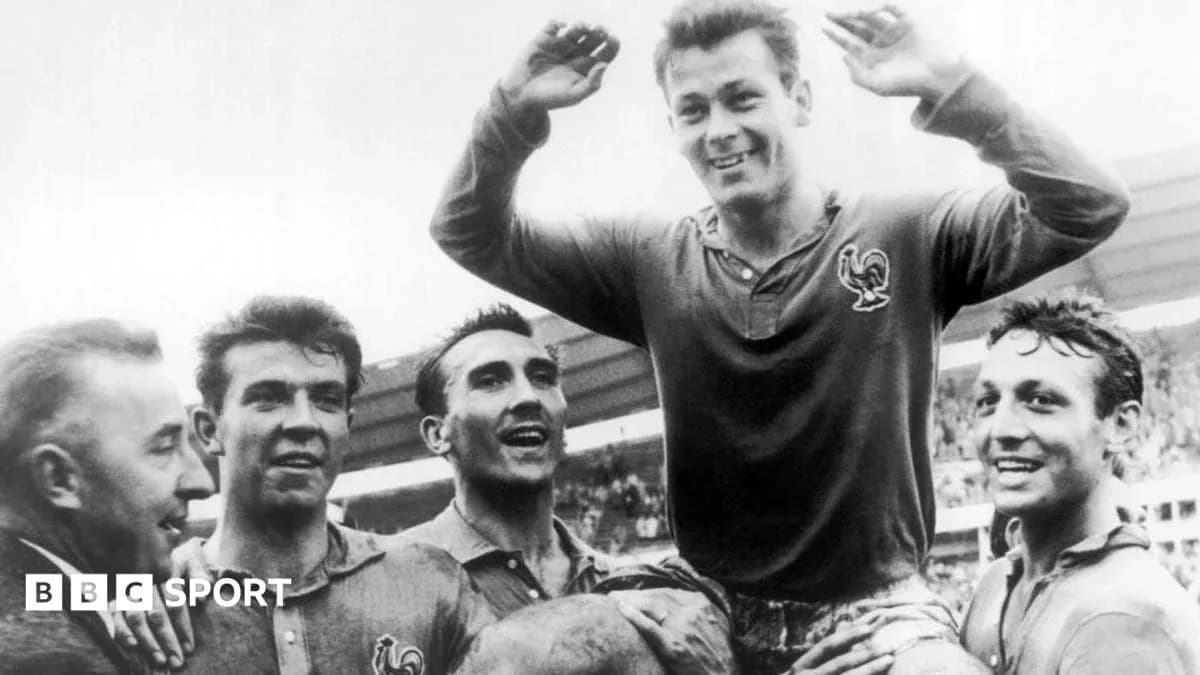
Just Fontaine: The Legend of World Cup Goals
Just Fontaine’s name usually lives on the fringes of football chat. A quiz answer. A line in a record book. Thirteen goals at a single World Cup, Sweden 1958, and then silence until the next tournament rolls around.
But that number hangs over the 2026 World Cup like a challenge.
In North America, the finest forwards of this age – Lionel Messi, Kylian Mbappe, Erling Haaland, Harry Kane, Jude Bellingham – are sprinting after a ghost. Mbappe already has eight. Messi and Haaland sit on seven. Kane and Bellingham trail by one. The goals are flying in, helped by an expanded 48‑team format that stretches the route to the final to eight games for those who go deep.
And yet, even with the extra safety net of an additional round, they are still staring up at Fontaine. Thirteen in six. In borrowed boots.
The man behind the number
The story begins far from Paris, far from the Parc des Princes or the Stade de France. Just Fontaine was born in Marrakesh in August 1933, when Morocco was still a French protectorate. By the time Morocco gained independence in 1956, Fontaine was already a rising star in the French leagues and an established international. The choice had effectively been made for him. He would wear the blue of France.
That made the 2026 quarter-final between France and Morocco the Just Fontaine derby in all but name, a reminder that the man whose record everyone is chasing today might well have lined up for the Atlas Lions in a different era.
Yet even for France in 1958, Fontaine was never supposed to be the centrepiece. He was not first choice. Rene Bliard held that status until an injury in a warm-up match opened the door at the last minute. The change was so sudden that Fontaine had to borrow a pair of boots from team-mate Stephane Bruey for the opening game.
No custom moulded studs. No sponsor’s logo. Just a striker, a pair of someone else’s boots and a chance.
He arrived in Sweden with only five caps and fresh from an operation on his meniscus during the season. The knee issue had cast doubt on his participation, but it also meant he came into the tournament with energy that many others, drained by a long campaign, did not have. Albert Batteux, the France manager, turned to him. Fontaine did the rest.
“My mind was not on the goals record”
Fontaine was hardly an unknown quantity in club football. At Nice and then at Reims he had become a ruthless finisher, winning four Ligue 1 titles in total – one with Nice, three with Reims. In the 1957-58 season, Reims completed the French league and cup double. A year later, they would reach the European Cup final, where Fontaine top-scored in the 1958-59 competition with 10 goals, only to see Real Madrid lift the trophy.
Inside the France camp, he shared a room with Raymond Kopa, the elegant playmaker who would win the 1958 Ballon d’Or, with Fontaine finishing third in that vote. They talked football, movement, timing. The understanding between them would light up Sweden.
Yet Fontaine insisted, speaking to the BBC in 2002, that he never chased the Golden Boot.
“In those days there was not so much pressure on us,” he recalled. Only two journalists followed the team. The French hierarchy were so convinced the side would not go far that they handed the players just three shirts each for the whole tournament. No marketing campaigns. No daily media storms. Just football.
“My mind was not on the goals record at all,” he said. He even turned down a penalty in the third-place play-off.
The irony is brutal. The man who declined an easy route to goal still ended up with a record that has stood for 68 years.
Six games, thirteen goals
The fuse was lit in the opening group game. France 7-3 Paraguay. Fontaine scored a hat-trick, attacking the box with late runs, springing the offside trap, sliding finishes into the corners. It was the performance of a modern striker, not a sepia-tinted relic from the days of heavy leather balls and unprotected goalkeepers.
He scored in every match France played at that World Cup. Group stage, quarter-final, semi-final, third-place play-off. Each game added another layer to the legend.
France, with Fontaine and Kopa at the heart of a thrilling attack, became the tournament’s entertainers. The 1958 World Cup produced 126 goals, the second-highest tally in a 16-team format after 1954. France contributed 23 of them, with the front five alone scoring 22. They moved the ball quickly, interchanged positions, and cut through defences that looked leaden by comparison.
The semi-final brought them up against something even more powerful: Brazil, with a 17-year-old Pele. France lost 5-2 to a side that would go down as one of the greatest of all time. That defeat denied Fontaine the chance to play in a World Cup final, but it didn’t stop him.
The third-place play-off against West Germany gave him one last stage. He scored four in a 6-3 win. The third of those goals stands out: collecting the ball near halfway, he surged past defenders and tucked the finish into the far corner. The run, the balance, the composure – it would not have looked out of place when Michael Owen shredded Argentina in 1998.
Thirteen goals. Six matches. A record that L’Equipe would later describe as “unbeatable”.
France’s first great side
When people talk about France, they reach instinctively for 1998 and 2018, for Zinedine Zidane and Mbappe, for the modern superpower. The 1958 team rarely gets mentioned in the same breath.
It should.
With Fontaine leading the line and Kopa orchestrating, that side can stand shoulder to shoulder with any French generation. They were not flat-track bullies padding numbers in a weak era. They were only stopped by 1958 Brazil, a benchmark side in world football history.
Yes, defences were slower, less athletic. But the way France moved the ball, the speed of their attacks, the variety of their play – those qualities would travel across eras. Fontaine wasn’t just finishing moves; he was creating for others, linking with Kopa, dragging defenders out of position. He was, as L’Equipe put it at the time, a leader of the attack in the English style: courageous, combative, stubborn.
Then his World Cup story ended almost as abruptly as it had begun. Injuries cut short his international career. He never returned to the tournament stage. It is impossible not to wonder what France might have achieved in 1962 or 1966 with Fontaine still at his peak.
Beyond the goals
Retirement did not nudge him out of the game. Fontaine helped form the French players’ union, the UNFP, and became its first president in 1961, shaping the landscape for generations of professionals who followed. He moved into coaching, taking charge of France for two matches in 1967, then later managing PSG and Toulouse. Eventually he circled back to his birthplace, spending two years in charge of Morocco.
He also ran sports shops and, every so often, would be reminded of the statistic that refused to fade. Someone would ask who held the World Cup scoring record. Fontaine’s eyes still lit up when people remembered.
He used to joke that if he came back in 200 years, the record would still be there. The French press treated the mark with the same reverence. “Unbeatable,” declared L’Equipe.
Fontaine died on 1 March 2023 at the age of 89. He lived long enough to see France crowned world champions twice, to watch Mbappe explode onto the scene as the new spearhead of Les Bleus, and to hear his name invoked every time a striker hit a hot streak at a World Cup.
Now Mbappe is closing in again. So are Messi and Haaland. The record is finally under genuine threat.
How fitting would it be if a Frenchman, born 90 years after Fontaine in a very different world, were the one to take it? Or does the number 13, stitched to the memory of a man in borrowed boots, still have one more tournament left to defy them all?