.svg&w=384&q=75 "Pitchgist logo")
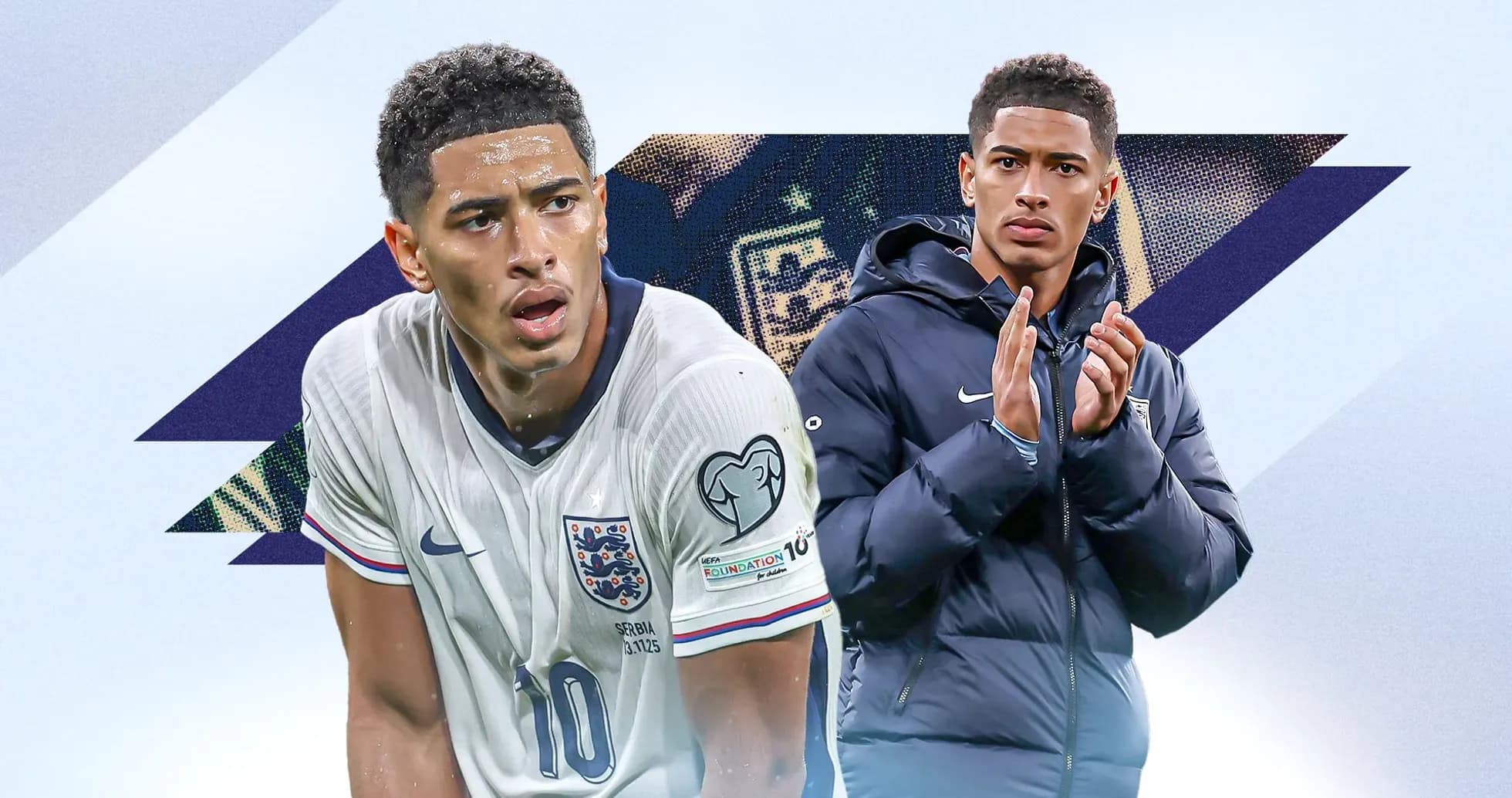
Jude Bellingham's Battle for England's No.10 Role
Thomas Tuchel has not tiptoed into the England job. He has kicked the door open and told his players the old certainties are gone. No reputations, no automatic picks. Every position is a fight.
Few feel that more keenly than Jude Bellingham.
While Bellingham has been in and out of camps with injury and post-surgery recovery, Morgan Rogers has quietly walked through the gap. The Aston Villa midfielder has turned a surge of club form into a genuine international case, slipping into that No.10 role and giving England a different kind of creator as Tuchel tinkered through qualifying.
The goals haven’t flowed for Rogers, not yet, but that isn’t really the point. He plays as a pure playmaker, an old‑fashioned No.10, living between the lines, knitting attacks together. Bellingham, for all his brilliance, is a hybrid: part playmaker, part runner, part force of nature. Tuchel has made it clear he prefers clarity.
"Rather than finding the best players a position to just have them on the field, it's maybe better to put everyone in their best position and have a competition. At the moment, the competition is between the two of them," the Germany coach said back in November, when the battle to start behind Harry Kane first came into sharp focus.
On form alone, Rogers has a strong claim. His last year in claret and blue, then in white, has been a steady rise rather than a spike, his influence obvious whenever England lean on possession and patterns. Bellingham, by contrast, now has to prove that his ceiling – one of the highest in world football – is worth the volatility that sometimes comes with it.
Because with Bellingham, the debate is no longer just about his football.
His game has always carried a swagger. It drives him, unnerves opponents, and at times spills over. The flashpoint came in that 3-1 defeat to Senegal last June, when his furious reaction to a VAR call that went against England became the enduring image of the night. Arms flung, eyes blazing, the rage was impossible to miss.
Tuchel was pressed on it soon after in an interview with TalkSport, and he chose to lean into the edge rather than dampen it.
"I think he brings an edge, which we welcome and which is needed if we want to achieve big things," Tuchel said. "It needs to be channelled. The edge needs to be channelled toward the opponent, towards our goal and not to intimidate team-mates, or to be over aggressive to team-mates or referees."
Then came the line that has followed him ever since.
Tuchel, trying to humanise the debate, brought his own family into it. "I see that it can create mixed emotions. I see this with my parents, with my mum that she sometimes cannot see the nice and well-educated and well-behaved guy that I see… If he smiles, he wins everyone, but sometimes you see the rage, the hunger and the fire, and it comes out in a way that can be a bit repulsive. For example, for my mother, when she sits in front of the TV, I see that, but in general we are very happy to have him, he's a special boy."
It was meant as nuance. It landed as a headline. And it has lingered over their relationship ever since.
Bellingham did not pull on an England shirt again until November, still working back from surgery. By the time he walked back into camp, every glance and gesture between player and coach was being read as a clue.
Tuchel’s first big call of that window only sharpened the focus. Bellingham sat on the bench against Serbia, watching as England tried to build without him. Three days later, he was back in the XI against Albania, restored to the role that has always felt like his natural stage. Then, with six minutes left of the final qualifier, the board went up. His number. Off he came, visibly unhappy, apparently gesturing in anger as he trudged to the touchline.
Tuchel did not sugar-coat it.
"That's the decision, and he has to accept the decision," he said. "His friend is waiting on the sideline, so you need to accept it, respect it, and keep on going."
Outside the camp, the scrutiny took on a different tone. The discussion around Bellingham’s attitude, his body language, even his facial expressions, has become relentless – and, in some quarters, something darker.
Former England striker Ian Wright called it out.
“I don't think they're ready for a black superstar who can move like Jude is moving. They can't touch him," Wright said of sections of the English media and fanbase. "He goes out there, he performs, he does what he does. It's too uppity for these people.
"They all love N'Golo Kante. He's a humble Black man, gets on with what he's doing. Someone like Jude frightens these people because of his capability and the inspiration he can give. Because if you are outspoken, Black, and playing to that level and not caring, that frightens certain people. It's a tiring exercise to speak about."
Strip away the noise and one thing remains obvious: when Bellingham hits his peak, England change level. He drags them up the pitch, bends games to his will, turns tight contests into his own stage. Those days, though, have come less often of late. Injury, adaptation, expectation – all have played a part.
So Tuchel flies into Dallas with a real decision, not a manufactured one. He can lean on one of the most gifted midfielders on the planet, knowing the emotional temperature might spike with him. Or he can reward Rogers, the in-form craftsman whose tournament experience is non-existent but whose recent body of work is hard to ignore.
This is not just about a name on a teamsheet. Tuchel has tried to spark Bellingham, to challenge him publicly, to demand more without losing the fire that makes him special. Yet the side-effects – the clumsy phrasing, the endless talk shows, the social-media clips – have smothered any cool assessment of what Bellingham is actually doing on the pitch.
He will wear the No.10 shirt this summer. That much is settled. Whether he walks out as England’s No.10 against Croatia is not.
Either way, he will own the spotlight. Match‑winning brilliance or flashes of petulance – Bellingham will write a story at this World Cup. The question now is simple, and it hangs over England’s entire campaign: when the defining moment comes, which version of Jude turns up?