.svg&w=384&q=75 "Pitchgist logo")
Japan Faces Brazil Without Kubo: A Test of Depth
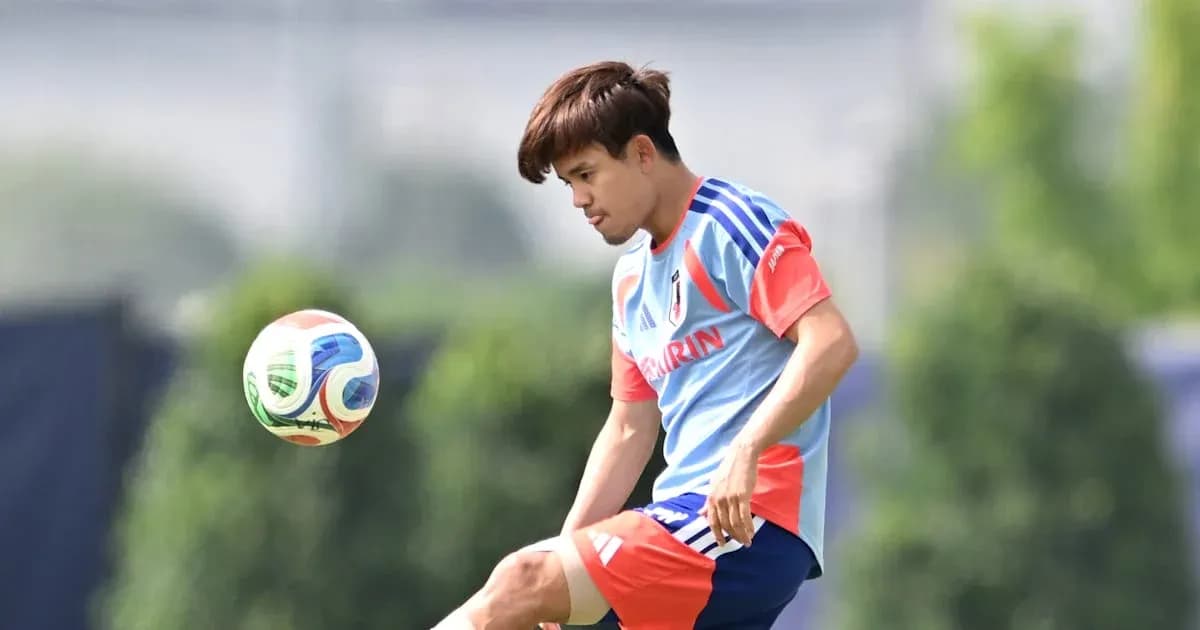
The tape on Kubo Takefusa’s left knee tells one story. His words tell another.
“I’m good,” he said on the eve of Japan’s World Cup round of 32 clash with Brazil, a casual shrug at an injury that has already cost him two matches and most of his tournament.
The reality is harsher. Since going down in Japan’s opening draw with the Netherlands, the Real Sociedad playmaker has been reduced to rehab sessions and lonely running drills, his knee heavily strapped, his influence confined to the sidelines. He has barely kicked a ball in anger since that first game.
On Sunday, coach Moriyasu Hajime made it official: Kubo will not play against Brazil.
“He’s doing everything he can to pick up his conditioning,” Moriyasu said in the pre-match press conference. “I’m hoping for a speedy recovery.”
Japan, a nation ready to stay up until 1 a.m. to watch, will be left with the same thought hanging in the air: what if?
A missing magician
There is no dressing this up. Japan are a better side with Kubo on the pitch. At 25, he brings a rare blend of flair, vision and that little touch of left-footed sorcery no one else in this squad quite matches. With Mitoma Kaoru, captain Endo Wataru and Minamino Takumi already ruled out through injury, Kubo had begun to grow into something more than a creative outlet. He was becoming a voice, a reference point, a leader.
His presence had seeped into the camp. In training, in meetings, around the hotel – this was his World Cup as much as anyone’s.
Now Japan must face Brazil without him.
Does that doom their bold declaration that they can beat Brazil and even go on to win the World Cup?
Not necessarily.
Depth over despair
Japan’s strength in this tournament has not been about one star. It has been about layers. Moriyasu has leaned heavily on his squad, using 23 of his 26 players so far – everyone except the two backup goalkeepers and one outfielder. When he talks about “next man up”, it is not the empty slogan that often gets thrown around in sport. It’s how this team operates.
Someone goes down, someone else steps in, and the level barely dips.
That resilience underpins Japan’s belief heading into a tie that, historically, would have carried an air of inevitability. For decades, Brazil represented the unreachable summit for Japanese football. When the J.League launched 33 years ago and professional football finally took root, Brazil were the gold standard. The Selecao, Joga Bonito, yellow shirts and impossible swagger – Japan watched in awe.
Not anymore.
No fear of the old giants
Listen to Wolfsburg striker Shiogai Kento and you hear a different generation speaking.
Asked which teams he considered the strongest at this World Cup, he named France and Argentina. Brazil did not make the list.
“You don’t really hear about Brazil lately,” he said.
The comment would have been unthinkable in 1993. Now it lands as a simple statement of how the football map has shifted, at least in the minds of players who grew up in a world where European club football, not Brazil’s mystique, set the standard.
Even Neymar, the man who has scored nine goals in five games against Japan, no longer carries the same aura in their eyes.
“That’s Neymar of the old,” Shiogai said. “I think we’re OK right now.”
Is that youthful bravado? Quiet conviction? Maybe a bit of both. What matters is that Japan are not walking into this match beaten by history before the ball is kicked.
A nation on pause
Still, as the country settles in for a sleepless night, the storyline is impossible to ignore. No Mitoma. No Endo. No Minamino. Now no Kubo. One creative pillar after another has been stripped away, leaving Japan to lean fully on the very thing they have spent a decade building: a collective.
The absence of their left-footed talisman will linger in every attack that breaks down too early, in every half-chance that needed just one more clever touch. The thought will be there, unspoken but present: this is where Kubo might have made the difference.
Yet this team has not come to North America to play the role of plucky underdog. They have said out loud they are here to win the World Cup. They have looked at Brazil not as myth, but as opponent.
The fear that once defined this fixture has gone. The respect remains. The deference does not.
So Japan step into the night without their magician, trusting the system over the star, the depth over the doubt. The country will watch, waiting to see if this new, unafraid Japan can finally change a script that has been decades in the making.
The tape on Kubo’s knee will stay on. The question of whether Japan still need Brazil’s old gods to fall before they can rise will be answered soon enough.