.svg&w=384&q=75 "Pitchgist logo")
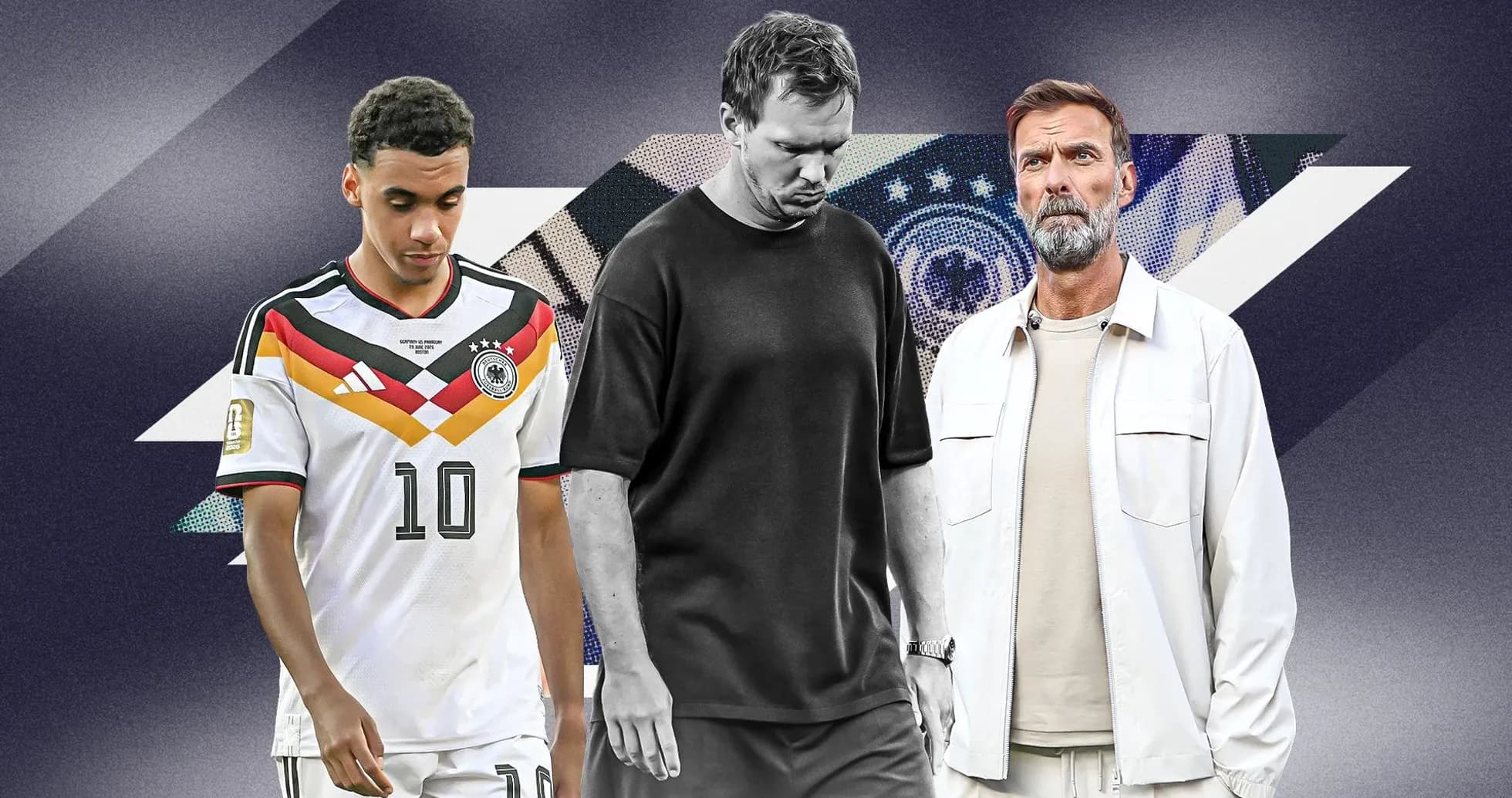
Germany's Coaching Crisis: Nagelsmann's Downfall and Klopp's Future
Germany have been here before. That is precisely the problem.
When the world champions crashed out of the 2018 World Cup in the group stage, humbled by Mexico and South Korea, the debate over Joachim Löw’s future felt almost ceremonial. Twelve years in charge, a World Cup title, a catastrophic collapse. The natural end point had arrived.
It never came. Löw’s credit as the architect of 2014 bought him three more years. Germany stumbled through a lost cycle, then exited Euro 2021 in the last 16 to England. Only then did he walk away.
Hansi Flick rode the next wave of optimism. His appointment promised a clean break: high pressing, Bayern-style intensity, a new edge. Instead, the 2022 World Cup brought a grim sense of déjà vu. Germany went out in the groups again, undone by a defeat to Japan after taking the lead. Flick survived when many expected the axe, only to be removed a year later when poor results finally overwhelmed the goodwill.
The DFB cannot pretend they do not recognise the pattern now.
Nagelsmann’s rise – and rapid fall
Julian Nagelsmann arrived in September 2023 as the moderniser, the prodigy. Fresh from Bayern Munich and RB Leipzig, he offered tactical clarity, bold selections and a sense that Germany were finally stepping into a new era.
Euro 2024 on home soil seemed to confirm that belief. Germany played with conviction, reconnected with their own supporters and reached the quarter-finals before falling to eventual champions Spain. For the first time in eight years, a major tournament felt like a step forward rather than another chapter in decline. Nagelsmann spoke openly about the next summit: winning the 2026 World Cup.
At that moment, he was the most popular Bundestrainer since Löw at his peak.
Two years later, that feels like a different lifetime. The aura has gone, the public capital spent at astonishing speed. The low point arrived in Foxborough on Monday, and it was not a shock. It was the logical end of a long, visible slide.
Nagelsmann did not just lose games. He lost the room outside of it.
On an almost cyclical basis, he used press conferences and interviews to deliver pointed, detailed critiques of individual players. What might have been framed as internal correction became a public spectacle. Statements veered from clumsy to flatly inaccurate. Promises about roles and hierarchies were made, then quietly broken. When challenged, he often bristled, sounding patronising rather than authoritative – a tone that surfaced repeatedly during the World Cup.
Kroos, Neuer, Kimmich – and a coach who wouldn’t settle
On the pitch, the decisions were just as damaging.
Toni Kroos’ return for the Euros worked. The veteran’s calm and passing range stabilised a team that had long lacked control. Buoyed by that success, Nagelsmann doubled down on experience for this World Cup, hauling 40-year-old Manuel Neuer out of international retirement after insisting he would not do so.
The cost was clear. Oliver Baumann, superb through qualifying and finally in line for his moment, was abruptly shunted aside. The process was handled poorly and, in the end, pointlessly. Neuer did nothing in this tournament that Baumann could not have delivered. The gamble brought no uplift, only friction and doubt.
Then came Joshua Kimmich. Once the heartbeat of Germany’s midfield, then a world-class right-back, he became the symbol of Nagelsmann’s tinkering. Even in the decisive defeat to Paraguay, the captain was shuffled between right-back and central midfield. It screamed indecision. In a must-win game, Germany’s leader on the pitch was treated like a movable piece in a tactical experiment.
The performance matched the confusion. Paraguay did not just edge Germany; they exposed them. The display was a comprehensive failure, entirely in keeping with what this team had shown since the Euros. Beyond a brief second-half surge against minnows Curaçao, Germany never looked like a side ready to challenge the world’s best.
They were blunt in attack, fragile at the back and repeatedly outmanoeuvred by ordinary opposition: Ivory Coast, Ecuador, Paraguay. Strip away the sentiment, and this campaign was even more disappointing than 2022, when Germany at least dug out a draw against Spain.
Coaching that never clicked
Inside the dressing room, the players closed ranks. After elimination, they took collective responsibility and publicly shielded Nagelsmann from blame. That speaks to the character of the squad.
It does not change the core truth. It is the coach’s job to provide a functioning plan. With the talent available – from Jamal Musiala and Florian Wirtz to the experienced spine around them – Germany should not be drifting through tournaments like this.
Nagelsmann’s in-game work came under the same scrutiny as his selections. Substitutions against Ecuador raised eyebrows. The decision to start super-sub Deniz Undav against Paraguay, stripping Germany of his impact from the bench, backfired badly. The team lacked rhythm, lacked clarity, and when the pressure rose, they had no reliable structure to fall back on.
The most uncomfortable twist for Nagelsmann? Every flaw, every misstep, was being broken down on live television by the man many Germans already see as his successor.
Klopp on the touchline – for now, only in the studio
Jürgen Klopp, now Red Bull’s head of soccer, spent the tournament in the pundit’s chair, dissecting Germany’s failings with the same directness that once fuelled his touchline charisma.
“You have to attack down the wings. There’s no alternative,” he told Magenta TV after Germany’s exit. It was a blunt assessment of a team that had played too narrow, too safe, too slowly.
“We all know how well these guys can play, but they didn’t bring that to the pitch. In three months, we’ll be raving about [Florian] Wirtz and [Jamal] Musiala again about how great they are, but not now.
“Paraguay had the opportunity to achieve something, Germany was under pressure to achieve something. Everyone in the stadium thought: Now they’ll turn it around! But we didn’t. We let them off the hook... We can talk about the DFB. We absolutely have to change a few things.”
For a growing section of the fanbase, the “change” is obvious: Klopp in the Germany dugout, leading the national team into Euro 2028 and the 2030 World Cup. The idea alone would ignite a level of euphoria German football has not felt in years.
Klopp, typically, refused to bite when asked in Boston.
“I haven’t thought about that yet. I understand that when the national coach position is discussed, my name is mentioned in some form. But it’s not the moment to really talk about it. There’s nothing to say about it. I have a job that I enjoy very much. As far as I know, it’s not a part-time job.”
The message was cautious, but the door was not slammed shut.
DFB at the crossroads – again
Inside the DFB, Nagelsmann still has public backing from the players and from sporting director Rudi Völler. On paper, that buys time. In reality, time is exactly what Germany do not have.
They have already lived through the danger of waiting too long – first with Löw, then with Flick. Both times, sentiment and loyalty trumped hard judgment. Both times, the reset came only after another tournament was wasted.
They cannot afford a third.
If the DFB believe Nagelsmann is no longer the man to lead this squad, they must act with a ruthlessness that has been missing for almost a decade. They must also recognise a simple truth: Klopp will not wait forever.