.svg&w=384&q=75 "Pitchgist logo")
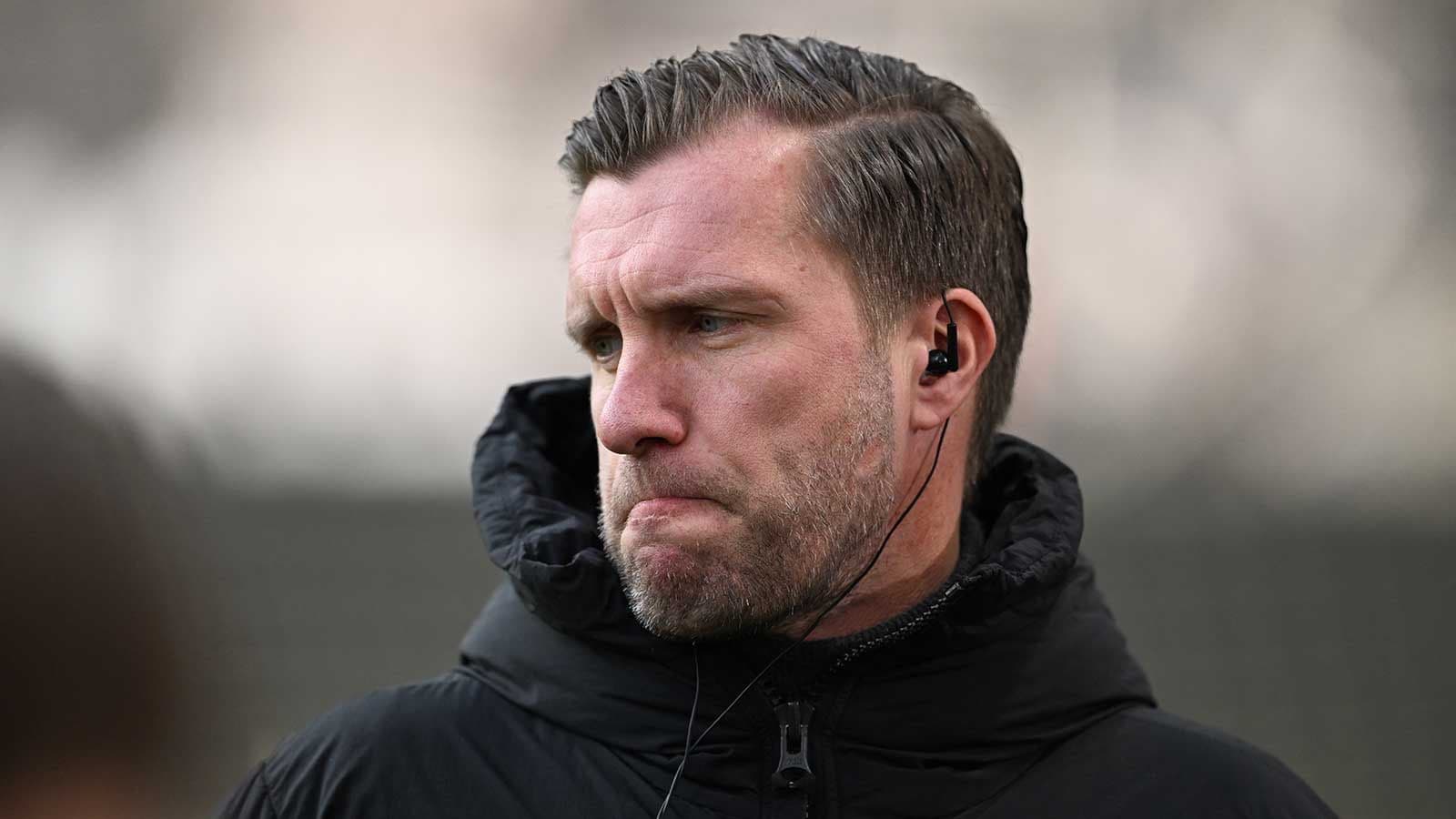
Frankfurt's Coach Search: Krösche Eyes Jaissle or Hütter
Markus Krösche has already admitted he broke his own rules once. He does not look like a man prepared to do it again.
The Eintracht Frankfurt sporting director sat in front of the microphones at the end of the season and called Albert Riera’s appointment “my mistake. My misjudgement.” No excuses, no soft landing. He had put a coach “in a situation where he had little chance of success” and watched the European places slip away.
Now comes the reset.
Old Red Bull Ties, New Frankfurt Plan
Krösche and Matthias Jaissle know each other’s world. One came through RB Leipzig, the other made his name at RB Salzburg. Their paths never crossed at the same club, but they moved in the same high-intensity, pressing-heavy universe.
Twice, Krösche tried to bring Jaissle to Frankfurt. First in the summer of 2023, when Oliver Glasner walked away after a turbulent but successful spell. Then again in the winter, when Dino Toppmöller’s tenure unraveled. Both times, the move collapsed.
Frankfurt pivoted to Riera. It never really worked.
Four wins from 14 matches, friction with key players, open tension with the media. The Spaniard, already viewed internally as “difficult to manage”, never found a stable footing and was gone almost as quickly as he arrived.
Krösche knows why. He spelled it out himself.
The Rule He Broke
“The key rule I brushed aside is simple,” he said. “If you have to replace a manager mid-season, don’t bring in someone who doesn’t know the league or have top-flight experience.”
He did it anyway. Why?
“I had a feeling, a conviction… I always act on conviction. It was so strong that I disregarded the principle of caution.”
That conviction cost Frankfurt a season of continuity and a place in Europe. It also hardened Krösche’s view of what Eintracht need next: clarity, intensity, and a coach who understands the terrain from day one.
This time, the profile is sharply drawn. German-speaking. Clear game idea. High-octane football that drags the crowd with it, not the other way around.
Jaissle fits that template almost perfectly.
Jaissle: High Intensity, High Ambition
The 36-year-old is not a stranger to German football. He once patrolled the back line for TSG Hoffenheim, and his coaching reputation exploded at RB Salzburg, where he drove a young, aggressive side with the kind of tempo Frankfurt fans still crave from the best Glasner nights.
Now at Al-Ahli, he has just lifted the Asian Champions League for a second time and is under contract until 2027. On paper, that makes him expensive. In reality, the door is not closed.
Eintracht have already sounded him out. Jaissle, for his part, is prepared to walk away from a huge salary package—around 15 million euros a year—if the right project appears in the Bundesliga or Premier League. He wants ambition and a stage big enough for his ideas. Frankfurt can offer both: a passionate fanbase, a demanding environment, and the promise of European nights if things click.
For Krösche, Jaissle is more than a stylistic match. He represents a return to a model that once made Eintracht one of the most awkward, energetic sides in Germany: aggressive pressing, fast counter-attacks, but also the ability to keep the ball and control phases of a game when needed.
As Krösche put it, Frankfurt must master “both styles” if they want to compete regularly for European places—a blend of counter-attacking and possession football, underpinned by “a certain intensity.”
Jaissle’s CV reads like a blueprint for that balance.
The Hütter Option
Yet Jaissle is not the only name on the table.
Adi Hütter, the coach who led Eintracht to the brink of the Champions League before leaving for Borussia Mönchengladbach in 2021, is again a leading candidate. He knows the club, the city, the expectations. He knows what it means to have 50,000 people roaring behind a team that plays on the edge.
Crucially, he is free. Since parting ways with AS Monaco in October last year, Hütter has been without a club. Bringing him back would not require a compensation fee, a factor that always matters when budgets are already earmarked for squad building.
Like Jaissle, Hütter ticks the boxes: German-speaking, clear philosophy, proven ability to weld intensity and structure into a coherent game plan. His previous spell in Frankfurt left a mark, both on the pitch and in the stands. The idea of a reunion carries obvious appeal.
Decision Time in Frankfurt
Krösche is not hiding behind vague timelines. “We are in talks. We want to find a solution soon,” he said recently, outlining a process that has already moved from broad profiles to concrete negotiations.
According to reports, Eintracht want the matter settled as early as next week. That urgency is deliberate. The new coach must shape pre-season, influence transfers, and reset a dressing room that has lived through too much turbulence in too short a time.
This is more than a choice between Jaissle and Hütter. It is a decision about what kind of club Eintracht Frankfurt want to be in the next cycle: a springboard for a rising tactician from the Red Bull school, or a familiar, battle-tested hand who already knows what the badge demands.
Krösche has already lived through one misjudgement. The next appointment will show whether the lesson has truly sunk in—or whether Frankfurt are prepared to gamble again at the very moment they can least afford it.