.svg&w=384&q=75 "Pitchgist logo")
Everton's Goalless Draw Exposes Early Worries for Moyes
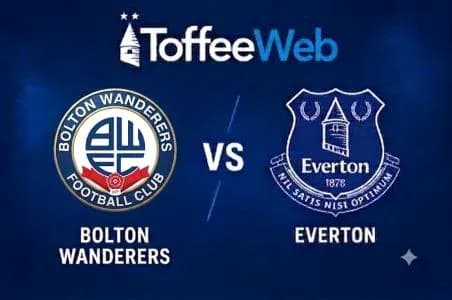
Everton’s pre-season took them just up the road into Lancashire, but the short journey to Bolton underlined a long list of problems. A 0-0 draw at Bolton Wanderers gave David Moyes minutes in the legs, a major defensive boost, and almost nothing to cling to in the final third.
This was a workout. It was also a warning.
Branthwaite back, recruitment still stalled
The headline positive came before a ball was kicked. Jarrad Branthwaite, wearing the No 4 shirt, returned to the starting XI and came through his first outing back from injury. He was steady, assured, and the one genuinely encouraging note in a squad that still looks thin and short of quality.
Around him, the picture is far less comforting. Hayden Hackney, the solitary summer signing, remained uninvolved. Tyler Dibling, another young option Moyes would like to look at, sat this one out with a minor knock; both are expected to feature against Stoke City on Tuesday. James Garner has undergone groin surgery and is now in recovery, while Vitalii Mykolenko rejoined the group after missing last week for the birth of his second child.
For now, Moyes is stuck with what he has. And what he has, particularly at the top end of the pitch, is misfiring badly.
Slow start, thin edge
Bolton began sharply, pinning Everton back and spending long spells in the visitors’ half. An early long ball from O’Brien gave Lewis Dobbin Barry something to chase, tempting the Bolton goalkeeper into a rash header and a collision, only for the referee to penalise the Everton forward.
Moments later, Merlin Röhl overlapped neatly and appeared to win a corner, the ball clearly deflecting off a Bolton defender. The assistant missed it, Bolton restarted, and Everton were back under pressure. Rodriguez cut in from the corner of the box and tested Mark Travers, a reminder that this was no gentle training exercise.
Everton’s response came in flashes. Aznou threaded a clever pass into Barry’s feet, but the striker hesitated instead of hitting it first time, and the chance vanished under a covering challenge. From the left, Barry’s cross earned a corner, then another, yet both set-pieces drifted away tamely, easily cleared and quickly forgotten.
In midfield, Tim Iroegbunam did the dirty work well, screening the back line and breaking up play. Around him, the contest grew scrappy. Bolton’s physical edge went largely unchecked by a lenient referee, while the home side continued to threaten from crosses, one header skidding just wide with Travers scrambling.
The best move of the half came from Dwight McNeil. Slipping into space, he took a superb diagonal from James Tarkowski and whipped in a teasing cross. Barry met it well, glancing his header inches wide of the far post. Not long after, Röhl drilled a brilliant low ball across the six-yard box and Barry finished from close range, only to be denied by a marginal offside flag.
Bolton then found joy down Everton’s left, Aznou initially beaten but recovering to put off the striker’s shot. At the other end, Aznou and Barry combined again, this time failing to find any quality on the final ball. Barry later worked a neat one-two with Armstrong, only to scuff a weak effort straight back to the goalkeeper.
Everton pushed higher as the interval approached, but the pattern was set. The structure was there. The bite in front of goal was not.
Second-half chaos in attack
The restart brought fresh legs and, almost immediately, a moment that summed up Everton’s afternoon. Barry received the ball in an advanced position, one defender ahead of him, the pitch opening up. Instead of driving at goal or pulling the trigger, he looked neither right nor left and rolled the ball aimlessly to his left flank — where nobody in blue existed. It trickled out of play. The chance died. The away end groaned.
Bolton, sensing the uncertainty, went back at Everton. A firm header forced a sharp save from substitute goalkeeper King, who had replaced Travers at the break, with Michael Keane tight to his man but unable to prevent the effort.
Barry’s afternoon deteriorated further. Easily dispossessed in midfield, he surrendered possession in a dangerous area, and Moyes did not wait any longer. On came Beto, tasked with injecting some presence and purpose up front.
There were glimpses. McNeil slid the ball into Röhl, who drove a low shot across the goalkeeper, drawing a solid parry. On the opposite flank, George and Kiernan Dewsbury-Hall combined neatly, only for the cross to drift through the box untouched.
Bolton made a series of changes around the hour, yet the rhythm of the game barely altered: Everton probing, then wasting; Bolton looking more coherent in their limited attacking moments.
When a ball over the top dropped invitingly for Beto, this looked the moment for a centre-forward to impose himself. Instead, he misjudged the bounce and lashed wildly, sending the ball high and wide. It was an ugly miss, and it set the tone for the rest of his cameo.
King was called into action again, forced to push a Bolton effort behind for a corner. Dewsbury-Hall, one of the few Everton players to show some craft between the lines, was then hauled back cynically by the shirt, the referee finally reaching for a yellow card.
McNeil tried to take responsibility from distance, stepping up and deciding to show Bolton how to finish. His shot sailed away, every bit as wasteful as those before it. Bolton took heart, pushed forward, and earned another corner via a deflection off Keane.
George attempted an ambitious switch of play to McNeil that flew straight out. Bolton responded with another wave of substitutions, the game fracturing into a stop-start contest with little flow and even less composure.
Beto, chances, and a damning verdict
There were still opportunities to steal it. George curled in a superb ball for Beto, who seemed to have the situation under control. Instead, he stumbled, lost his footing, and let the defender recover. The move fizzled out, another glaring example of an attack utterly devoid of conviction.
From a George free-kick, Tarkowski nodded the ball back across goal, only for Keane to misdirect his header badly, nowhere near the target. More changes followed, with three further Everton substitutions in the final 10 minutes, including Mykolenko’s introduction and a late run-out for Malik Olayiwola.
Bolton pieced together one final threatening move, Mykolenko stretching to cut it out at the cost of a corner, which Everton cleared. Olayiwola then stepped up from distance, unleashing a powerful drive that tested the goalkeeper but lacked the angle to truly trouble him. At the other end, a direct ball through the middle for Bolton ended with a shot into the side netting.
And then it was over. No goals, few clear answers, and a blunt illustration of where this Everton side currently stands.
The fitness will please Moyes. Branthwaite’s return will reassure him. But the lack of edge, the repeated technical errors, and the wastefulness of his forwards point to a simple truth: either this group finds a cutting edge very quickly, or Everton’s summer will have to be defined by new faces rather than new ideas.