.svg&w=384&q=75 "Pitchgist logo")
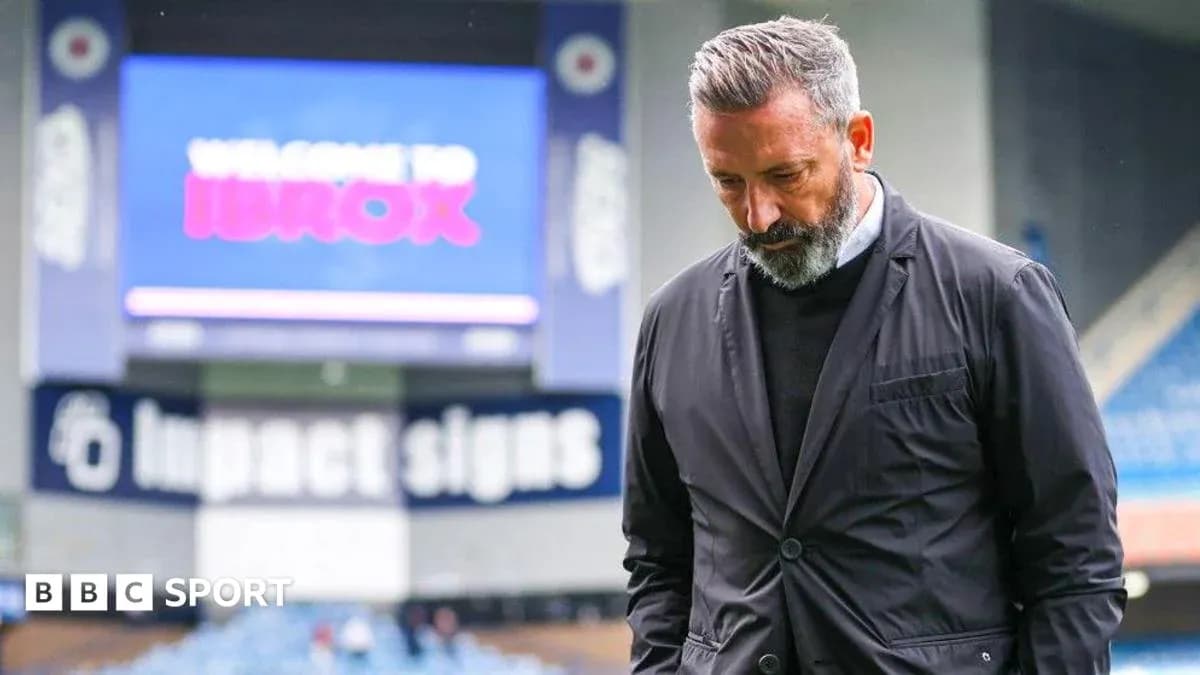
Derek McInnes: From Hearts to Rangers
Derek McInnes has never really hidden who he is. When he walked into Tynecastle last May and called the Hearts job “everything I wanted”, it sounded heartfelt, it sounded right – but it was always laced with an unspoken caveat. Everyone knew the line that would sit beneath the fine print: if Rangers call, the conversation changes.
Thirteen months later, the call came. And McInnes didn’t hesitate.
Hearts’ nearly man, Rangers’ chosen one
Once Rangers made it clear they wanted him at Ibrox, this was never a saga. No brinkmanship, no late twists. It felt inevitable, a deal waiting for a date on the calendar rather than a decision in the manager’s mind.
Hearts supporters would be entitled to fury. A coach who came within three minutes of delivering the most extraordinary title in the club’s modern history has walked away after a single season. Yet the mood around Gorgie is more shrug than outrage.
McInnes was always a Rangers man. He always said the right things in Edinburgh, always fronted up, always drove a team that smashed club records and rattled the Premiership’s established order. But he never quite felt like a Hearts lifer, never the manager you build a decade around. Not when the Rangers job has hovered in his orbit for so long.
Hearts, in the end, were the bridge. Not the destination.
A manager who craves control
His single season in the capital was impressive and awkward all at once. On the pitch, Hearts were ferocious, organised and relentless. Off it, McInnes was working inside a structure that didn’t fit his instincts.
He is a manager who likes to run the football side, not just coach it. At Hearts, Jamestown Analytics hold serious sway. Recruitment, minutes, profiles – data carries weight in every major call. That is the modern model the club has chosen, and it has served them well. But it was never going to give McInnes the authority he enjoyed at Kilmarnock and, most notably, Aberdeen.
At Rangers, that changes. He walks into Ibrox with something close to full command of the football department and, crucially, a budget unlike anything he has previously handled. For a coach who almost pinched the title last season on what amounted to loose change, the promise of serious backing is a powerful lure.
Accuse him of disloyalty if you like. In the hard reality of elite football, this was a simple decision for him. Rangers, with money to spend and a squad to reshape, are a different proposition entirely.
No more excuses at Ibrox
McInnes now gets what he has always craved: his own train set. He will pick the players he wants, not the ones who merely light up an algorithm. No more data specialists asking why “their” signings are not in the team. No more targets vetoed because the numbers don’t glow brightly enough on a dashboard.
But that freedom comes at a brutal price. At Rangers, the job description is short: win the league.
Danny Rohl tried and failed. Third place brought him no sympathy. Philippe Clement finished second and supporters still wanted him gone as quickly as possible. The patience levels at Ibrox are subterranean. There is an “angry desperation” for titles now, a fanbase exhausted by watching someone else set the pace.
McInnes understands that better than most. He is a persuasive talker, an excellent communicator, but words have lost their currency in Govan. Only trophies move the needle.
A big personality with unfinished business
On paper, he fits the brief. He knows Rangers. He knows the league. He knows the pressure. He has already shown the current Ibrox hierarchy what he can do, outmanoeuvring them with a Hearts side that had no right to push as hard as it did last season.
He is tactically sharp. He is hard-edged. He has never lacked self-belief. During Hearts’ near-title campaign, when records tumbled week after week, his messaging rarely missed. Calm when the noise rose, demanding when standards slipped. That presence will be vital in a dressing room that has grown used to upheaval.
His track record in big games is both impressive and naggingly incomplete. At Aberdeen, Hampden became a regular haunt: League Cup finals in 2013-14, 2016-17, 2018-19, a Scottish Cup final in 2016-17. Celtic repeatedly blocked his path, and nobody can seriously criticise a manager for losing to a juggernaut at full tilt.
Yet the story is not only about running into Celtic. There were cup exits to Dundee United, Hibs, St Johnstone, Dundee, Hearts, Motherwell, Hearts again, St Mirren, Motherwell again and United again. While he went without silverware at a Premiership club, others broke through: St Johnstone, Inverness, Hibs, St Johnstone again and Aberdeen in the Scottish Cup; Ross County, St Johnstone and St Mirren in the League Cup.
Tommy Wright, John Hughes, Alan Stubbs, Callum Davidson – twice – Jimmy Thelin, Jim McIntyre, Stephen Robinson. A long list of managers outside the Old Firm found a way to lift trophies in the years McInnes did not.
That is why the “nearly man” tag still clings to him. Always competitive, always there or thereabouts, rarely the one with his hands on the cup when the confetti falls.
The chance he has waited for
Now comes the defining test. His duels with Celtic’s manager, and with whoever replaces him at Tynecastle, will shape not just his own reputation but the balance of power in Scottish football.
Hearts turned out to be the job he wanted at the time, not the one he had dreamed of for a lifetime. Rangers is different. This is the role that has loomed over his career, the one he has been linked with, the one he has, in many ways, been preparing for without ever saying so out loud.
He has walked away from a club that he took to the brink of immortality. He has walked into a club that will offer him money, control and expectation on a scale he has never known.
No more stepping stones. No more almosts.
Derek McInnes has his chance now. What he does with it will define him forever.