.svg&w=384&q=75 "Pitchgist logo")
Cremonese's Narrow Escape Against Udinese in Serie A
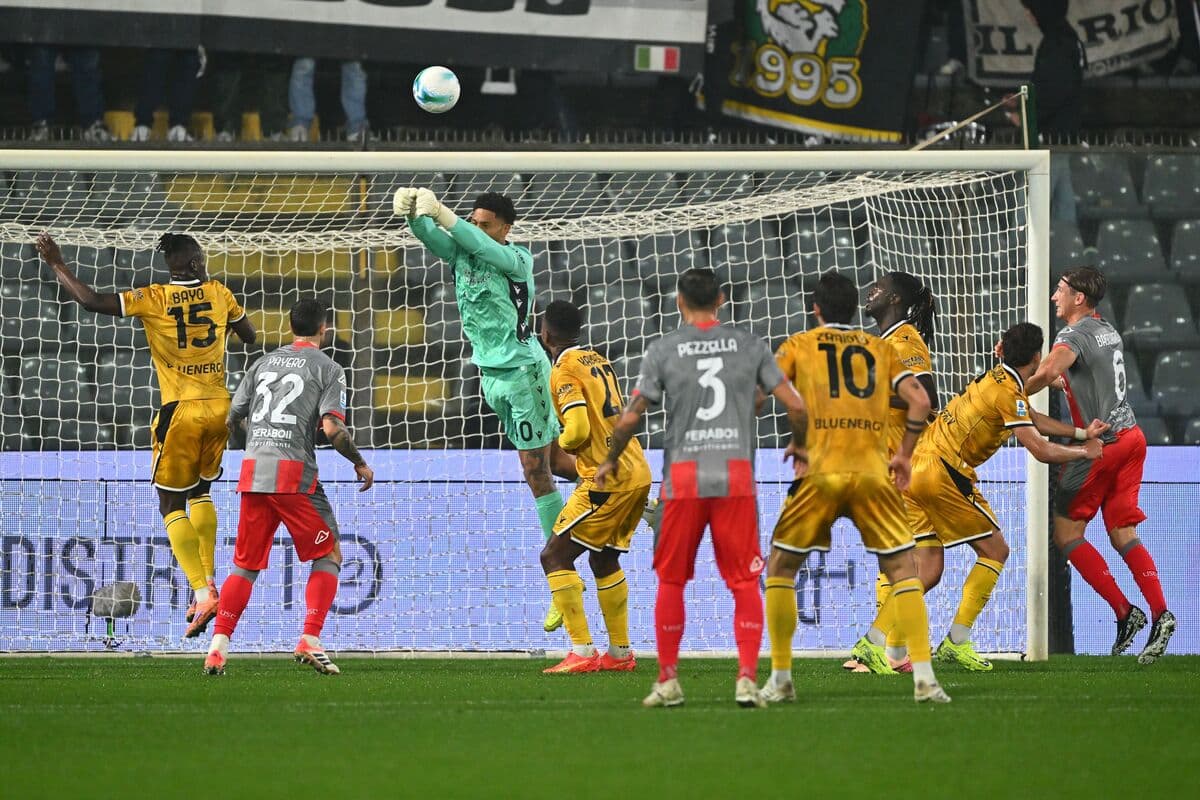
Under the lights of the Bluenergy Stadium – Stadio Friuli, Udinese and Cremonese met in a late‑season Serie A fixture that felt heavier than its “Regular Season - 37” label suggested. By the final whistle, Gianluca Manganiello signalled a 1–0 away win for Cremonese, a result that reverberates differently for two clubs heading in opposite emotional directions.
Heading into this game, Udinese sat 10th on 50 points, their goal difference at -2, a neat encapsulation of a campaign balanced between resilience and inconsistency. Overall they had scored 45 and conceded 47 across 37 matches, with a clear split between a more productive attack on their travels and a more cautious, blunt edge at home. At home they averaged 0.9 goals for and 1.1 against; away those figures jumped to 1.5 scored and 1.4 conceded.
Cremonese arrived in Udine under the shadow of relegation. They were 18th with 34 points and a goal difference of -22, having scored 31 and shipped 53 overall. Their away record – 5 wins, 3 draws, 11 defeats – had been paradoxical: more victories on their travels than at home, but built on meagre attacking returns of 0.7 away goals per game and a leaky 1.5 conceded.
Both coaches leaned into familiarity: Kosta Runjaic and Marco Giampaolo mirrored each other in a 3‑5‑2, but their interpretations of that shape and the absentees shaping it gave the contest its tactical narrative.
Tactical voids – absences that redrew the map
Udinese’s squad sheet carried notable absences. K. Ehizibue was suspended due to yellow cards, while J. Ekkelenkamp, N. Zaniolo and A. Zanoli were all ruled out with injuries. The loss of Zaniolo in particular removed Udinese’s leading creative hub – 6 assists and 5 goals this season, plus a league‑wide profile as one of Serie A’s top assist providers. Without his ball‑carrying and final‑third invention, Runjaic was forced into a more workmanlike midfield.
That reality was reflected in the trio of J. Karlstrom, L. Miller and A. Atta through the centre, flanked by J. Arizala and H. Kamara as wing‑backs. It is a five‑man line designed more for balance and coverage than for high‑risk creativity, and it placed an even greater burden on the front two, A. Buksa and K. Davis, to create their own chances.
Cremonese had their own injury ledger: F. Baschirotto, W. Bondo, F. Ceccherini and F. Moumbagna were all unavailable. The absence of Baschirotto and Ceccherini trimmed Giampaolo’s defensive options and arguably nudged him toward a more possession‑oriented back three of S. Luperto, M. Bianchetti and F. Terracciano, protected by a combative but technically capable midfield.
Giuseppe Pezzella’s presence in that midfield was a double‑edged sword. He is Cremonese’s leading yellow‑card collector this season with 8 bookings and 1 red, and the team’s season‑long card profile shows a late‑game spike: 26.09% of their yellows arrive between 76‑90 minutes. For a side often chasing games, that late aggression has been both necessary and costly.
Udinese, by contrast, have seen 27.94% of their yellows in the 61‑75 minute window and 22.06% from 76‑90, suggesting a team that tends to bristle and stretch as matches open up after the hour. In a match where one side was desperate for survival and the other for consolidation, the disciplinary risk zones were always likely to intersect in the second half.
Key matchups – hunter vs shield, engine vs enforcer
The most intriguing duel on paper was the “Hunter vs Shield” clash between Cremonese’s main scorer F. Bonazzoli and an Udinese defence that has been marginally sturdier at home than away. Bonazzoli came into the fixture with 9 goals and 1 assist in 34 appearances, backed by 55 shots (31 on target). He is not just a finisher but a focal point: 242 duels contested, 125 won, and 76 fouls drawn underline how often he becomes the outlet when Cremonese are under pressure.
Udinese’s back three of T. Kristensen, C. Kabasele and O. Solet were tasked with containing him while also tracking the clever movement of J. Vardy alongside him. With Udinese keeping 6 clean sheets at home this season and conceding 21 goals in 19 home matches (an average of 1.1), they have usually been capable of absorbing pressure in Friuli. Yet their overall goal difference of -2 underlines how fine the margins are; a single lapse can tilt a balanced game.
At the other end, the “Hunter” role belonged to K. Davis. With 10 goals and 4 assists in 29 appearances, plus 25 shots on target from 38 attempts, he has been Udinese’s primary reference point. His physical presence – 310 duels contested, 146 won – and 47 fouls drawn make him a constant irritant for centre‑backs. Against a Cremonese away defence that has conceded 28 goals in 19 matches (1.5 per game), Davis should, on paper, have found fertile ground.
But without Zaniolo’s service, the supply line into Davis was narrower, forced to rely on Karlstrom’s passing, Miller’s energy between the lines and Kamara’s surges from wing‑back. Cremonese’s midfield triangle of M. Thorsby, A. Grassi and Y. Maleh, screened by Pezzella, worked as the “Shield” – compressing central spaces and forcing Udinese wide, where crosses could be more easily defended by the back three and goalkeeper E. Audero.
The “Engine Room” confrontation was thus defined by intensity and second balls rather than pure artistry. Grassi’s role as the passer from deep, Thorsby’s aerial work and Maleh’s mobility allowed Cremonese to break Udinese’s rhythm and launch transitions toward Bonazzoli and Vardy.
Statistical prognosis – why 0–1 made sense
Following this result, the numbers and the tactical story align in a grimly logical way for Udinese. A team averaging just 0.9 goals at home, missing its chief creator and often forced into low‑margin games, succumbed to a Cremonese side whose away identity is built on narrow, attritional contests. Cremonese’s overall attacking average of 0.8 goals per match, and 0.7 on their travels, points to a side that rarely blows opponents away; instead, they rely on set pieces, isolated moments and Bonazzoli’s craft.
Defensively, both teams’ season‑long Expected Goals profiles (not explicitly provided but inferable from goals for/against and clean sheets) suggest low‑xG, low‑margin football. Udinese’s 11 clean sheets overall and Cremonese’s matching 11 underline that both are capable of compressing games into tight scorelines. In such contexts, a single high‑quality chance or a defensive error often decides the outcome.
Cremonese’s discipline risk in the final quarter of matches did not ultimately cost them; instead, their structural compactness and the authority of Audero behind a settled back three allowed them to protect a slender lead. Udinese, stripped of Zaniolo’s invention and Ehizibue’s thrust, lacked the extra layer of chaos needed to destabilise a deep block.
In narrative terms, the 1–0 away win is the kind of result that can keep a relegation fight alive until the final day, while for Udinese it is a reminder of the limits of solidity without cutting edge. The formations mirrored each other, but the urgency did not: Cremonese hunted every loose ball as if their season depended on it, and in a game of fine margins, that intensity turned statistical probabilities into a precious, season‑defining victory.