.svg&w=384&q=75 "Pitchgist logo")
Craig Gordon’s World Cup Farewell Highlights His Remarkable Comeback
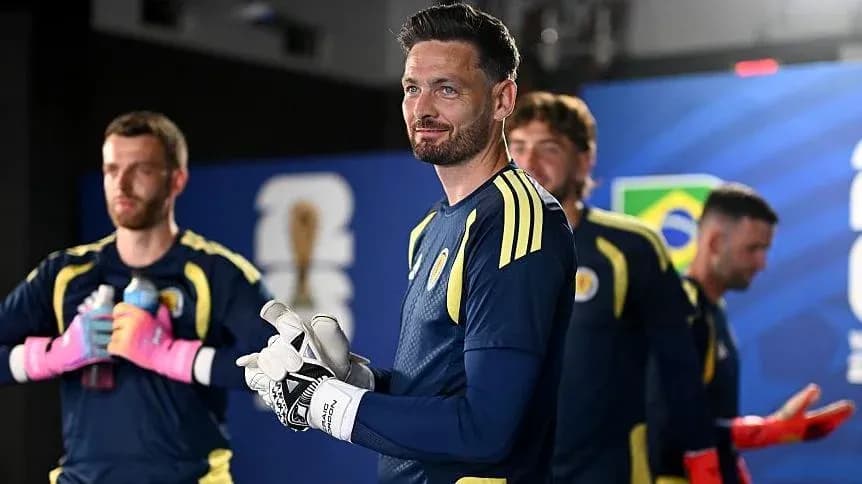
By the time Craig Gordon walked away from international football at this summer’s World Cup, his story had already moved beyond the usual arc of caps, clean sheets and medals. It had become something closer to defiance.
A double leg break at 39 is usually the final line in a goalkeeper’s career. For Gordon, it was the start of a four–year fight that ended with him back in a Scotland shirt on the biggest stage of all, and now, with his retirement from playing confirmed, the scale of that achievement is being laid bare by those who know exactly what he went through.
Rory Loy, the former striker turned pundit, suffered the same brutal injury. He did it in his early 20s, when the body heals quicker, the mind is wired to chase comebacks and the future still feels wide open. Gordon did it with the clock very clearly against him.
“I did the same thing, but I did it when I was 20, 23,” Loy said on the BBC’s Scottish Football Podcast, reflecting on the Hearts and former Celtic and Sunderland goalkeeper’s journey. Gordon’s break came at an age when most players are quietly negotiating their exit, not plotting a return.
The description is stark. “The shin bone just snaps basically,” Loy explained. From there, nothing is simple. The bone has to heal. Then comes the long, hidden battle: the way you walk, the way you move, the way your body lines itself up for every jump, every dive, every landing. All of it changes.
Loy spoke of needing orthotics in his boots just to adapt to a new way of moving, a new version of his own body. Layers of adjustment, physically and mentally. The kind of unseen detail that turns a comeback from a headline into a grind.
That is why Gordon’s return, not just to club football but to a level high enough to keep his place with Scotland and reach a World Cup, has drawn such admiration from a fellow professional who has lived the same pain.
“To do it at his age, in his late 30s and still manage to come back from it… I know how difficult it is to come back from that injury, psychologically as well as physically,” Loy said. The motivation required at that stage of a career, when retirement is a perfectly respectable option, is something he clearly views as exceptional.
The mindset, in Loy’s eyes, defines Gordon as much as any medal or appearance tally. The goalkeeper refused to let the injury dictate his ending. He fought through the rehab, rewired his body and stepped back into a position that demands absolute trust in every leap and collision.
And then there is the other part of the story: once he got back, he didn’t just survive. He excelled.
“Away from all of that, the level of goalkeeping and saves he had was incredible,” Loy added. That line matters. Gordon was not carried along on sentiment. He earned his place, again and again, with the kind of shot–stopping and presence that had defined his career long before his leg shattered.
So when he bowed out with Scotland at a World Cup, it wasn’t simply a veteran getting a last hurrah. It was the culmination of a comeback that, as Loy’s testimony underlines, should probably never have been possible at all.
For most players, a double leg break at 39 writes the final chapter. Gordon chose to write one more.