.svg&w=384&q=75 "Pitchgist logo")
Como Edges Parma 1–0: A Tactical Analysis
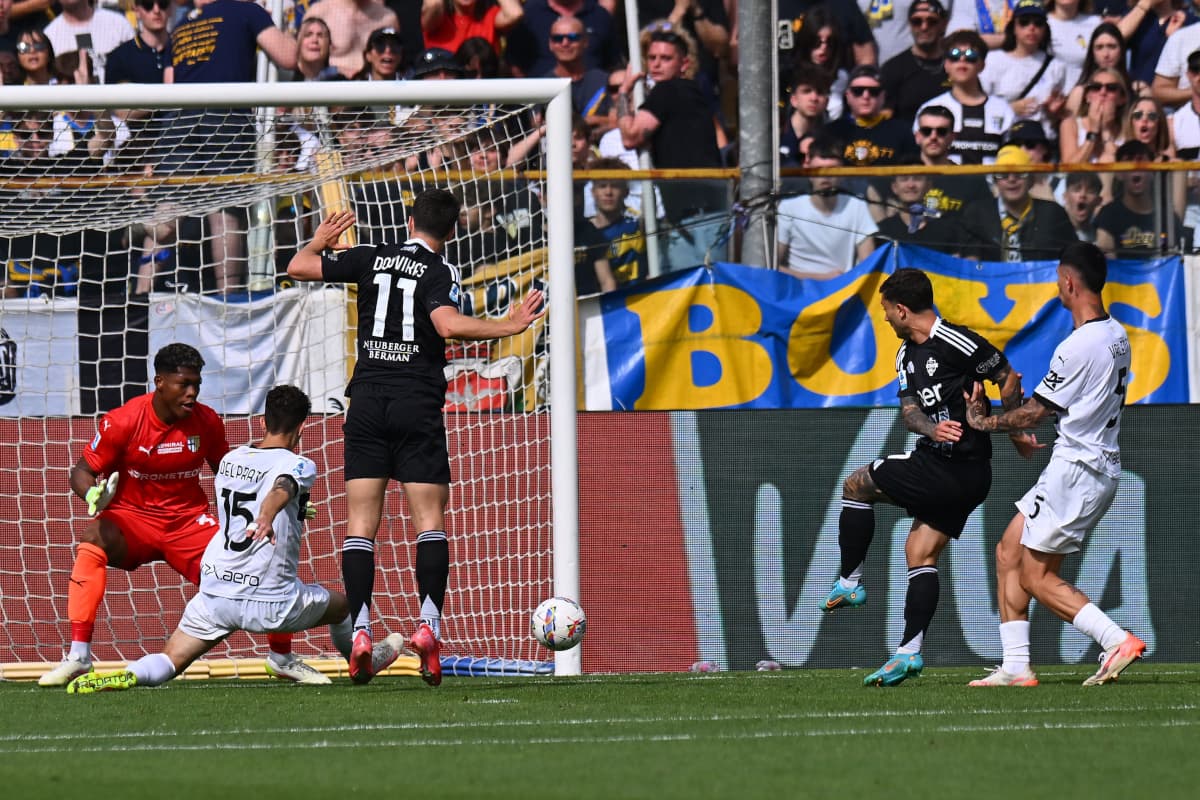
The afternoon on the shores of Lake Como ended with a narrow, carefully engineered victory. At the Stadio Giuseppe Sinigaglia, Como edged Parma 1–0, a result that crystallised the different stages of their seasons. Following this result in Round 37 of Serie A, the fifth‑placed hosts under Cesc Fabregas looked every inch a Europa League side in waiting, while 13th‑placed Parma again showed why their campaign has been defined by grit more than craft.
I. The Big Picture – Structures and Season DNA
Fabregas stayed loyal to his seasonal blueprint, rolling out the familiar 4‑2‑3‑1 that has underpinned Como’s rise. It is the same shape they have used in 33 league matches, and it plays to their strengths: controlled possession from deep, high technical quality between the lines, and a single focal point up front.
With 61 goals in total this campaign and an average of 1.8 at home, Como came into this one as one of Serie A’s more reliable attacking units. Just as telling is their defensive base: only 28 goals conceded overall, with a home average of 0.8. The goal difference of 33 (61 scored, 28 conceded) is not a statistical quirk; it is the numerical expression of a team that dominates both boxes.
Parma, by contrast, arrived with the scars of a long season. Carlos Cuesta’s side lined up in a 3‑5‑2, their most used system with 18 league appearances, designed to compact central spaces and give them numbers behind the ball. But the numbers heading into this game told a harsher story: only 27 goals in total, an average of 0.7 per match, and 46 conceded at 1.2 per game. Their goal difference of -19 (27 for, 46 against) framed them as underdogs trying to survive a superior structure rather than match it blow for blow.
II. Tactical Voids – Absences and Discipline
Both managers had to navigate significant absences that shaped the tactical landscape.
For Como, the creative void left by N. Paz was enormous. Twelve league goals and six assists from midfield do not simply vanish; they force a re‑drawing of the map. Paz’s absence (knee injury) meant Fabregas had to redistribute responsibility in the half‑spaces. Without his 51 key passes and his willingness to carry the ball – 125 dribble attempts, 69 successful – Como lost their most complete “all‑phases” midfielder. J. Addai (Achilles tendon) and A. Valle were also unavailable, trimming depth but not disturbing the core structure as much as Paz’s injury.
Parma’s list was longer and more brutal: A. Bernabe, S. Britschgi (suspended after a red card), B. Cremaschi, M. Frigan, J. Ondrejka and G. Oristanio all missing. That is a spine’s worth of talent removed, forcing Cuesta to lean heavily on the likes of H. Nicolussi Caviglia and C. Ordonez for progression, and on Mateo Pellegrino and G. Strefezza to conjure something from relatively sparse service.
From a disciplinary perspective, both sides carried warning labels into the contest. Como’s season card map shows a clear late‑game spike: 61–75' and 76–90' each account for 20.25% of their yellow cards, and all their red cards (three in total) have come in the 76–90' window. This is a side that finishes fiercely, but occasionally frays at the edges.
Parma’s pattern is more scattered but equally telling. Their yellow cards peak at 46–60' and 76–90' with 21.88% in each window, while their red cards are spread across 31–45', 61–75', 76–90' and 91–105'. This is a team that can lose control at almost any stage once the game becomes stretched.
III. Key Matchups – Hunter vs Shield, Engine Room Battles
The “Hunter vs Shield” duel was always going to centre on T. Douvikas against Parma’s three‑man back line. With 13 goals in total and 46 shots (28 on target), Douvikas is a penalty‑box forward who thrives on timing and service rather than volume shooting alone. Against a Parma defence that has conceded 21 goals on their travels at an away average of 1.1, his movement between L. Valenti and M. Troilo was the key pressure point.
Troilo himself arrived as a fascinating counterweight. A defender with 18 blocked shots and a card record that includes both a straight red and a yellow‑red, he embodies Parma’s high‑risk, high‑contact approach. His ability to step out and engage Douvikas was crucial, but so too was the danger that his aggression could tip into indiscipline.
In midfield, the “Engine Room” battle was defined by Como’s double pivot of M. Perrone and L. Da Cunha, flanked by the subtlety of M. Caqueret and M. Baturina, against Parma’s five‑man band led by Nicolussi Caviglia and M. Keita. Perrone’s season numbers – 2111 passes at 91% accuracy, 56 tackles – mark him out as the metronome and screen. Caqueret, with 24 key passes and five assists, adds verticality and final‑third craft.
Without Paz, Caqueret’s role as secondary playmaker grew. He had to find pockets between Parma’s wing‑backs and outside centre‑backs, dragging the 3‑5‑2 out of its comfort zone. On the other side, Nicolussi Caviglia was tasked with disrupting Como’s rhythm and feeding early passes into Pellegrino, whose 525 duels and 67 fouls drawn make him a constant physical reference point.
IV. Statistical Prognosis and Tactical Verdict
On paper, this was always leaning Como’s way. At home they score 1.8 and concede 0.8 on average; Parma on their travels score only 0.6 and concede 1.1. Layer those profiles and the expected goals landscape naturally tilts towards a Como side generating the clearer chances, while limiting Parma to hopeful moments rather than sustained pressure.
The 1–0 scoreline fits that statistical arc. Como’s season‑long defensive solidity, underlined by 19 clean sheets overall (10 at home), again held firm. Parma, who have failed to score in 16 matches in total, including nine away, once more struggled to convert effort into incision against a structured block.
Following this result, the story is consistent: Fabregas’ Como are a Europa‑bound machine built on repetition, stability and a clear use of their 4‑2‑3‑1 tools, even when a star like Paz is missing. Parma, shorn of several key players and carrying a -19 goal difference, remain a side that fights, blocks and battles – Troilo’s profile epitomises that – but too often lacks the attacking clarity to bend tight games their way.
In tactical terms, this was a victory for system over improvisation, for a well‑drilled shield that allowed its hunter just enough margin to decide the afternoon.