.svg&w=384&q=75 "Pitchgist logo")
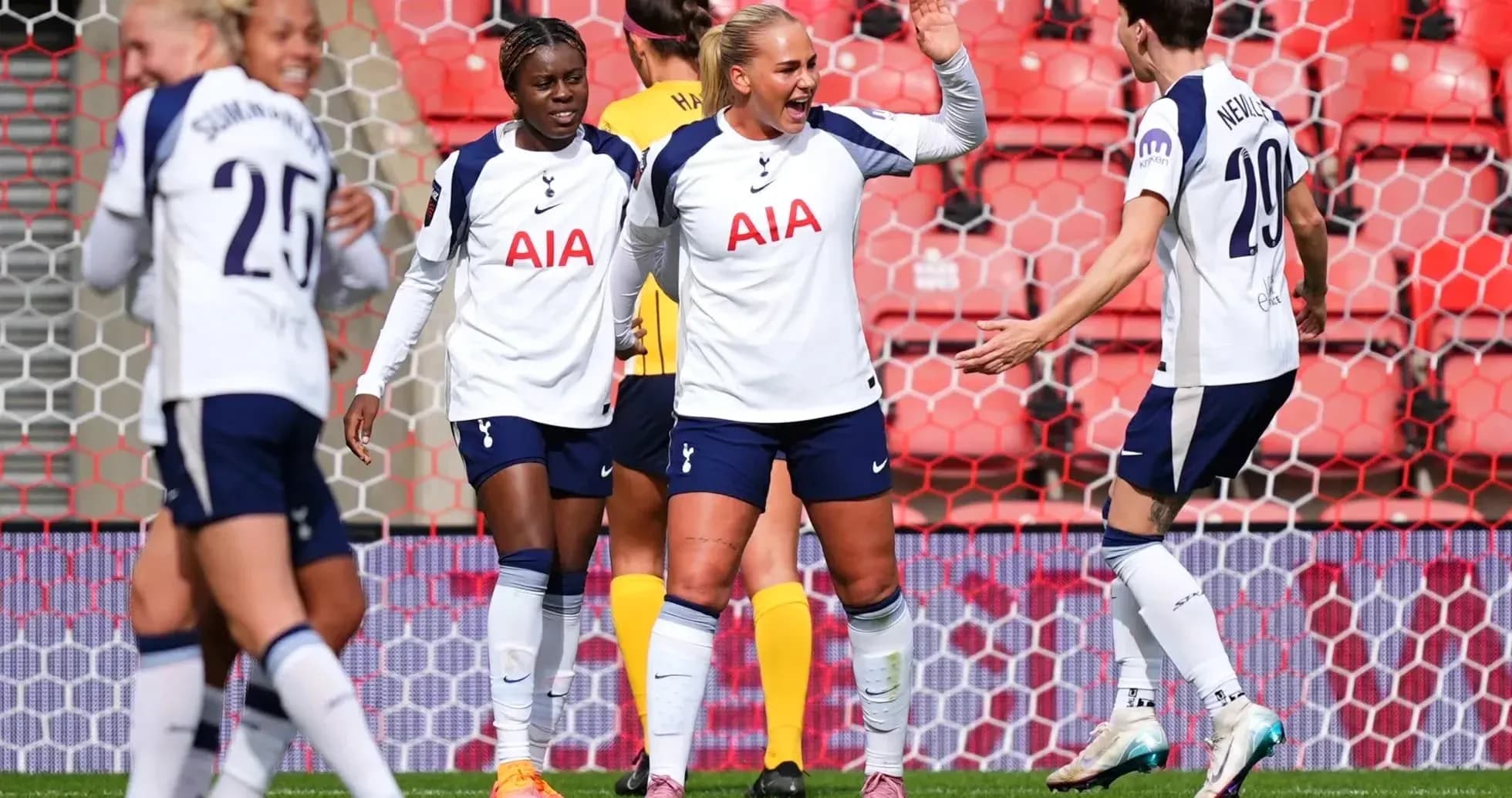
Brighton W vs Tottenham Hotspur W: FA WSL Tension at Amex Stadium
Brighton W vs Tottenham Hotspur W at the Amex Stadium on 16 May 2026 brings the FA WSL regular season to a tense close for two sides locked in their own mini-battle in mid-table. Brighton arrive in 6th place on 26 points with a neutral goal difference, Tottenham one rung higher in 5th on 33 points but with a slightly negative differential. There are no cup stakes here, but league positioning, momentum and pride in a growing rivalry are all firmly on the line.
Context and form: Brighton steady, Spurs wobbling
In the league, Brighton’s trajectory into this fixture looks quietly encouraging. They sit 6th with a record of 7 wins, 5 draws and 9 defeats from 21 matches, scoring and conceding 26. Their recent form line of “DDWWD” underlines a side that has become harder to beat and is finishing the campaign with resilience.
At home, Brighton have been solid rather than spectacular: 4 wins, 3 draws and 3 defeats from 10 games, with 16 goals scored and 13 conceded. An average of 1.6 goals for and 1.3 against per home match paints the picture of a team that can hurt opponents without losing defensive structure. Three home clean sheets and only three home games without scoring reinforce that balance: they are rarely blown away and usually find a way to create.
Tottenham arrive with a more volatile profile. In the league they are 5th, with 10 wins, 3 draws and 8 losses from 21 games, scoring 33 and conceding 37. Their form line of “WDLLL” tells the story of a side that has hit turbulence at the wrong time, losing three of their last four.
Away from home, however, Spurs have been one of the division’s most entertaining and unpredictable outfits: 4 wins, 1 draw and 5 defeats from 10 away matches, with a striking split of 22 goals for and 25 against. They average 2.2 goals scored and 2.5 conceded per away game, suggesting that this trip to the Amex is unlikely to be cagey if the match follows their season-long pattern.
Tactical outlook: Brighton’s structure vs Spurs’ attacking risk
Brighton’s season-long statistics hint at a side built on compact organisation and flexible systems. They have used six different formations across the campaign, most frequently 4-2-3-1 (4 times) and 4-4-1-1 (3 times), with spells in 4-4-2 and 3-4-3 as well. That variety suggests a willingness to adapt shape to opponent and game state, but the common thread is a back four with clear protection in front.
Defensively, Brighton concede 1.2 goals per game overall, with a near-identical split home and away (1.3 at home, 1.2 away). Six clean sheets and only five games without scoring across the season indicate they are often competitive at both ends. Their biggest home win, 4-1, and heaviest home defeat, 0-3, show they can both exploit and suffer from open games, but the averages point more towards control than chaos.
Going forward, much will rest on the influence of Takako Seike. The midfielder is Brighton’s standout attacking contributor in the league this season with 4 goals and 1 assist from 19 appearances, backed by 16 shots (10 on target) and 19 key passes. Her 7.04 average rating reflects a player who links midfield to attack, capable of both finishing chances and creating them. Her willingness to work without the ball (19 tackles and 6 interceptions) also fits Brighton’s need to compress space in midfield against a Spurs side that thrives in transition.
Tottenham, by contrast, are defined by attacking ambition and defensive risk, especially away from home. Their most common formation is also 4-2-3-1 (used 9 times), with 4-4-2 and 3-4-2-1 appearing as alternative structures. The away goals data – 22 scored and 25 conceded – suggests full-backs pushing high, midfielders breaking lines and a front line encouraged to take risks.
The key figures in the final third are Bethany England, Olivia Møller Holdt and Cathinka Cecilie Friis Tandberg. England leads Spurs’ league scoring chart with 5 goals from 20 appearances, taking 31 shots (16 on target). Her profile – nominally a midfielder but clearly operating in advanced zones – makes her a central goal threat between the lines.
Holdt adds creativity and penetration from midfield. With 4 goals and 3 assists, plus 16 key passes and 57 dribble attempts (25 successful), she is the main conduit for progression, carrying the ball and drawing fouls (25 won). Her 7.09 rating, the highest among the listed players, underlines her importance to Spurs’ attacking structure.
Tandberg, with 4 goals and 9 key passes, offers vertical running and finishing from the front line. Her five yellow cards hint at an aggressive pressing style, which fits Spurs’ preference for high-intensity phases, particularly after turnovers.
Tottenham’s penalty record in the league this season is clean at team level (2 scored from 2, 100.00%), with Tandberg individually converting 1 penalty without a miss. That gives Spurs an additional edge in high-pressure moments inside the box.
Defensively, though, Spurs remain fragile. Conceding 37 goals in 21 league games (1.8 per match) and 25 away (2.5 per away game) reveals a back line that can be exposed, especially when the team commits numbers forward. Their heaviest defeats – 1-5 at home and 5-2 away – underline how quickly matches can unravel if they lose control of midfield.
Head-to-head: Spurs edge recent history
The last five competitive meetings in the FA WSL show a finely balanced but slightly Spurs-leaning rivalry:
- On 5 October 2025 at Brisbane Road in London, Tottenham Hotspur W beat Brighton W 1-0.
- On 16 March 2025 at Gaughan Group Stadium in London, Brighton W beat Tottenham Hotspur W 1-0.
- On 14 December 2024 at Broadfield Stadium in Crawley, the sides drew 1-1.
- On 28 April 2024 at Gaughan Group Stadium in London, Tottenham Hotspur W and Brighton W drew 1-1.
- On 15 October 2023 at The American Express Community Stadium in Falmer, Tottenham Hotspur W beat Brighton W 3-1.
Across these five league fixtures, Tottenham have 2 wins, Brighton have 1, and there have been 2 draws. Scorelines have generally been tight, with three of the five decided by a single goal and only one match featuring more than three goals.
Discipline and game rhythm
Card data adds another layer to the tactical picture. Brighton’s yellow cards cluster notably in the 31-45 and 76-90 minute ranges, suggesting intensity spikes before half-time and in the closing stages. Spurs show a similar late-game edge, with 31.25% of their yellows arriving between 76-90 minutes and a significant share between 46-60. Both sides, then, tend to become more combative as matches wear on, which could influence substitutions and tempo management in the second half.
Spurs also have a red card recorded in the 91-105 minute window this season, underlining how fine the line can be between aggression and indiscipline in their approach.
The verdict
The data points towards a clash of styles: Brighton’s structured, balanced game against Tottenham’s high-variance, attack-minded approach, especially away from home. Spurs’ superior league position and greater overall firepower – 33 goals to Brighton’s 26 – give them a slight edge on paper, but their recent “WDLLL” form and porous away defence leave the door wide open.
Brighton’s home solidity (only 13 goals conceded in 10 games) and improved recent form suggest they are well placed to frustrate Spurs and exploit defensive gaps, particularly through Seike’s creativity and late surges from midfield. Tottenham, for their part, will look to tilt the match into a more open contest where England, Holdt and Tandberg can impose themselves.
Given Brighton’s resilience at the Amex and Spurs’ tendency for goal-laden away fixtures, a competitive, high-intensity match with chances at both ends looks likely. A narrow margin either way or a scoring draw feels the most logical outcome, with Brighton slightly better positioned to stabilise their season, and Spurs relying on individual attacking quality to break through.