.svg&w=384&q=75 "Pitchgist logo")
World Cup 2023: U.S. Dominates Paraguay in Historic Opener
LOS ANGELES — For months, the World Cup felt like a political minefield more than a football festival. Protests, visa headaches, spiraling ticket prices, worries about how fans would even get to the stadiums across three sprawling host nations.
Then the whistle blew.
Once the ball started rolling across Mexico, Canada and the United States, the noise around it faded, replaced by something much simpler: a tournament that has exploded into life.
A U.S. opener for the ages
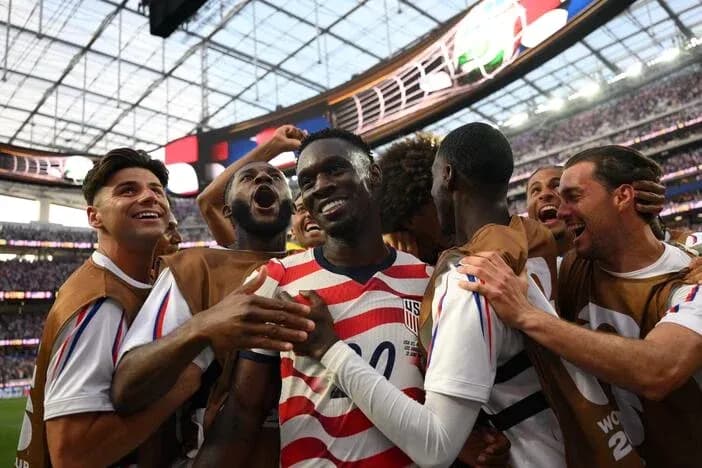
From an American perspective, everything starts with Los Angeles Stadium on Friday night and a performance that will sit near the top of the U.S. men’s World Cup history.
USA 4, Paraguay 1.
Four goals — the most the U.S. men have ever scored in a World Cup match. A statement, not a scrape. The kind of scoreline that forces the rest of the field to look up from their scouting reports and take notice.
Folarin Balogun walked off with the headlines. Two goals, the first multi-goal game by a U.S. player on this stage since the inaugural World Cup in 1930. Ninety-four years between braces. He didn’t just finish; he led the line with conviction, stretching Paraguay, punishing every gap.
Behind him, Chris Richards stitched the whole thing together. The defender, only just back from injury after missing both pre-tournament warm-ups, stepped straight into the cauldron and played like he’d never been away. Eighty-three passes attempted. Eighty-three completed. No one has completed that many passes in a World Cup match since records began in 1966. He turned the back line into a launchpad.
There was one cloud. Christian Pulisic, the star around whom so much of this U.S. attack orbits, came off at halftime with a calf problem. He left the stadium walking gingerly toward the team bus, his status uncertain. For a team that finally looks ready to punch with the heavyweights, that’s the subplot no one wanted.
Still, from front to back, the U.S. sparkled. Composed on the ball, ruthless in front of goal, relentless in their pressing. It was everything this generation has promised.
And yet, it’s only one game.
Australia crash the party in Group D
The Americans didn’t have to wait long to see what’s next. On Saturday, their two other Group D opponents stepped into the spotlight: Turkey and Australia.
On paper, Turkey carry the star power. Arda Güler, the Real Madrid prodigy with a left foot that can rearrange a game in a heartbeat. Kenan Yildiz, the Juventus attacker who glides through lines and looks built for nights like these. A squad dotted with players from Europe’s biggest leagues.
None of that mattered.
Australia ripped up the script with a 2-0 win, a classic World Cup ambush. Organized, direct, fearless. They harassed Turkey, forced mistakes, and then punished them. By the final whistle, the so-called underdogs had control of their own destiny and had thrown Group D wide open.
Which brings us to Friday: USA vs. Australia.
Win that, and the U.S. won’t just lead the group. They’ll seize control of their path into the knockouts, with room to maneuver and confidence surging. Lose or stumble, and all that early swagger suddenly feels fragile. Group stages can turn on a single misstep.
Scotland’s return, Brazil’s reality check
Elsewhere, the World Cup delivered another old favorite: the shock from an unexpected corner.
Scotland, back on this stage for the first time in 28 years, didn’t tiptoe into Group C. They beat Haiti and, for the moment, sit top of a group that also includes Brazil and Morocco.
That’s what makes it so striking. Brazil, five-time champions and permanent residents of the World Cup’s top tier. Morocco, fresh off a recent era as a genuine powerhouse. Those two were supposed to glide through.
Instead, they split the points in a 1-1 draw. A result that leaves Scotland looking down at the giants, at least for now, and injects a little tension into a group that was meant to be straightforward.
World Cups rarely stick to the script.
Qatar’s first point, a heavyweight stalemate
The drama hasn’t been confined to the traditional powers.
Qatar, in only its second World Cup appearance, finally has something tangible to show for it. A 1-1 draw with Switzerland on Saturday brought the nation its first-ever World Cup point. Four years ago, as hosts, Qatar lost all three matches. This time, they walked off with a result that will matter deeply back home.
On Sunday, two of Group F’s big hitters went toe-to-toe. Netherlands vs. Japan promised intensity and delivered a 2-2 draw that felt like a warning shot to the rest of the field. Neither side blinked, neither backed off. It was the kind of early group game that feels like a preview of a later-round clash.
Curaçao’s 17 glorious minutes
Then there was Curaçao.
Population: 158,000. The smallest country ever to appear at a World Cup. On Sunday, they walked out to face Germany, a nation whose relationship with this tournament is carved into football history.
Germany scored first. Order restored, or so it seemed.
Curaçao hit back. One goal, one roar, one moment when a Caribbean island stood level with a giant. For 17 minutes, the scoreline read 1-1, and belief surged. You could almost feel it through the screen.
Then Germany did what Germany so often does. They adjusted, accelerated, and ran away with it, 7-1 — a scoreline that will always carry echoes from their own past on this stage. For Curaçao, the dream result vanished, but the debut still left a mark. Those 17 minutes will live on.
Politics in the background as Iran arrive late
The football hasn’t entirely drowned out the geopolitics.
On Monday at Los Angeles Stadium, Iran face New Zealand in their Group-stage opener, a fixture that almost never happened. After the U.S. and Israel attacked Iran in February, there were serious doubts about whether the Iranian team would even take part in this tournament.
Their preparations have reflected the tension. Iran originally planned to base their training camp in Tucson, Arizona. Instead, citing security concerns and the wider hostilities, they shifted to Tijuana, Mexico. The U.S. government has imposed strict conditions: the Iranian squad can only enter the country the day before each of their three group matches.
So Iran will arrive late, play, and leave again, all under a tighter spotlight than most. On the pitch, though, the task is the same: find a way through a group and into the knockouts.
Mbappé, Messi, and the chase for history
Tuesday belongs to the superstars.
France, with Kylian Mbappé at the peak of his powers, open their World Cup against Senegal in Group I. Every time Mbappé steps into a major tournament now, the questions grow louder. Can he drag France to another title? Can he dominate a World Cup the way only a handful of players ever have?
On the same day, the defending champions enter the arena. Argentina and Lionel Messi begin their bid for back-to-back titles against Algeria in Group J. Only two nations have ever defended a World Cup crown: Italy in 1938 and Brazil in 1962. That’s the scale of the mountain Argentina are trying to climb.
Messi has already lifted the trophy that eluded him for so long. This campaign is about something else: legacy, dominance, the chance to etch his name even deeper into the game’s history.
The politics will rumble on. The logistics will still test fans and organizers across three countries. But with the first round of games already throwing up shocks, statements, and storylines, one question now hangs over this World Cup:
If the opening week looks like this, what on earth is still to come?