.svg&w=384&q=75 "Pitchgist logo")
Jordan Bos Shines as Australia Advances in World Cup
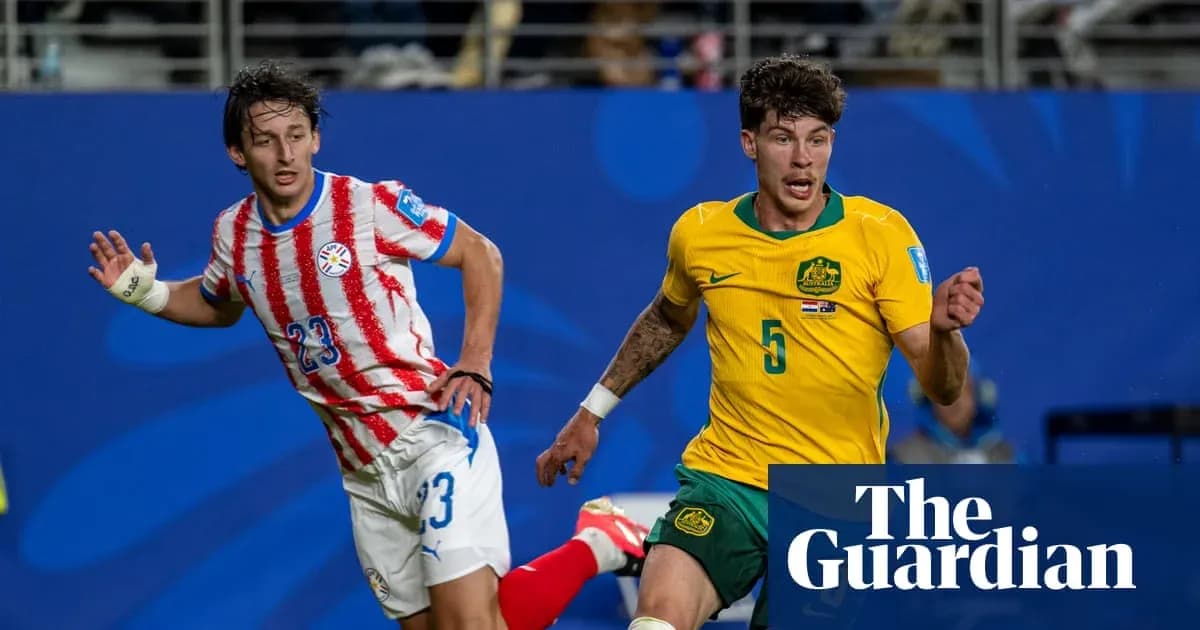
Jordan Bos did not so much play right-back in San Francisco as rip up the job description and sprint off with it.
Nominally stationed on the “wrong” flank, the Socceroos’ left-back spent the night thundering down the right touchline, skipping one challenge, riding another, and tearing into the box with a force that dragged his team – and 12,000 Australians wrapped in yellow – towards the World Cup last 32.
At 0-0 against Paraguay, this was a game balanced on a knife edge. Every minute without a goal nudged Australia closer to qualification from Group D, yet every Julio Enciso touch, every Patrick Beach save, reminded them how thin that margin really was. Tony Popovic kept glancing at the clock. So did the fans. Every clearance felt like a minor act of survival.
Australia did not need to score. They simply needed to endure. But they needed something else too – a jolt, a sense that this World Cup campaign had more to offer than damage control after the flat loss to the United States.
Bos supplied it in waves.
Just a few kilometres from Google’s Mountain View headquarters, the Socceroos’ search for a spark returned the clearest of results. Time and again, Bos bounced off one would-be tackler and accelerated past the next, his strides lifting teammates and crowd alike. Every metre he stole on the right pushed the ball further from Australian danger and deeper into Paraguayan anxiety.
Popovic began the second half by reshuffling. Cristian Volpato, Bos’s partner in the first 45, went to the bench. So did Nestory Irankunda, the hero against Turkey. The structure changed. The energy did not. Bos simply kept going, smashing into duels, driving into the box, refusing to let the game drift into the kind of nervous stalemate that swallows teams at tournaments.
Ajdin Hrustic, introduced on the opposite flank, had the prime vantage point for what will go down as one of the most commanding Australian World Cup displays in recent memory. “He’s a great player, he’s got power, you’ve seen it,” Hrustic said, sounding less like a teammate and more like a fan who had paid for his ticket. Aiden O’Neill walked off with the player of the match trophy but admitted it probably belonged to Bos.
Inside the dressing room, the verdict was unanimous. Harry Souttar called Bos “a special player, a special guy, and just takes everything in his stride” before adding, with a grin, that “the guy’s body’s just unbelievable to look at”. Then came the line that will follow Bos for a while: “I don’t want to obviously put too much pressure on him, but if he keeps performing like that and there’s no ceiling.”
Milos Degenek went even bigger. In his eyes, Bos is already among the very best in the world in his position. “Top-five left-back in the world and the best at his age,” he said. When a journalist pushed him on where that would put Bos as a right-back, Degenek shot back, laughing: “Top 10.”
Irankunda, never shy, simply called him “the best player in the world, Jordy Bos, best winger in the world”. The forward even floated a positional switch. “He might have to switch to a winger, in my opinion. He’s done so well at right-back today, but he got so high up the pitch today and he showed glimpses of what he can do with the ball.”
The twist is that Bos was not meant to be the answer at right-back at all. Popovic had natural options there – Kai Trewin, Jason Geria – yet turned to his left-back, armed with the memory of Bos’s stint on the right for Westerlo in Belgium and a half-hour cameo in that role against New Zealand nine months ago. “We’ve seen that he can adapt and play on that side,” Popovic said. “It’s the best game he’s played of the three [World Cup matches] by far.”
Bos arrived at this tournament with serious pedigree after proving himself in the Dutch Eredivisie. At 23, he is one of the most polished members of a young Socceroos squad, a player expected to deliver rather than just develop. Until Thursday, his World Cup had been steady, reliable, almost understated.
Then came this explosion – out of position, on a booking tightrope, knowing that one yellow card would rule him out of the last 32. Instead of shrinking, he grew.
The performance had a familiar silhouette. At training this week, Hrustic had started calling him “Dani Alves”, a nod to the Brazilian great who turned the right flank into his personal runway. Others have mentioned Arjen Robben, the left-footed right winger whose trademark cut-ins haunted defenders for a decade. Bos brushed those comparisons aside with a smile. “Unfortunately I didn’t score like him, but I tried,” he said.
The numbers backed up the eye test. No Australian took more shots than Bos’s three. He created the joint-most chances. He completed four dribbles, more than anyone else in green and gold, and won the most duels on the pitch, including seven of nine in the air. “I was enjoying it too, honestly, tonight,” he said, which felt like an understatement.
The name that has followed him longest, though, is Gareth Bale – another who started life as a left-back and morphed into a right-sided force of nature at Tottenham and Real Madrid. That same blend of power, stride length and relentless running underpinned Bos’s display, even if the end product has not yet reached Bale’s stratosphere.
Asked which comparison he felt closest to, Bos paused. “Yeah, Robben … I don’t mind Bale, to be honest,” he replied. It almost did not matter. Alves, Robben, Bale – the references say as much about the scale of his performance as they do about his style.
Because this night in San Francisco was not about who Bos might become. It was the night he stopped being a promising full-back from the Eredivisie and started being something else entirely: the player who grabbed a World Cup campaign by the scruff of the neck and refused to let go.