.svg&w=384&q=75 "Pitchgist logo")
Valencia vs Rayo Vallecano: Tactical Analysis of a 1-1 Draw
Valencia and Rayo Vallecano shared a 1-1 draw at Estadio de Mestalla in a match where the tactical story diverged from the raw scoreline. Valencia controlled slightly more of the ball (53% possession) and generated twice as many shots (12 to 6), but Rayo’s more vertical, direct approach produced the higher xG (1.21 to 0.69). Both sides finished with three shots on target and two goalkeeper saves, underlining how much of the contest was fought in structure and territory rather than in repeated clear chances.
Team Formations
Valencia lined up in a 4-4-2 under Carlos Corberan, with S. Dimitrievski behind a back four of Renzo Saravia, C. Tarrega, E. Comert and J. Gaya. The double pivot of D. Lopez and Pepelu was flanked by G. Rodriguez and L. Rioja, supporting the front two of H. Duro and J. Guerra. The shape aimed to create width from the full-backs and wide midfielders while using the two forwards to pin Rayo’s centre-backs and occupy their holding midfielders.
In contrast, Inigo Perez set Rayo Vallecano up in a 4-2-3-1. A. Batalla was protected by a line of I. Balliu, F. Lejeune, N. Mendy and P. Chavarria. O. Valentin and G. Gumbau formed the double pivot, with F. Perez, P. Diaz and Pacha behind lone striker R. Nteka. The structure was designed to congest central spaces, with the double pivot screening and the three attacking midfielders ready to spring forward when possession was won.
Match Analysis
The early pattern reflected those intentions. Valencia’s 445 passes to Rayo’s 404 and their 80% accuracy (356 accurate) indicated a side comfortable in phased buildup, moving the ball through Pepelu and D. Lopez to progress. However, the home side’s chance creation lagged behind their territory: 12 total shots but only 3 on goal, and an xG of just 0.69, suggests much of their shooting came from less dangerous zones or under pressure.
Rayo, by contrast, were more selective but more incisive. Their 6 total shots included 5 from inside the box and only 1 from distance, aligning with their higher xG of 1.21. This points to a game plan built on absorbing pressure in a compact 4-4-1-1/4-2-3-1 block and then attacking quickly into the spaces left by Valencia’s advanced full-backs. The opening goal from F. Lejeune, assisted by G. Gumbau, encapsulates that: a centre-back finishing after a well-delivered ball from deep, taking advantage of Valencia’s set-piece or structural vulnerability.
Defensively, both goalkeepers had relatively quiet but telling evenings. S. Dimitrievski made 2 saves for Valencia, matching A. Batalla’s 2 for Rayo. The goals_prevented metric of -0.61 for each goalkeeper underlines that both conceded slightly more than the underlying shot quality would predict, hinting that neither had a standout, game-stealing performance. Instead, defensive control came more from shape and duels than from spectacular shot-stopping.
Defensive Strategies
Valencia’s back four were asked to defend large spaces, especially once they pushed higher to chase the game after going behind. J. Gaya’s overlaps and Renzo Saravia’s willingness to step forward were central to stretching Rayo’s block, but they also opened channels for Rayo’s transitions. The early yellow card for Renzo Saravia in the 6th minute for “Foul” was significant tactically: it constrained his aggression in duels and may have influenced Corberan’s decision to replace him at 32', with U. Nunez (IN) coming on for Renzo Saravia (OUT). That substitution stabilised the right flank defensively but marginally reduced Valencia’s thrust from that side.
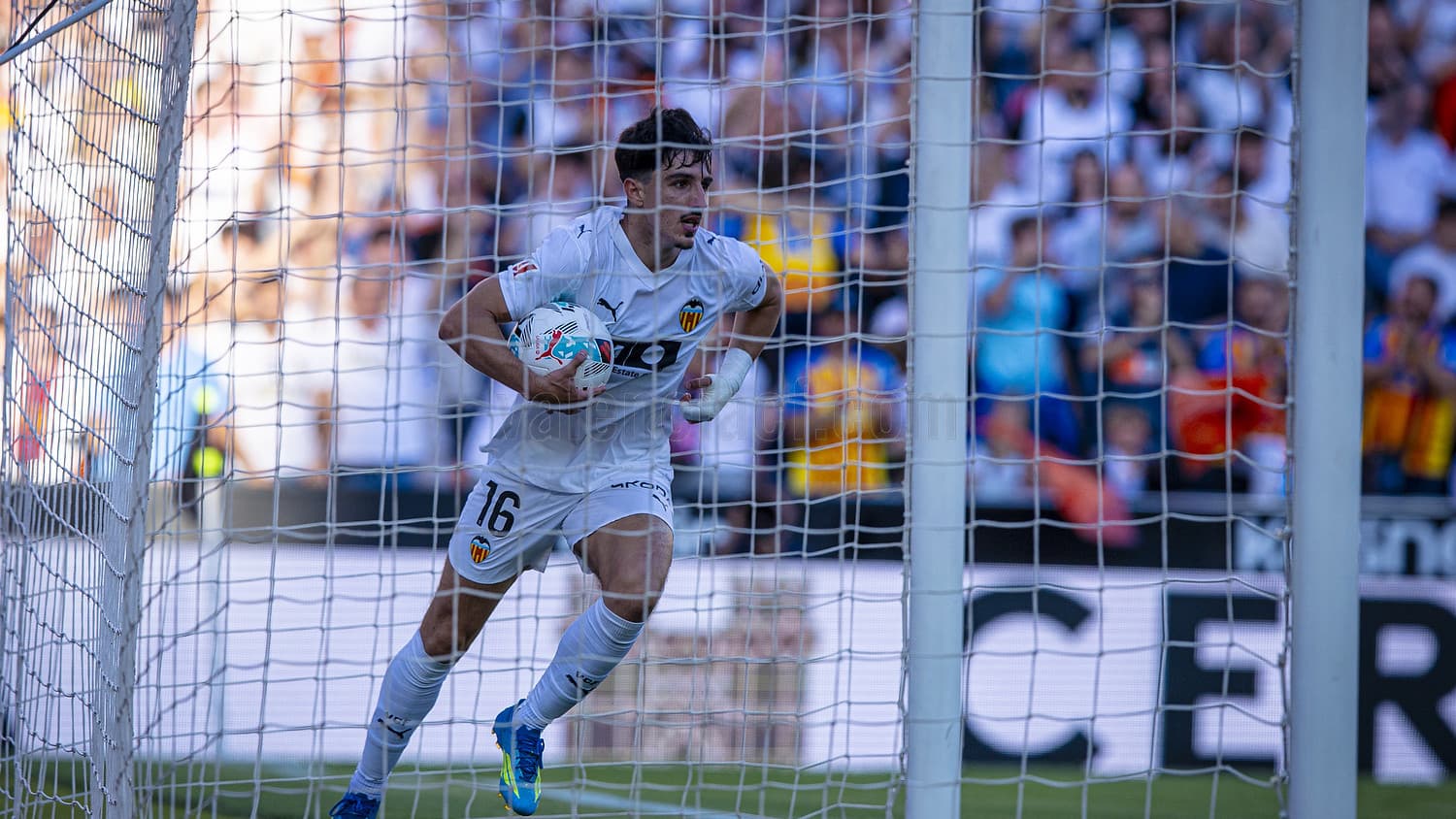
In midfield, the key tactical hinge was the duel between Valencia’s double pivot and Rayo’s double pivot plus the advanced midfield line. D. Lopez, who later equalised, had to balance breaking lines with protecting his centre-backs from R. Nteka’s movements between the lines. Pepelu functioned as the metronome, helping Valencia maintain that 53% share of the ball and orchestrating switches of play to L. Rioja and G. Rodriguez. Yet Rayo’s compactness meant that much of Valencia’s circulation was in front of the block rather than through it.
Rayo's Structure
Rayo’s structure out of possession was disciplined. The 4-2-3-1 flattened into a 4-4-1-1, with F. Perez and Pacha dropping alongside P. Diaz to form a second line of pressure. The fact they committed 20 fouls to Valencia’s 9 shows how they were prepared to break rhythm and disrupt combinations rather than allow clean central progress. The yellow card for Randy Nteka in the 56th minute for “Argument” reflected a more emotional flashpoint rather than structural breakdown, but his substitution four minutes later — Alemao (IN) came on for R. Nteka (OUT) — refreshed the pressing line and added more vertical running against a tiring Valencia back line.
Substitutions and Tactical Adjustments
The wave of substitutions around the hour marked a clear tactical pivot for both coaches. For Valencia, the triple change at 61' — U. Sadiq (IN) came on for H. Duro (OUT), F. Ugrinic (IN) came on for Pepelu (OUT), and L. Ramazani (IN) came on for J. Guerra (OUT) — reconfigured the 4-4-2 into a more dynamic, almost 4-2-3-1/4-4-1-1 hybrid. U. Sadiq provided a more mobile focal point, Ramazani added one-versus-one threat between the lines, and F. Ugrinic offered forward-running from midfield. This injection of verticality and dribbling quality helped Valencia sustain pressure and underpinned the equaliser from D. Lopez, assisted by J. Guerra, before the reshuffle fully took effect.
Rayo responded in kind. Alongside Alemao for R. Nteka, J. de Frutos (IN) came on for F. Perez (OUT) at 60', adding fresh legs and direct running from the flank. At 61', P. Ciss (IN) came on for O. Valentin (OUT), giving Rayo more physicality and ball-winning in the pivot to cope with Valencia’s growing territorial dominance. Later, U. Lopez (IN) came on for G. Gumbau (OUT) at 67', and A. Ratiu (IN) came on for I. Balliu (OUT) at 73', moves that aimed to preserve defensive intensity on the right and maintain passing quality under pressure.
Statistical Overview
The defensive index for both sides can be inferred from the balance of shots and xG. Valencia limited Rayo to just 6 attempts, but the fact that 5 of those were inside the box and the visitors posted the higher xG suggests that when Valencia’s block was breached, it was breached cleanly. Conversely, Rayo’s deeper block allowed more volume (12 shots conceded) but kept many of those efforts to lower-quality positions, aligning with Valencia’s modest xG of 0.69.
In statistical verdict, the draw reflects a clash of contrasting game plans that largely cancelled each other out. Valencia’s overall form within this match was that of a possession-dominant side: more passes (445 vs 404), higher accuracy (356 accurate, 80% vs 315 accurate, 78%), more corners (5 vs 1) and more territorial pressure. Rayo’s profile was that of a counter-puncher: fewer shots but better chances (xG 1.21), more fouls to manage tempo, and a defensive block that forced Valencia into less efficient shooting.
The disciplinary balance — one yellow card each, with Valencia’s for “Foul” and Rayo’s for “Argument” — mirrors the tactical tone: Valencia’s issues arose from defensive interventions in space, Rayo’s from the emotional edge of a team defending deep and contesting every duel. With both goalkeepers posting the same negative goals_prevented figure (-0.61), neither side can claim their last line as a decisive advantage. Instead, the 1-1 at Estadio de Mestalla stands as a tactical stalemate in which Rayo’s structural compactness and Valencia’s controlled possession each earned a point, but neither could bend the underlying numbers enough to force a winner.