.svg&w=384&q=75 "Pitchgist logo")
Uruguay Begins New Era Under Marcelo Bielsa in World Cup Opener
Uruguay’s new era under Marcelo Bielsa begins under the Miami lights on Monday night, with Saudi Arabia the first obstacle in a World Cup Group H that La Celeste expect to dominate.
Expectation is nothing new for a country that has lifted this trophy twice. The question this time is whether Bielsa’s relentless football can turn that expectation into something more than nostalgia.
Bielsa’s Uruguay: relentless, risky, and still unfinished
Since Bielsa walked through the door, Uruguay have played on fast‑forward. High pressing, aggressive lines, constant movement. His teams never stroll; they sprint, harry, suffocate. The price is obvious: it demands lungs of iron and absolute concentration.
The rewards were clear in South American qualifying. Uruguay swept through the campaign with authority, their intensity too much for most of the continent. They looked like a side reborn, a traditional powerhouse updated with modern fury.
Then came the friendlies, and the doubts.
Uruguay failed to score against both Mexico and Algeria. They were ripped apart 5-1 by the United States. For a side built to play on the front foot, those numbers sting. The performances exposed a blunt edge in attack and a team still learning where the risk must stop and the control must start.
The absence of a natural finisher hangs over this campaign. Edinson Cavani has stepped away from the international stage. Luis Suarez, the great predator of a generation, did not make the final squad. Two icons gone, and with them a guarantee: give them one chance, they’d usually need no second.
Now, Uruguay lean on the collective. They lean on a ferocious midfield and Bielsa’s structure. They lean on a forward still learning to turn chaos into composure.
Midfield muscle, star power, and a familiar No. 9
If Uruguay reach the latter stages of this World Cup, it will likely be because their midfield drags them there.
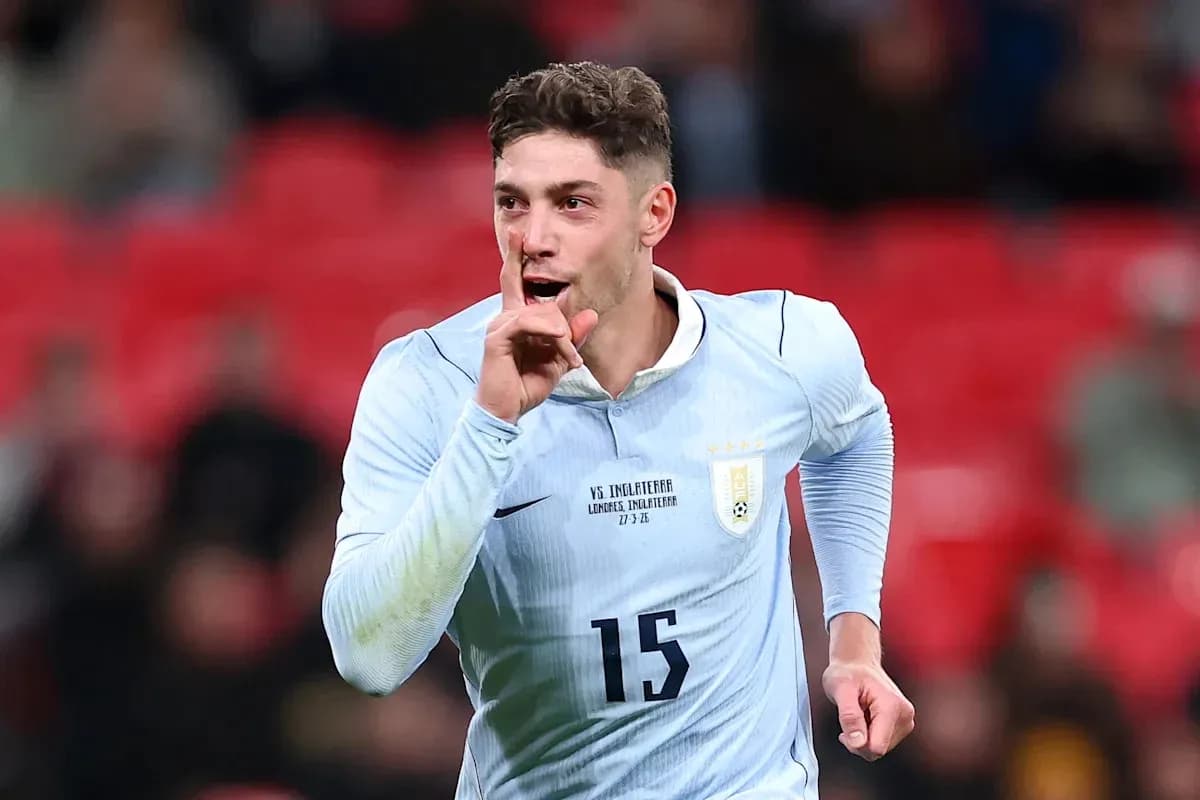
Federico Valverde stands at the centre of it all. The Real Madrid man brings a mix that every coach covets: he can run a game, rip a shot from distance, and cover half a pitch in seconds. He will set the tempo, speed it up, slow it down, and strike when space opens 25 yards from goal.
Behind and around him, the work never stops. Manuel Ugarte will anchor the middle with his snarling, physical presence, snapping into duels and screening a defence that arrives in Miami patched together. Rodrigo Bentancur adds balance and class, the final piece of a central trio that can go toe-to-toe with anyone in this tournament.
Out wide, Maximiliano Araujo will be asked to stretch the game, provide width, and drive at defenders. His job is simple in theory, brutal in execution: keep running, keep crossing, keep forcing mistakes.
Up front, the focus falls on Darwin Nunez. The striker arrives with something unusual for a World Cup opener: inside knowledge. He plays his club football in the Saudi Pro League and knows many of these defenders well. That familiarity cuts both ways, of course, but Uruguay will hope it helps him find his rhythm quickly.
Nunez will not do it alone. Federico Vinas is expected to operate close to him, offering support in the final third, linking play and attacking the box. Between them, they must find the goals this team has recently lacked.
A defence held together by tape and hope
For all the talk of pressing and attacking patterns, Bielsa’s most immediate headache lies at the back.
Ronald Araujo, one of the best defenders of his generation, is effectively ruled out with a calf injury that has frustrated player and staff alike. Jose Gimenez, a pillar of experience, remains a serious doubt with an ankle problem. Matias Vina is nursing a muscle issue and could also miss the opener.
Those are not minor absences. They rip through the core of Uruguay’s defensive structure and strip away continuity at the worst possible moment.
Sebastian Caceres, who recently suffered a head knock, might yet be cleared in time. If he is, he becomes crucial, the likeliest partner for Santiago Bueno in central defence. Around them, Bielsa must trust his system and his full-backs to hold firm.
Giorgian de Arrascaeta, a creative spark and a player capable of unlocking tight games, is also doubtful with a lingering calf complaint. His absence would remove one of Uruguay’s most subtle weapons between the lines.
Uncertainty hangs over the back line. Bielsa will not change his principles, though. The line will stay high. The press will go on. Uruguay will live on the edge and dare Saudi Arabia to exploit the space.
Predicted XI and the stakes in Miami
Barring late surprises, Uruguay are expected to line up as follows:
Muslera; Varela, Caceres, Bueno, Olivera; Valverde, Ugarte, Bentancur, M. Araujo; Vinas, Nunez.
On paper, that side still carries enough quality to control this Group H opener. On the pitch, the demands of Bielsa’s system and the weight of expectation will tell us more.
Saudi Arabia know what awaits them: a team that will press from the first whistle and try to pin them back inside their own half. For Uruguay, the mission is clear. Start fast, impose the game, and prove that the recent stumbles were an aberration, not a warning.
The match kicks off at 23:00 BST on Monday, 15 June 2026, in Miami. In the UK, it will be shown live on ITV1. In the United States, Fox Sports carries the broadcast.
A new World Cup journey begins for La Celeste. The names have changed. The style has changed. The ambition has not.