.svg&w=384&q=75 "Pitchgist logo")
Tottenham's Injury Crisis: Is the Stadium Design to Blame?
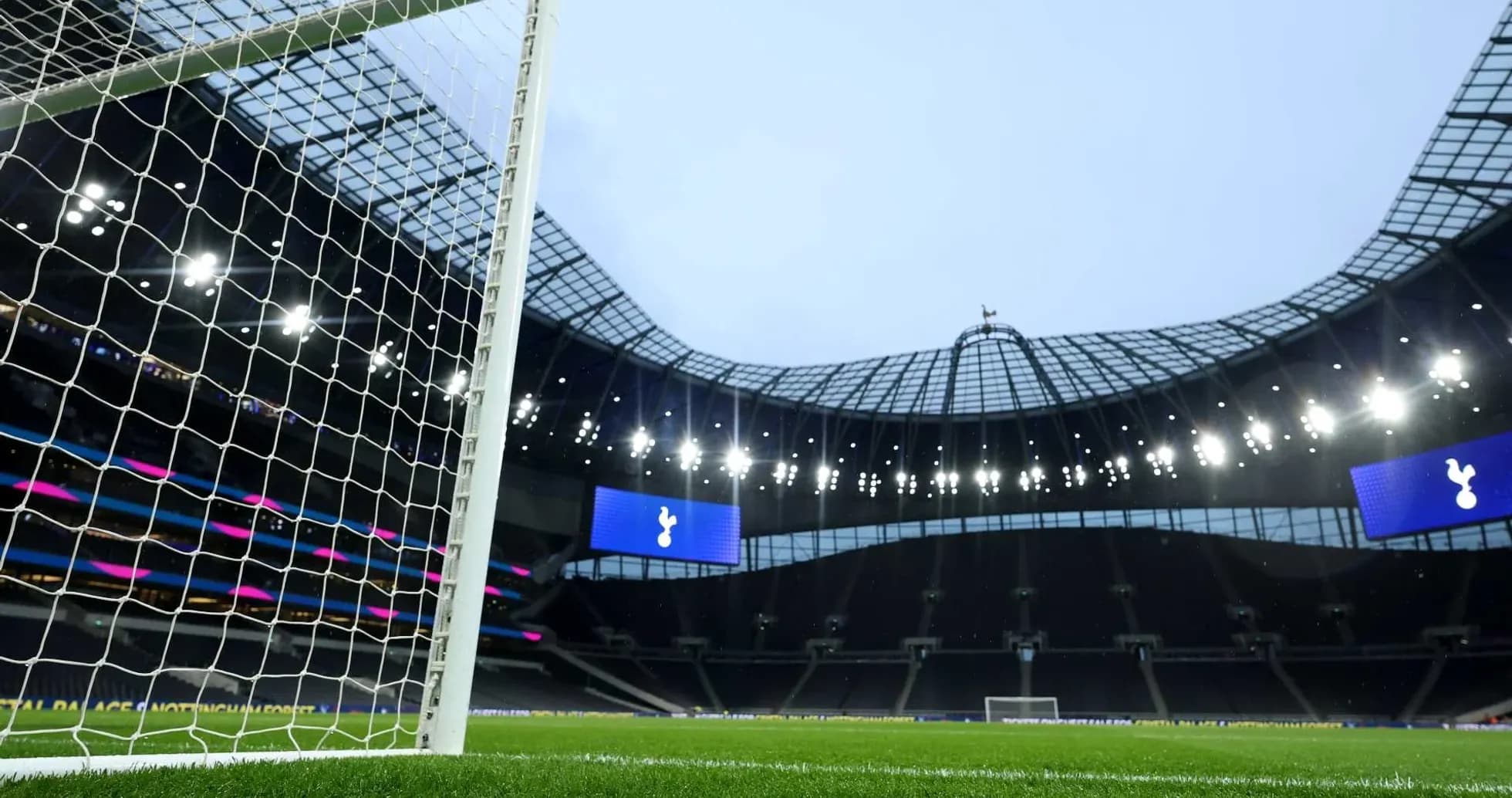
The Tottenham Hotspur Stadium was built to be a showpiece of modern engineering. A grass pitch that glides away to reveal synthetic turf for NFL games and concerts; a dual-surface system that drew praise from architects, broadcasters and sponsors alike.
Now the club is asking a far more basic question: is this wonder of design helping to break its players?
Dan Lewindon, the club’s new performance director, has launched a deep investigation into whether the retractable surface is playing a part in a surge of serious leg and ligament injuries at home. Independent testing has already examined bounce, grip and surface tension. The data, for now, sits in a grey area – nothing conclusive, nothing that clearly clears the pitch either. So the work goes on, with Spurs comparing their surface against those across the Premier League.
The concern is not abstract. It is personal, painful and recent.
- Dejan Kulusevski
- Radu Dragusin
- Wilson Odobert
– all hit by significant injuries in N17. James Maddison suffered a partial ACL tear in a home clash with Bodo/Glimt, then later ruptured it completely. Too many big names, too many big blows, all on the same stretch of turf that was meant to symbolise progress.
Spurs are not alone in their doubts. Real Madrid, having installed a retractable pitch at the revamped Santiago Bernabeu, are also poring over a cluster of ACL injuries. Two superclubs, two flagship stadium projects, one uncomfortable parallel.
A Department Under the Microscope
Lewindon’s remit stretches beyond the grass. His three‑month review has peeled back layers inside the club’s performance structure, and what it has revealed is as troubling as any divot.
The diagnosis from within is stark: too many silos, not enough shared thinking. Medical staff and coaches operating alongside each other rather than with each other. Decisions on workloads, returns from injury and conditioning not always aligned. The result, in the eyes of the hierarchy, has been a pattern of reoccurring problems and players breaking down again just when they thought they were clear.
Spurs’ response is to go smaller, not bigger. The club plans to move to a “small-team approach”, assigning specific physios to groups of around six players. The idea is intimacy: closer relationships, tailored training plans, and a clearer understanding of each player’s physical history and risk profile. Less bureaucracy, more ownership.
Four Managers, One Bruised Squad
Over all of this hangs the chaos in the dugout. Stability has been a stranger.
Four head coaches in a single year – Ange Postecoglou, Thomas Frank, Igor Tudor and Roberto De Zerbi – have dragged the squad through four different training philosophies, four tactical blueprints, four sets of physical demands. High press, mid block, possession-heavy, transition-focused; each shift comes with its own loading patterns, its own intensity spikes.
Players have been asked to adapt again and again. The club believes that constant change has raised the physical risk, as bodies struggle to recalibrate to new regimes before the next one arrives.
The injury list tells its own story. It is long. It is expensive. And it has shaped the season.
The Simons Flashpoint
The scrutiny has not stopped at the grass or the training ground. Spurs’ medical staff have been forced to defend their judgment after the handling of Xavi Simons’ season-ending injury at Wolves.
Simons, injured during a victory at Molineux, received ice spray and returned to the pitch before eventually being stretchered off with a ruptured ACL. The images triggered fury among sections of the fanbase, who saw a player clearly in distress allowed back into the fray.
Inside the club, the view is very different. Spurs maintain that the decision was correct in the circumstances. Simons wanted to continue, and with an ACL test notoriously difficult to perform accurately at pitchside in the heat of a match, the staff felt justified in giving him the chance to try. Crucially, the club insists his brief return did not worsen the damage.
Lewindon, whose job is to probe and question, is understood to have been very satisfied with how the medical team handled that specific incident.
It did not make the wider picture any prettier. Simons’ injury arrived in a nightmare opening spell for De Zerbi, who also lost Cristian Romero and Destiny Udogie to serious problems in his first three matches. The Italian has wasted no time in pushing for a stronger support framework, including the appointment of a team psychologist to sharpen communication between performance, medical and coaching staff.
Maddison’s Reality Check
From the dressing room, the frustration has a human face. James Maddison has been one of the most forthright voices on the crisis.
“Our situation with the injuries has been worse than any other club,” he said recently. “People try and say, ‘Oh, but we've got this and that’. But ours is astronomical, and we need to look at why that is.”
He is no conspiracy theorist. Maddison is quick to point out that some injuries are just football’s cruel lottery.
“Sometimes it can just be unlucky, sometimes it can be a coincidence, like me doing my ACL or [Dejan] Kulusevski getting a horrendous knock off [Marc] Guehi. That's not the medical team, that's not the pitch or all the theories that you see, sometimes that's rubbish.”
Yet he is equally clear about the impact. As Spurs battled to stay out of the relegation zone, the absences of key players loomed over every team sheet, every tactical meeting, every late scramble for points.
“We've been a bit unlucky,” Maddison added. “But like I said, the big names that we've missed, it does affect you and you can't just deny that. Myself, Kulusevski and [Mohammed] Kudus, and [Rodrigo] Bentancur missed three months and whatnot. If you had had them for the whole season, we wouldn't have been in this situation, I strongly believe. That's just not me being naive, that's just a fact. But it is the situation we find ourselves in, and I am just proud of the lads to dig deep today.”
It is a player’s eye view of a season bent out of shape by medical bulletins and rehab schedules.
A Club at a Crossroads
So Spurs stand at an awkward intersection of innovation and consequence. A stadium that dazzles the world. A pitch under suspicion. A performance department being rebuilt on the fly. A squad that has endured the physical and mental toll of constant change.
The science may yet clear the turf. The new structures may steady the injury curve. The psychologist De Zerbi wants may help bind the whole operation together.
But until the numbers fall and the scans ease, every slip, every twist, every player clutching a knee on that pristine grass will carry the same unspoken question: is this just bad luck, or something Spurs have built into their own home?