.svg&w=384&q=75 "Pitchgist logo")
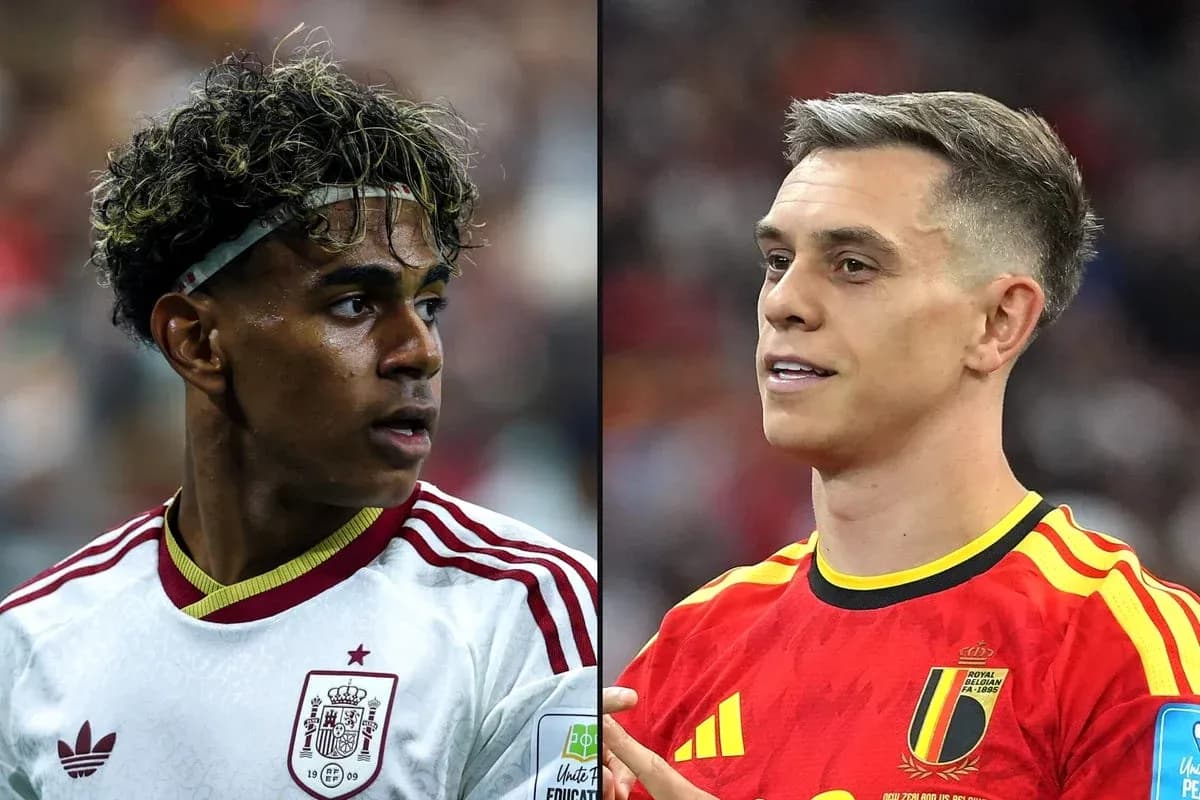
Spain vs Belgium: A Quarter-Final Showdown
The SoFi Stadium has seen its share of blockbuster events, but on Friday it stages something different: a European champion that still feels short of full throttle against a rebuilt contender that has already ripped up its own script once this World Cup.
Spain arrive as the only team yet to concede a goal at this tournament. Belgium arrive as the side that stunned the co-hosts, dismantling the United States 4-1 and stirring a country that had begun to wonder if its golden age had quietly slipped away.
The prize is simple and brutal: a semi-final against France in Arlington on Tuesday.
Spain: immaculate at the back, imperfect up front
Luis de la Fuente’s team have moved through this World Cup like a train you barely hear until it’s right beside you. Top of Group H with seven points, unbeaten, barely rattled: a goalless opener against Cape Verde, then a 4-0 dismantling of Saudi Arabia, a controlled 1-0 over Uruguay and a 3-0 dismissal of Austria in the round of 32. When the stakes rose against Portugal in the last 16, they still found a way — Mikel Merino’s stoppage-time header sealing another 1-0 and another clean sheet.
That defensive record is not just good, it is historic. Unai Simon has yet to pick the ball out of his net at this World Cup, extending Spain’s run to 609 minutes without conceding across this tournament and the 2022 edition — an all-time record. Aymeric Laporte and Pau Cubarsi have been imposing at centre-back, but this is not simply about a back four holding firm. Spain suffocate games higher up, pressing in packs, forcing errors, and then doing what they have done better than almost anyone for more than a decade: keeping the ball until opponents lose both breath and belief.
The flip side? The attack has not always matched that control. Mikel Oyarzabal’s doubles against Saudi Arabia and Austria showed there is a ruthless No 9 in this squad, yet Spain drifted through long spells without incision against Uruguay and Portugal. The structure is there; the spark has flickered.
Which brings the spotlight back to Lamine Yamal. The Barcelona winger, still only 18 and turning 19 on Monday, has shown flashes — clever combinations with right-back Pedro Porro, the odd surge that makes defenders backpedal — but has not yet lit up this World Cup. Nuno Mendes and then Nelson Semedo kept him quieter than Spain would like in the last 16. Against a Belgium defence that has creaked at times, this feels like a stage set for a breakout.
De la Fuente’s main headache lies in the No 10 role. Dani Olmo has been tidy and influential, one of the few attacking starters to impress against Portugal, yet Merino’s dramatic winner has forced the issue. Does the coach reward impact or trust continuity? There is also the question of whether to freshen midfield by turning to Fabian Ruiz at the expense of Pedri, who has not yet reached his familiar rhythm. On the left, Alex Baena’s steady work with Marc Cucurella should keep him in the side.
Spain look serene, but not yet spectacular. That might be exactly how they like it.
Belgium: identity crisis to dangerous outsider
Belgium’s tournament began in a fog. Draws with Egypt (1-1) and Iran (0-0) left them top of Group G but short on conviction, a team that seemed to be carrying its big names rather than built around them. Then came Senegal in the round of 32, and a turning point that may yet define Rudi Garcia’s tenure.
Trailing 2-0 with five minutes of normal time left, Belgium were heading for the exit. Garcia responded by doing the unthinkable: he took off Jeremy Doku and Kevin De Bruyne, the two brightest names in his squad. On came Dodi Lukebakio and Nicolas Raskin. On came a different Belgium.
Lukaku and Youri Tielemans dragged them level, Tielemans then buried a late penalty in extra time to complete a 3-2 comeback that felt like a tactical and psychological reset. Belgium suddenly looked like a team again — compact, aggressive, with roles that made sense.
Garcia stuck with that logic against the United States in the last 16. De Bruyne and Doku started on the bench. Raskin kept his place alongside Tielemans and Amadou Onana, whose first start of the tournament was cruelly cut short by an anterior cruciate ligament injury after 21 minutes. Even after Hans Vanaken replaced him, Belgium controlled the midfield and then unleashed their stars at the right moment, using Lukaku and Doku off the bench when the game opened up. The result was emphatic: 4-1, and a statement that this team is more than a collection of marquee names.
The likely consequence is ruthless: De Bruyne and Doku are again expected to start among the substitutes against Spain. It is a reflection of how Belgium’s identity has shifted. They now lean on work, structure and balance first, magic later. Against a side that will dominate the ball, Garcia wants legs, pressing and discipline. The glamour can wait.
Leandro Trossard has quietly become their creative engine, leading the entire tournament for chances created with 17. Tielemans has been the heartbeat, timing his runs into the box and bringing calm to chaotic moments. Belgium’s resurgence has been collective, not star-led, and that may be their only realistic route through a team as complete as Spain.
Stars, scars and a century of history
This is not a new rivalry. Spain and Belgium first met at the 1920 Olympics in Antwerp, where the hosts won 3-1. Their most famous clash came in the 1986 World Cup quarter-final in Mexico, when Jan Ceulemans’ diving header put Belgium ahead and Juan Señor’s 30-yard thunderbolt dragged Spain level. The shootout that followed turned Jean-Marie Pfaff into a hero and left Spain with another World Cup scar.
Spain took a small measure of revenge at Italia ’90, winning 2-1 in the group stage. Since the turn of the century, though, the balance has swung heavily: Spain have won all five meetings, including a 5-0 qualifying demolition in La Coruna on the road to their 2010 World Cup triumph. Their last encounter, a 2-0 friendly win for Spain in Brussels in 2016, featured Thibaut Courtois, Lukaku, Thomas Meunier and De Bruyne for Belgium — a reminder of how long this Belgian core has been circling the summit.
The stakes now are higher, the generations partly refreshed, but the undercurrent remains. Spain know how to hurt Belgium. Belgium know what it feels like to knock Spain out of a World Cup.
Where this game breaks: the flanks and the press
Strip away the names and reputations and the battle lines are clear: this quarter-final will be decided in wide areas and in the moments after possession changes hands.
On Spain’s right, Yamal and Porro form one of the tournament’s most intriguing partnerships. The teenager’s ability to isolate full-backs, combined with Porro’s underlapping and overlapping runs, stretches defences and opens lanes for late arrivals like Olmo or a roaming No 10. On the left, Cucurella and Baena overload relentlessly, creating angles for cut-backs and runs in behind that opponents have struggled to track.
Belgium, under Garcia, have leaned heavily on their full-backs too. Off-the-ball runs from wide defenders have been a key weapon, dragging markers away and allowing wingers to attack the box or deliver low crosses — a pattern that shredded New Zealand in the 5-1 group-stage win. Both teams are among the best at exploiting low balls across the area: each has created three chances from low crosses, the joint-highest at this World Cup alongside the Netherlands and Switzerland.
The numbers underline how quickly both sides like to strike. Belgium lead the tournament in first-time shots with 58; Spain sit third with 46. When the ball flashes across the box, there is rarely time for a touch.
Out of possession, Spain’s edge is obvious. No team has drawn more offsides (18) or won more possessions in the final third (36). Their high line and aggressive counter-press squeeze opponents into mistakes and deny them clean breaks. Belgium, by contrast, have been more porous. Six errors have led directly to shots against them — only the United States and Brazil, with seven each, have worse figures — and they have allowed 53 shots in total, almost double Spain’s 29.
Belgium’s attacking volume comes with a caveat too. They have had 32 shots blocked, more than any other side. Only 14 of their 107 attempts have been “clear” efforts, with zero or one defender between shooter and goal. The conversion rate on those clear chances is remarkable — 13 goals from 14 shots, better even than France, England and Spain — but the path to those situations has been crowded and costly.
Against Spain’s structure, can they carve out enough of those clean looks? Or does the red wall simply push them further and further from Simon’s goal?
Predictions, pressure and a looming France
Among analysts and observers, the verdict leans heavily one way. Scorelines vary, but the theme does not: Spain to advance, Spain to keep control, Spain to keep the scoreline tidy. Several see a 2-0, one a more open 3-1 with Belgium striking first before De la Fuente’s team settle and Yamal finally finds the net again.
The pattern many expect is familiar. Belgium, buoyed by their run and emboldened by their new-found cohesion, punch hard early. Spain absorb, adjust, and gradually take the ball and the air out of the contest. Yamal, Olmo, Oyarzabal, Pedri or his replacement — someone in red finds the gaps that always appear once Belgium’s midfield tires.
Yet tournaments rarely follow the script for long. Belgium have already survived one brink-of-elimination drama and then dismantled a host nation. Spain’s attack has yet to explode. One early Belgian goal, one moment of Yamal brilliance, one misjudged high line — the story can flip in seconds.
What is certain is the scale of the opportunity. Win here, and a semi-final with France awaits at AT&T Stadium on Tuesday, another colossal night in a World Cup already thick with narrative. Spain are chasing a second global crown to sit alongside their European title. Belgium, still haunted by near-misses from a golden generation, are trying to prove that the window has not closed, just changed shape.
One side will leave Inglewood with a ticket to Texas and a shot at history. The other will walk out into the California night with the nagging thought that this, again, was a chance that slipped away.