.svg&w=384&q=75 "Pitchgist logo")
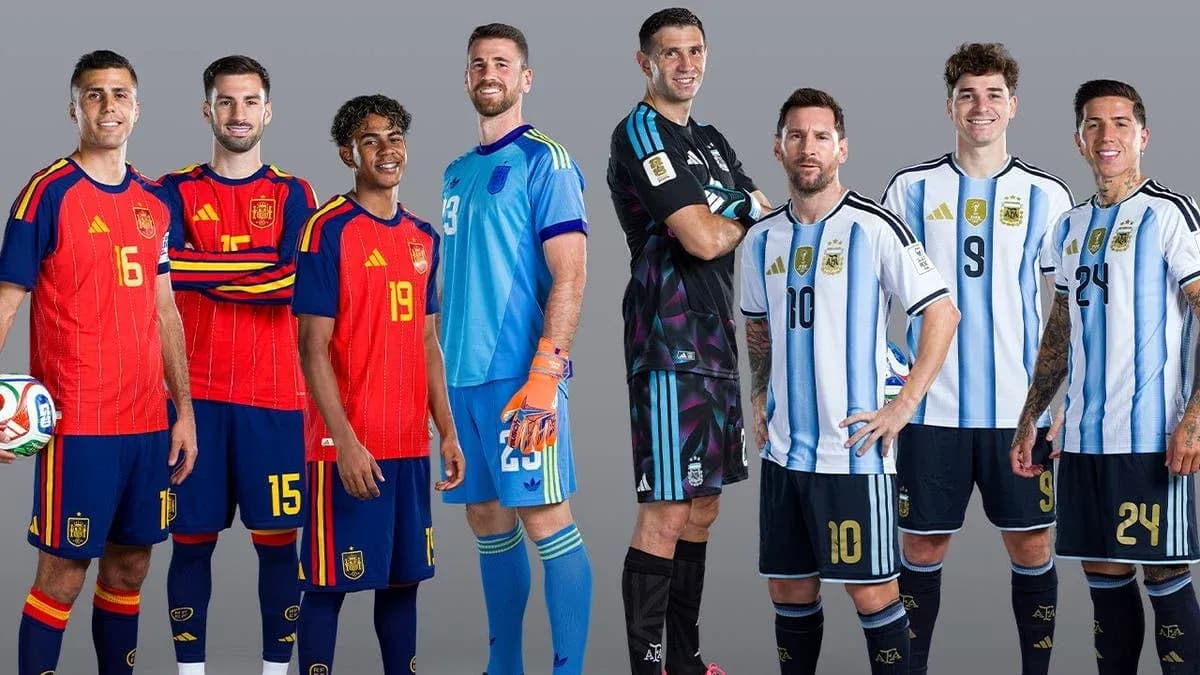
Spain vs Argentina: 2026 World Cup Final Preview
Spain and Argentina meet in the 2026 World Cup Final in what profiles as a finely balanced clash between the tournament’s best defence and its most explosive attack, with the model marginally leaning towards Spain on a “win or draw” basis.
Spain arrive as 1st in Group H with 7 points from 3 matches (2 wins, 1 draw, goal difference 5:0). They have been almost flawless in this World Cup campaign overall: across 7 fixtures in the predictions dataset they are unbeaten, with 6 wins and 1 draw, scoring 13 and conceding just 1. Argentina, 1st in Group J with a perfect 9 points (3 wins, goal difference 8:1), are on an even more emphatic overall run: 7 wins from 7, 19 goals scored and 7 conceded.
Form Deep-Dive
For the recent tournament window, the prediction model lists Spain’s league form as “DWWWWWW” over 7 matches: one early draw followed by six consecutive victories. They average 1.9 goals scored and only 0.1 conceded per game in this span, with 6 clean sheets. Their defensive profile is elite: only 1 goal conceded in those 7 fixtures, and the against-goals minute distribution shows they have been breached only in the 31–45 and 46–60 intervals (one goal in each), underlining concentration and control in most phases.
Offensively, Spain spread their 13 goals well across the match: strong between minutes 16–30 (4 goals, 33.33%) and 76–90 (3 goals, 25.00%), suggesting they can both seize control early and finish strongly. Under/over patterns show a tendency towards controlled, lower-scoring games: only 2 of 7 matches went over 2.5 goals, and 6 of 7 stayed under 3.5. This backs the model’s “-2.5” goals expectation for Spain individually.
Argentina’s recent tournament form is even more relentless on paper: “WWWWWWW” over 7 matches, a perfect winning streak. They average 2.7 goals scored and 1.0 conceded per game, clearly more open than Spain but far more explosive going forward. Their goal distribution is heavily back‑loaded: 8 of their 19 goals (44.44%) arrive between minutes 76–90, with additional strikes in added time (91–105 and 106–120). This late surge pattern makes them extremely dangerous if the game is level or if they are chasing.
Defensively, Argentina concede more frequently and more broadly across the match, with goals allowed in early (0–15), mid (46–60, 61–75) and late phases (91–105, 106–120). Under/over data shows a strong bias to at least two goals in their matches (7 of 7 over 1.5; 5 of 7 over 2.5), reflecting their high‑event style compared with Spain’s controlled approach.
H2H Analysis
The recent competitive history between these sides is sparse. The scheduled Finalissima on 27 March 2026 was cancelled and never played. The last completed meeting in the dataset is a friendly on 27 March 2018 at Estadio Wanda Metropolitano in Madrid, where Spain, as the home team, defeated Argentina 6–1 in regular time. While friendlies are not a perfect guide for a World Cup Final, that result aligns with the comparison block’s h2h index (Spain 80, Argentina 20) and hints that Spain’s possession‑heavy style can trouble Argentina.
Betting Verdict
The official prediction model assigns Spain a 45% chance to win in regular time, the draw also at 45%, and Argentina just 10%. That distribution is unusually draw‑heavy for a final and clearly underpins the advice: “Double chance : Spain or draw” with Spain tagged as the “winner” on a win‑or‑draw basis.
The comparison indices reinforce this tilt. Overall, Spain lead the total comparison index 69.2 to 31.0. In defence, Spain are far ahead (88 vs 13), reflecting their 6 clean sheets in 7 and only 1 goal conceded, while Argentina’s attack is superior (attack index 61 vs 39) and backed by 19 goals scored. Form is rated even (form index 50 vs 50), and the Poisson distribution index favours Spain 72 to 28, suggesting that when you factor in goal patterns and averages, Spain are more likely to control the expected scoreline.
With no bookmaker odds data available, we cannot cross‑check model probabilities against market prices, but from a pure model‑driven angle the value‑aligned play is to follow the official advice: backing Spain on the double chance (Spain or draw) as the primary bet. Given Spain’s defensive numbers and their under‑skewed goal profile versus Argentina’s late‑goal tendency, a cautious secondary angle for bettors would be to lean towards a tight, lower‑scoring regulation time decided by Spain’s control rather than Argentina’s chaos, while respecting that the model still gives a substantial 45% probability to the match ending level after 90 minutes.